Music review: Adelaide Symphony Orchestra – New Ground
Gershwin’s An American in Paris invariably proves a hit, but in this instance a new accordion concerto by Australian composer Holly Harrison stole the show. It’s a brilliant piece.
There is always a place for programs of the lighter kind. Orchestras of course like putting them on to bring in the crowds, but occasionally ‘light classics’ can really shake up the status quo. George Gerswin’s An American In Paris is a case in point. In seeking to paint the sound and bustle of a noisy streetscape, he even purchased four taxi horns from Avenue de la Grande Armée to add to what became a revolutionary score.
One couldn’t verify if the ASO actually used four calibrated Parisian taxi horns as Gershwin requires in the score – sightlines prevented that – but the honking sounded right, the atmosphere felt right, and word had it that every other detail about this performance was executed in accordance with Gershwin’s demands.
The ASO under Benjamin Northey were sparky and clearly on top of themselves. Belching tuba and skittish squeals of clarinet moved into a mellower string section before pure jazz erupts in a trio of sliding saxophones whose ‘blue notes’ slide up against a mournful solo trumpet. Northey has a natural way with music like this, and the orchestra aced it.
Just as Gershwin could describe An American in Paris in 1928 as “the most modern music I’ve yet attempted”, Holly Harrison has attempted something remarkably similar in her concerto InsideOut for classical accordion. Using this most unlikely of instruments as the centrepiece she turns convention, well, inside out. Introducing it at the microphone, she said her new work explores the “challenges and opportunities” afforded by the classical accordion in its “huge range of colours”.

Harrison is not the first to write an accordion concerto: InsideOut follows in the footsteps of Penderecki, Piazzolla and various others, although the latter’s Aconcagua concerto was composed for its somewhat different relative, the bandoneon. But this dynamic Sydney composer just might be the first to exploit its fullest potential. Some preliminaries: the instrument she writes for is no mere squeeze box. The classical accordion differs in its wide choice of registers and in its unique ability to be played polyphonically: the ‘button’ side on the left can function as a fully independent keyboard.
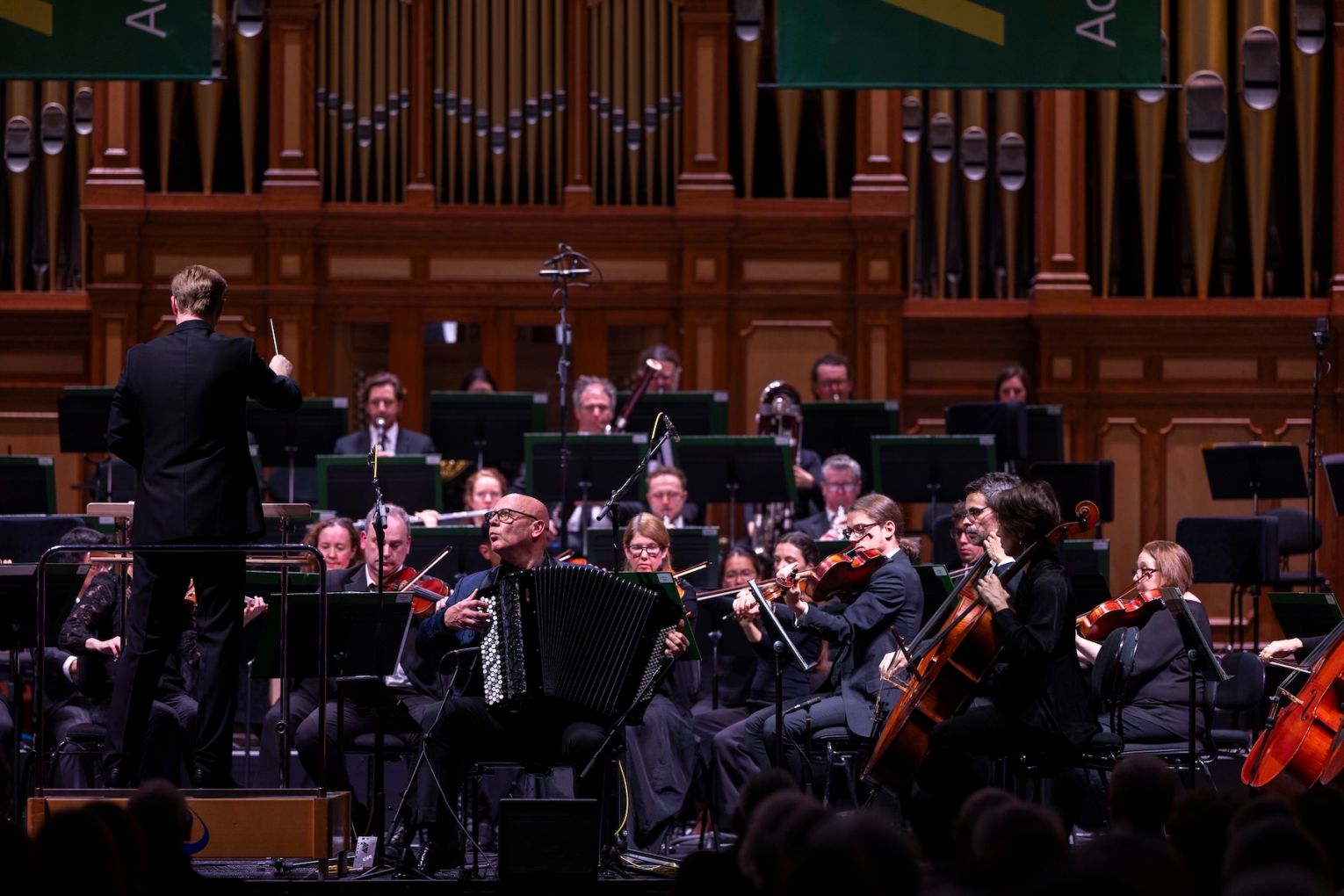
One first notices its impressive bulk. Soloist James Crabb’s shiny, custom-made ‘Mythos’ accordion from Italy is an absolute beast of an instrument.
But never mind the look: the sound of this concerto was where it truly broke new ground. InsideOut is a work of highest excitement. In keeping with her trademark style, Harrison employs funk, techno and dance grooves in a full-on, brazen manner but does so within a tightly maintained orchestral structure. It begins with an explosive percussive crack and pulses along at speed in a dazzling interplay between soloist and the orchestra. Kicked along by fierce off-beats, its rhythmic energy reaches a tremendous intensity.
Crabb marvels with his virtuosic dexterity and expressive nuances. Fastidiously executed scales, tremolos and pitch-changing effects leaves one in no doubt that this Scottish-born accordionist is an absolute master accordionist. Sometimes his instrument sounds like a honking saxophone, sometimes like a full wind band, and even a cathedral organ. Admittedly amplified, its projection matched that of the entire orchestra.
Harrison’s stylistic mashups do not appear to be intended to provoke or confront. Rather, the impression in InsideOut is that – much like Gershwin – she delights in quoting contemporary sounds and giving the audience a lift. Her newest concerto succeeds spectacularly well and possesses impressive technical accomplishment. It truly stole the show.
Subscribe for updates
Strangely, or perhaps not so strangely, Bartók’s Concerto for Orchestra felt an uncomfortable partner in this ‘New Ground’ concert. It was not that Bartók would have disapproved of being programmed alongside pure entertainment pieces like An American In Paris. He genuinely admired Gershwin. Rather, it is the Hungarian composer’s introspective thinking that places him in a completely different orbit. Outwardly spectacular in its virtuosic demands on every section of the orchestra, Concerto for Orchestra has the sternest of interiors. It reflects a composer in pain.
Its mysterious first movement and third-movement “death-song” need to build toward an exhilarating, life-affirming finale. This performance certainly revealed a lot about the concerto’s amazing rhythmic intricacy, and the ASO always performs well under Northey. Even so, a gliding smoothness tended to mask the score’s even more special psychological intensity.
The Adelaide Symphony Orchestra performed New Ground at the Adelaide Town Hall on July 18
Want to see more stories from InDaily SA in your Google search results?
- Click here to set InDaily SA as a preferred source.
- Tick the box next to "InDaily SA". That's it.
Free to share
This article may be shared online or in print under a Creative Commons licence