A gutsy addition to Adelaide’s classical music landscape
Adelaide Baroque’s historically-informed string quartet offers a new slant on the form, inspired by the past.
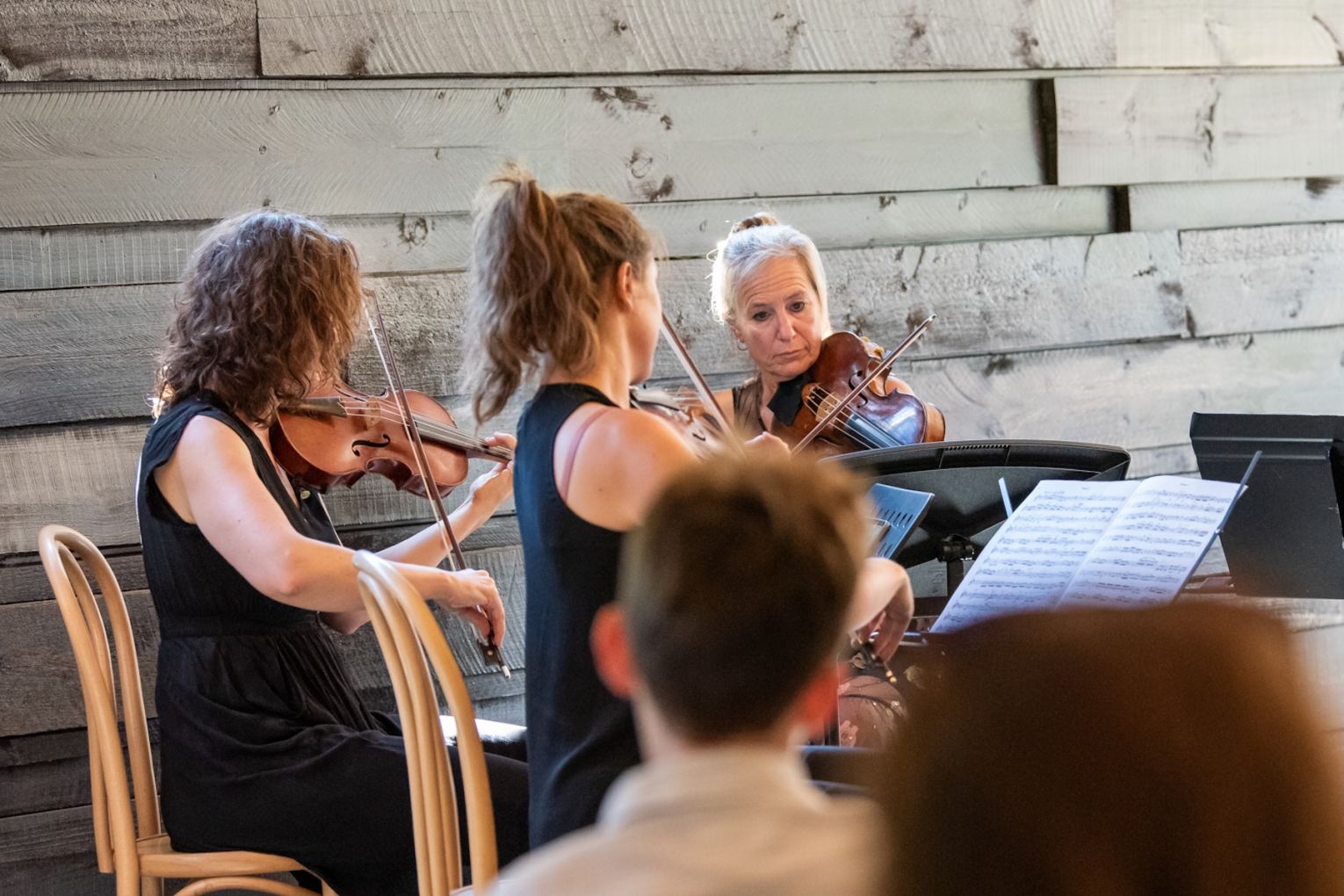
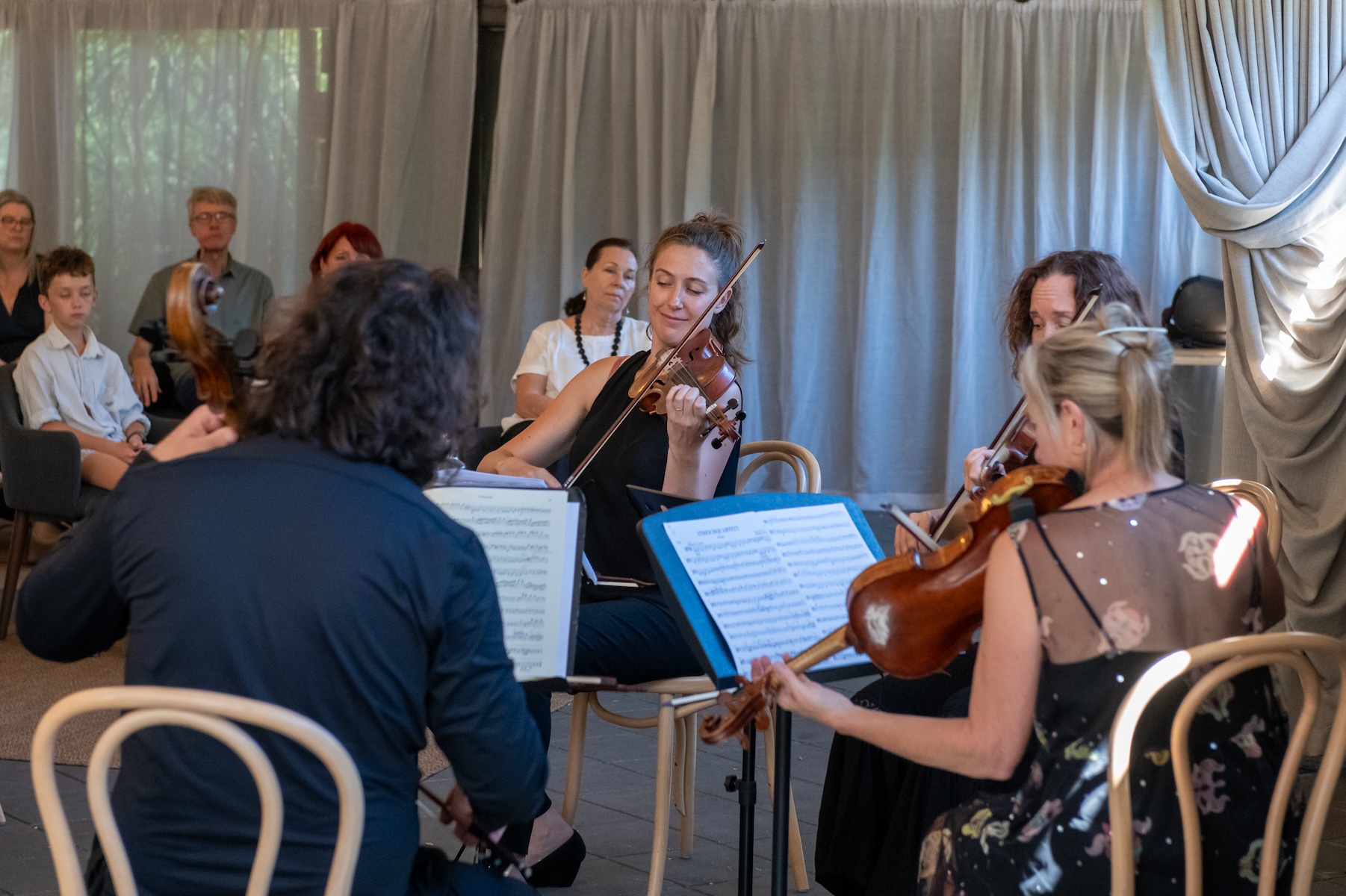
Adelaide’s newest string quartet comes with a difference that separates it from the crowd. Formed under the auspices of Adelaide Baroque, the aptly named Adelaide Baroque String Quartet uses gut strings, period bows, and historically informed performance (HIP) to explore music from the earlier end of the string quartet repertoire.
Comprising violinists Alison Rayner and Janet Anderson, violist Heidi Von Bernewitz and cellist Tom Marlin, they made their debut in 2024 at Chamber Music Adelaide’s innovative ‘Perspectives’ concerts in the Town Hall, in which they contributed excerpts from J.S. Bach’s Art of Fugue and Vivaldi’s Concerto Grosso in D minor in a one-per-part, quartet version.
Sensing they were onto a good idea, they debuted their first standalone concerts at last year’s Fringe, playing Alessandro Scarlatti’s Sonate a quattro. Dating from 1725, it is frequently described being as history’s first true ‘string quartet’ on account of how it specifically excludes the harpsichord.
In the 2026 Fringe, Adelaide Baroque String Quartet returns to play a series of concerts called ‘Enlightened Strings: Quartets in the Age of Enlightenment’. These run from 22 February to 1 March and seek to illustrate how the quartet perfectly embodied the philosophy of the Enlightenment by creating “a musical conversation with dialogue resembling intellectual discourse”.
Haydn stands at the pivotal centre in his Quartet No. 66 in G major, Op. 77, No. 1.
"I love quartets, and I also love other music that cannot really be performed any other way than by taking on a historically informed approach."
The idea of basing a string quartet directly on historical principles has been Marlin’s longstanding passion.
You might like


“I love quartets, and I also love other music that cannot really be performed any other way than by taking on a historically informed approach,” Marlin tells InReview.
“We are exploring many utter masterpieces of the genre from other composers too, from Alessandro Scarlatti to Purcell. From our perspective, it is not just Haydn onwards.
“But it has to be an idea that is not executed poorly,” Marlin emphasises.
A number of factors are fundamental here, he says.
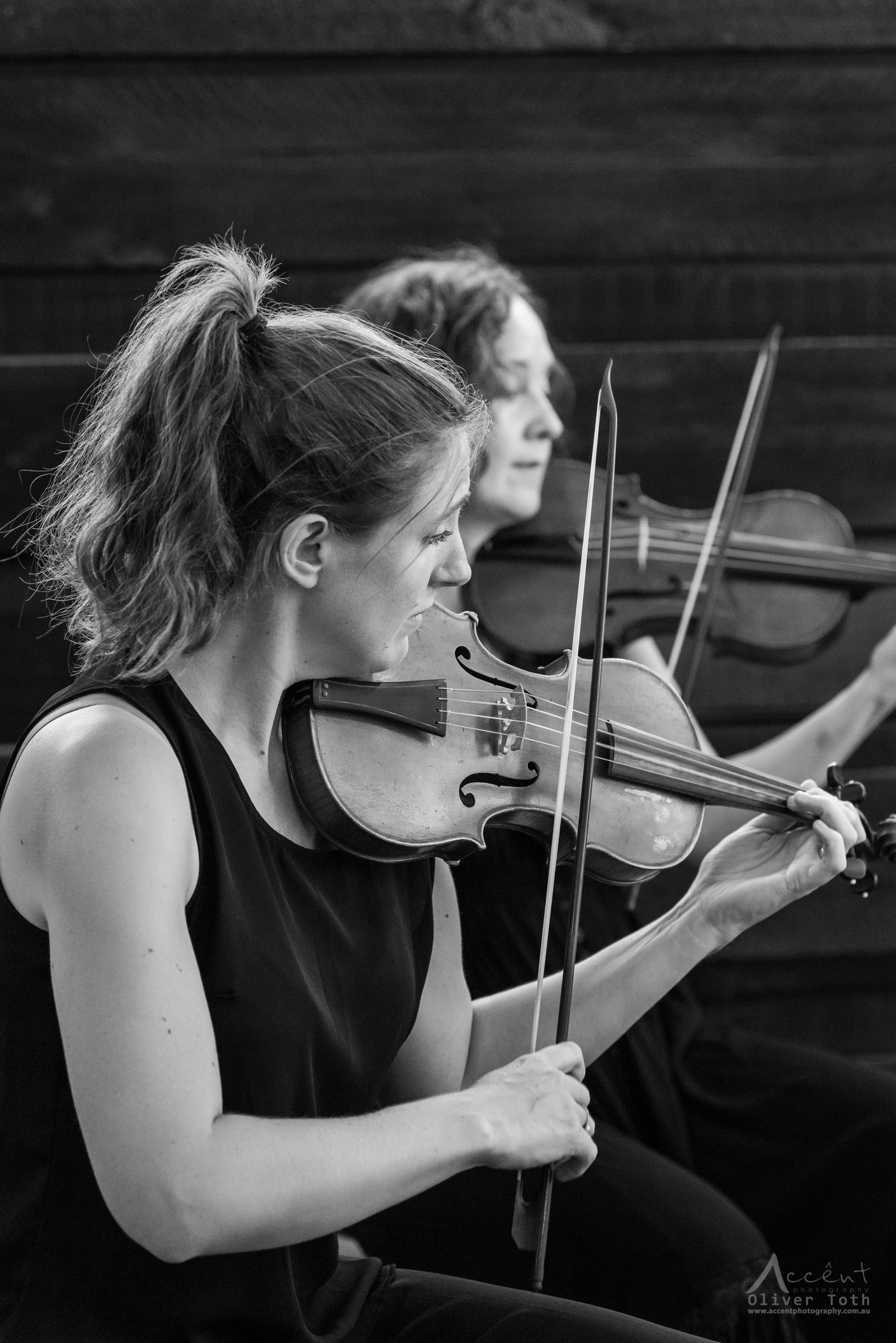
“A deep exploration of period bowing technique is obviously critical, and along with that we use gut strings and A 430 tuning.”
Although the instruments Adelaide Baroque String Quartet plays are “relatively modern”, they use historical bows. These are lighter and less in-curved than contemporary bows, and when combined with the flatter ‘Classical pitch’ of A 430 (based on tuning forks that survive from the eighteenth century), this optimises tension on the gut strings.
The combined effect opens up a clarity into music throughout the Classical period and even as far as the first decades of the nineteenth century, says Marlin.
Besides Haydn, Adelaide Baroque String Quartet will be playing Mendelssohn’s Op 13 in its ‘Enlightened Strings’ Fringe program. Written in 1827, it well typifies a composer whom Robert Schumann regarded as the ‘Mozart of the nineteenth century’.
“In my opinion Mendelssohn is a classical composer,” Marlin says.
“He lies on the cusp of the Romantic era but was closely involved in the revival of Bach’s music. Stylistically, he is very classical and heavily influenced by Haydn and Mozart.”
Subscribe for updates
By the same token, HIP offers several advantages can be applied to contemporary music as well. According to Marlin, the lighter bowing and faster articulation it can achieve help create a “living sound” that lends a “new energy” to modern repertoire for the quartet medium.
Two other concerts by Adelaide Baroque String Quartet during the Fringe pursue precisely this aim Called ‘Stories in Song’, they continue the group’s collaboration from last year’s Fringe with Indigenous singer-songwriter Nathan May and jazz violinist Julian Ferraretto. ‘Stories in Song’ take place at Nexus Arts on 24 February and 17 March.
All of which tends to make this new quartet one of a kind. Besides taking on their HIP specialisation, all four players are well versed in modern string technique. Marlin himself studied at the Guildhall School of Music and Drama and has performed with the Orchestre des Champs Élysées and under renowned early music conductor, Philippe Herreweghe.
Alison Rayner has played with Norwegian Chamber Orchestra, Australian World Orchestra and other orchestras in addition to the Australian Romantic & Classical Orchestra (ARCO). She and Anderson, who are both in the ASO’s string section, trained in Munich and plays a North Germany violin from the 1790s affectionately known as ‘Old Heinrich’.
Besides appearing with numerous modern orchestras and ensembles, Von Bernewitz has played with London Classical Opera, Modern Musick of Washington D.C., and ARCO.
Adelaide Baroque String Quartet forms a subset of Adelaide Baroque, which is mounting over two dozen concerts in 2026. Once again it is offering an Orchestral Series, an Exploration Series, its annual Adelaide Baroque Academy in September partnered by the Elder Conservatorium, and Handel’s Messiah in December.
Somehow it manages to fit in various house concerts in and around the city as well. The organisation’s impressive rise in activity over the past two years comes despite its recent loss of State Government funding. Crucially, it now relies on philanthropy.
Rob Nairn, its general manager and a renowned specialist in historical performance on double bass and violone, says that fast-tracking Adelaide Baroque towards a self-funding model has proven successful up to this point.
“We achieved it through a donor’s circle and individual chair initiative, and the transition towards being independent has been fast. Seventy-five per cent of our funding now comes from philanthropy.”
This new model also sets Adelaide Baroque apart from the rest, Nairn believes.
“There are few arts organisations anywhere, here or in Australia generally, who are operating like this. Our interstate colleagues cannot believe that we do everything without any full-time staff,” he says.
Adelaide Baroque nominally falls into the category of ‘heritage arts’ in terms of how government arts agencies allocate grant money, consequently making it extremely hard to satisfy grant priorities and secure funding, explains Nairn.
“This makes things difficult to sustain in the long-term, but we’re in a healthy position. And we’re really proud of that.”
Learn more about Adelaide Baroque’s upcoming concerts here
Read more 2026 Adelaide Fringe coverage here on InReview.
Want to see more stories from InDaily SA in your Google search results?
- Click here to set InDaily SA as a preferred source.
- Tick the box next to "InDaily SA". That's it.
Free to share
This article may be shared online or in print under a Creative Commons licence