Book review: The Night Parrots
Stephen Orr’s latest novel draws from the life of anthropologist Theodore ‘Ted’ Strehlow to explore the power of belief, intergenerational legacies and the limits of good intentions.
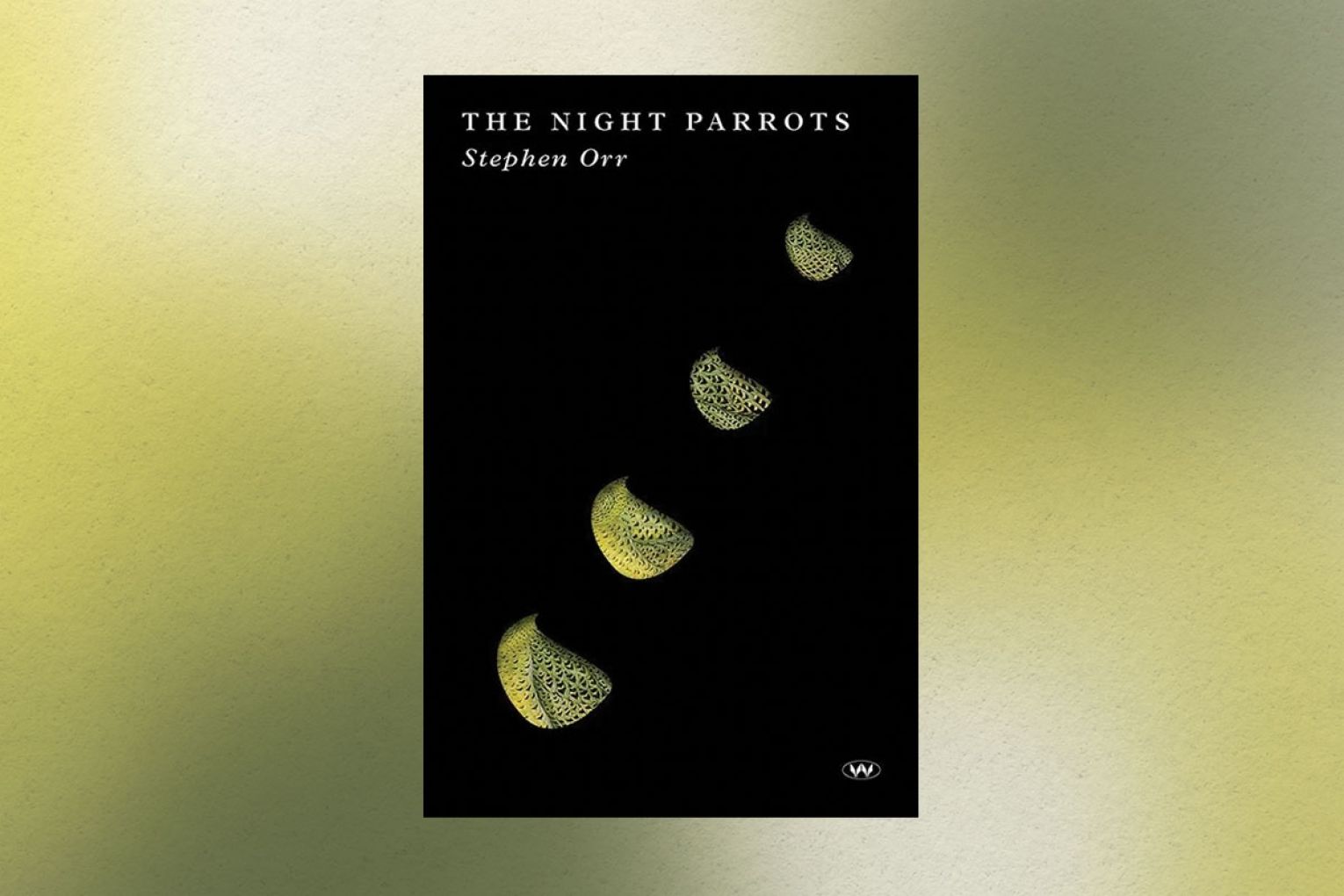
The night parrot is an elusive, critically endangered species endemic to inland Australia. With no recorded sightings between 1912 and 1979, the bird was long speculated to have become extinct. In Adelaide writer Stephen Orr’s latest book, this small, mysterious creature takes up the role of titular metaphor, symbolising the power of belief in fragile, perhaps imagined things which can nevertheless allow people “to feel secure.”
Based primarily on the life of Australian anthropologist and linguist Theodore ‘Ted’ Strehlow (represented here by protagonist and narrator Benjamin ‘Benno’ Gerlach), the novel’s narrative scaffold primarily takes its cues from Strehlow’s Journey to Horseshoe Bend (1969). That autobiographical account records a desperate slog through scorching desert in October 1922 to obtain medical help for his father, Carl (fictionalised as Martin Gerlach), a Lutheran Pastor at the Hermannsburg Mission west of Alice Springs.
As Orr writes in his author’s note, this is primarily “the story of a father and a son.” So far, this is all relatively familiar territory, recalling Orr’s frequent adaptation of real historical events and figures as the basis for exploring themes of – yes – fathers and sons, but also family and social dynamics more broadly. Orr’s writing often weaves multiple character arcs together, along with reflecting on the role of stories themselves in connecting people – and the ambiguous lines between commitment to a good or righteous cause and rigid, fixated obsession.
As in many of his narratives, the characters Orr focuses most intently on here are deeply and, in-all-likelihood, dysfunctionally and self-destructively overwhelmed with a need to piece together some world of meaning they feel sure exists but remains hidden, has slipped away, or been taken from them. This is the “childhood of overhearing, digging for hidden notes” Benno describes, or Martin’s belief – expressed to his son – in the importance of making “connections. Every song has its equivalent in another culture.”
In The Night Parrots, that concern with charting or constructing, recording or revealing connections – between different, even disparate, elements of a life, a world, of experience – is reflected most clearly by frequently abrupt time shifts and the chronologically interwoven nature of Benno’s narrative. Although anchored by the recollection of that overland journey with his ailing father back in 1922, the story’s present-day is 1988 and begins with Benno telling us about the apparent suicide of his long-estranged brother seventeen years earlier in 1971. Benno had been separated from the rest of the Gerlach family, living in Leipzig, when his father and mother took him – alone among their children – to central Australia on Martin’s missionary calling.
You might like
The reason he tells us this “so early in my story is that as a creaky eighty-year-old I’ve worked out the longer you live the less you understand, or at least, can know with any certainty.” The effects of separation and traumas – both obvious and more subtle – run deep throughout Orr’s take on this tale. In the emotional distance of an apparently well-meaning but nonetheless rigidly arrogant, rules-based Prussian father, but also in that far more insidious violence which sits at the edge of a fictionalised white anthropologist’s experience and memory – the Stolen Generations whose removal from their parents we are told Pastor Gerlach opposed, but never quite had the ability (or guts) to prevent.
And it is this historical context – of invasion and dispossession, the political implications of exploring what subjective intent might underlie more liberal, paternalistic colonising mindsets – which present the book’s most complex, potentially challenging aspects. This is something Orr anticipates when he guesses that many “will come to this story with doubts.” There are multiple, layered perspectives in play that invite our attention, or compete for our approval – sometimes quite literally, as in Martin’s repeated, almost pleading insistence that “we came here in good faith. We’ve worked hard, haven’t we? We’ve done good. And that’s something.”
There is growth and generational change presented here, but even Benno remains a man blind to the depth of structural injustice he has witnessed and participated in, whose decency and moving desire to make sense of a messy world cannot entirely prevent him from, like his father, “reaching into the darkness, trying to hold onto the past.” At his grandson’s school show-and-tell, discussing the missionary project, Benno is asked by a girl: “Wasn’t it like a genocide?” And Benno says no, “it wasn’t.” His version of the past recognises only “a few bad ones” who took the land and smashed a culture’s way of life, who committed the murders, took the children from their mothers. For everyone like them, he says, “there were a hundred others trying to do good. Like my father. And me.”
He’s wrong, of course, in sentiment if not literal substance. Very little of the violence in this world is committed by those who think they are doing wrong. But that doesn’t mean there isn’t value in an engaging exploration of just how we could ever believe in that comforting fantasy – and why so many still do.
The Night Parrots (Wakefield Press) is out now
Want to see more stories from InDaily SA in your Google search results?
- Click here to set InDaily SA as a preferred source.
- Tick the box next to "InDaily SA". That's it.
Free to share
This article may be shared online or in print under a Creative Commons licence