‘The only ecstasy in my life’: Reopening Barbara Hanrahan’s diaries
As the publication of Helen Garner’s decades-long diaries sparks a late-career revival, critic Jo Case reflects on the similarly expansive and exposing journals of the late artist and writer Barbara Hanrahan, published posthumously in 1998. Initially pored over for literary gossip, today they reveal an artist deeply, painfully permeated by the world.
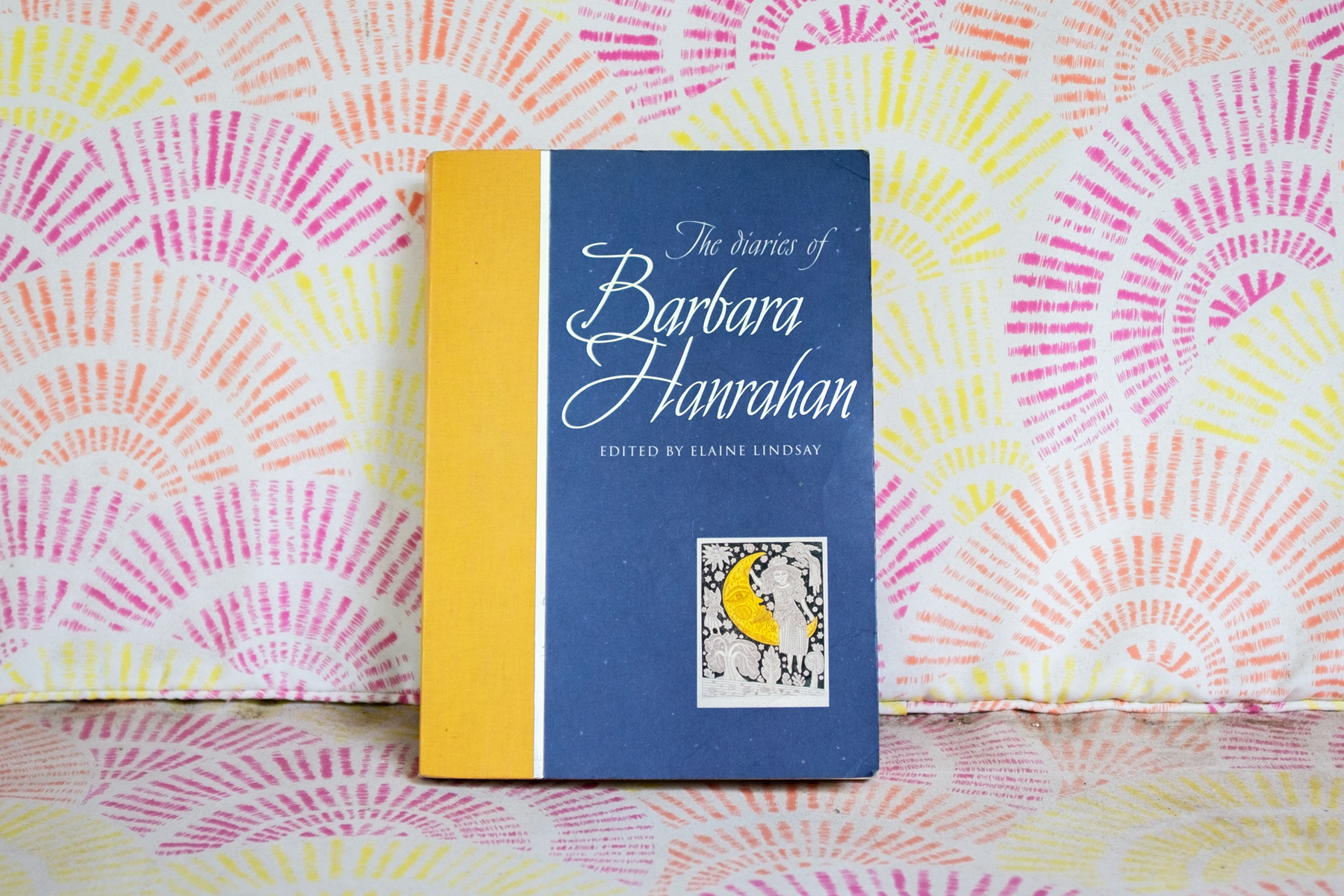
I was gifted a second-hand copy of artist and writer Barbara Hanrahan’s legendary, long out-of-print collected diaries by Jason Lake, then co-owner of Imprints, who knew it would speak to my neurotic writers’ brain. But the first time I spied the blue and gold volume was at poet Geoff Goodfellow’s house, where I was working with him on his boyhood memoir. He read me Hanrahan’s three entries about him with relish, including one where he’s sending off a story at the post office, “dressed in white with a gold chain around his neck and goldy hair and a red face and his cigars”.
It’s that kind of book: when the diaries were first published, over twenty-five years ago, people rooted through the index at the 1998 Writers’ Week tents to read about themselves, their friends and their enemies.
“I want to try to love people as people, not look down my nose secretly at them, and pull them to pieces afterwards,” Hanrahan vowed, in the Diaries’ opening pages. But in the nearly thirty years of entries collected in this volume (ending in 1991, months before her death), she would rarely manage this. Her acid sketches of literary personalities, even those she liked, are among the diaries’ many – sometimes guilty – pleasures.
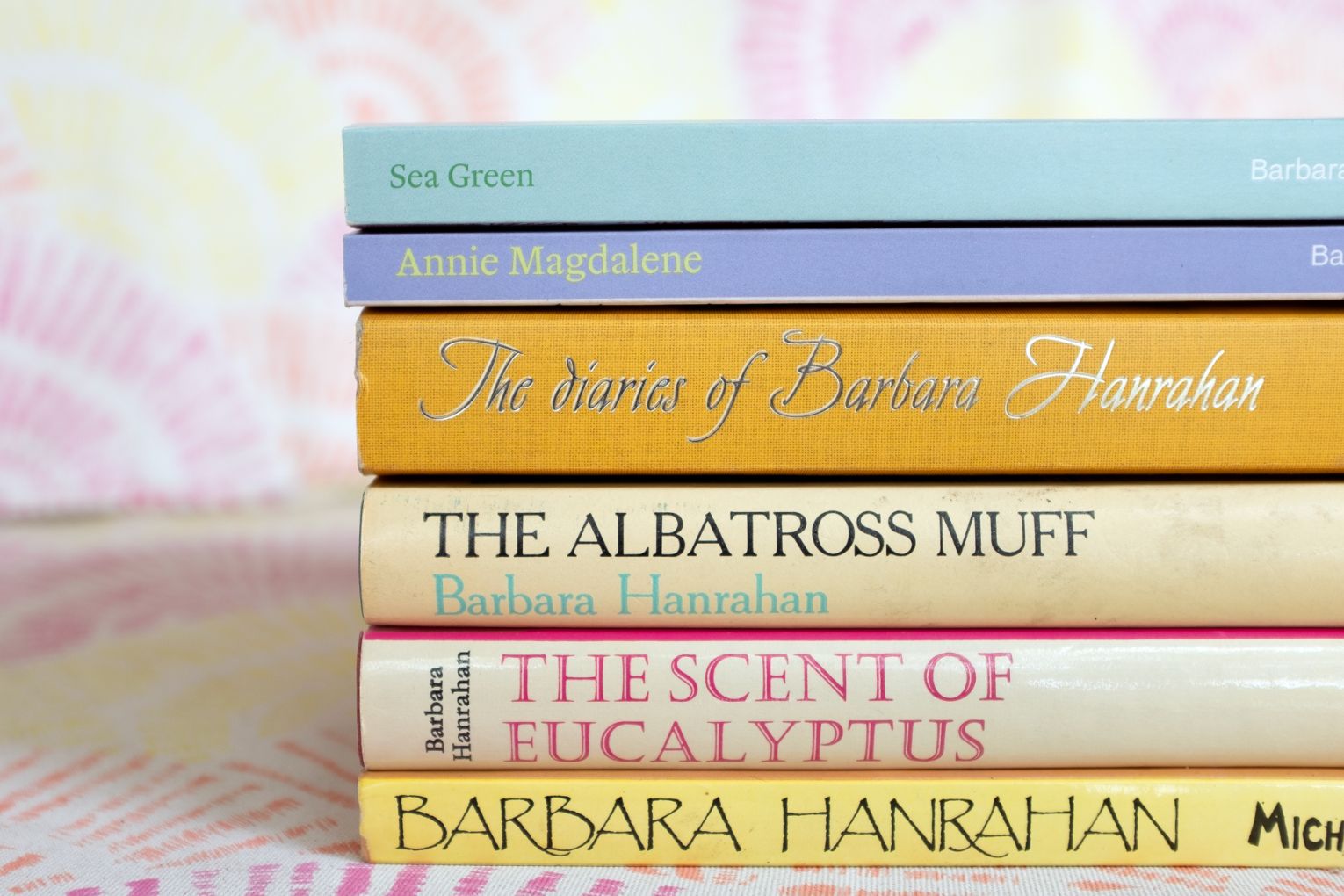
Hanrahan is best known for her surreal prints combining childlike menace, raw humour and dark, sexual whimsy. She also published fifteen novels. Some, including her classic 1973 debut The Scent of Eucalyptus, about her childhood in Thebarton, fictionalised her own experiences. Others, like the recently reissued Annie Magdalene (1985), vividly charting a working-class woman’s 20th century life, fictionalising oral histories she collected. Others still were more fantasy than realist, like the magic-infused Victorian gothic The Albatross Muff (1977). But real life and fantasy were always intertwined in Hanrahan’s work, as her biographer Annette Stewart observed.
It’s fascinating now to compare Hanrahan’s diaries with those of Helen Garner, who appears in them: visiting Rose Street Thebarton on her way to the airport from Writers’ Week, after reading and loving Annie Magdalene. Garner’s diaries are rightly getting international acclaim, while Hanrahan’s are out of print: a legend passed around at bookshops and in the houses of literary people.
Garner’s diaries were published under her own control in her eighties, from 2019, nearly twenty years after Hanrahan’s were published in 1998, following her death from cancer at the age of fifty-two. Hanrahan’s, on the other hand, were edited under the stewardship of her life partner, sculptor Jo Steele, working with journalist Elaine Lindsay.
Both writers’ volumes fit the authentic, ragged, revealing record Hanrahan preferred in a literary diary – she scorned any that were too neat, like Anais Nin’s Henry and June (1986), or her poet friend Kate Llewellyn’s “fashionably done” garden diaries, Waterlily (1987). But while Garner disguises most of her players with initials or nicknames, Hanrahan’s are named.
Elizabeth Jolley is “nice”, but “a very clumsy writer” who “capitalises on her nervousness” and plays “the dotty spinster” at writers’ festivals, her voice “like a bird’s twig claw scratching”. (Garner, on the other hand, admires Jolley’s novels, and exchanges letters and literary cartoons with her.) Margaret Atwood, with her “strange lidded/hooded eyes” has “a hardness, a sureness”.
Virago founder Carmen Callil, who published Hanrahan’s ninth novel, Annie Magdalene – and called it “perfect, a little jewel” – has a “very frightening” voice, “like a pantomime queen, a horse”. McPhee Gribble publisher Hilary McPhee, who offered to publish Hanrahan’s twelfth novel (eventually published by UQP) is described as “lush – like a Colette girl, a more glamorous softer pussy-cat Carmen”.
In the diaries, Hanrahan often regrets her “catty” outbursts and considers destroying them. She frequently admits to being “jealous and envious”. Jolley is a great example. On returning to Australia from the UK in 1983, Hanrahan writes: “I had just imagined all sorts of people reading me – show-off that I am. Then, since I have been here I have found that Elizabeth Jolley is the writer.”
Garner, who destroyed some of her own early diaries, seems to use hers as a kind of writing practice, one I’ve always envisaged as something akin to piano scales – producing the in-the-moment technical excellence that implies. Hanrahan, while capturing key insights (particularly into the process of making art and putting it into the world) and putting down some beautiful passages, describes hers (“a passion”) as a psychological outlet, though it also includes lines she’d later use in her books. “I used the diaries to write out all my negative emotions,” she wrote in 1989, calling them “certainly not objective” and describing her “poor mind” as “frightening to read of”.
As one famous diarist, the fictional Bridget Jones, might say, “everyone knows diaries are just … full of crap”. I don’t think this means quality so much as objective truth: a diary’s essential in-between-ness usually privileges its role in processing thought and experience as it happens over considered reflection.
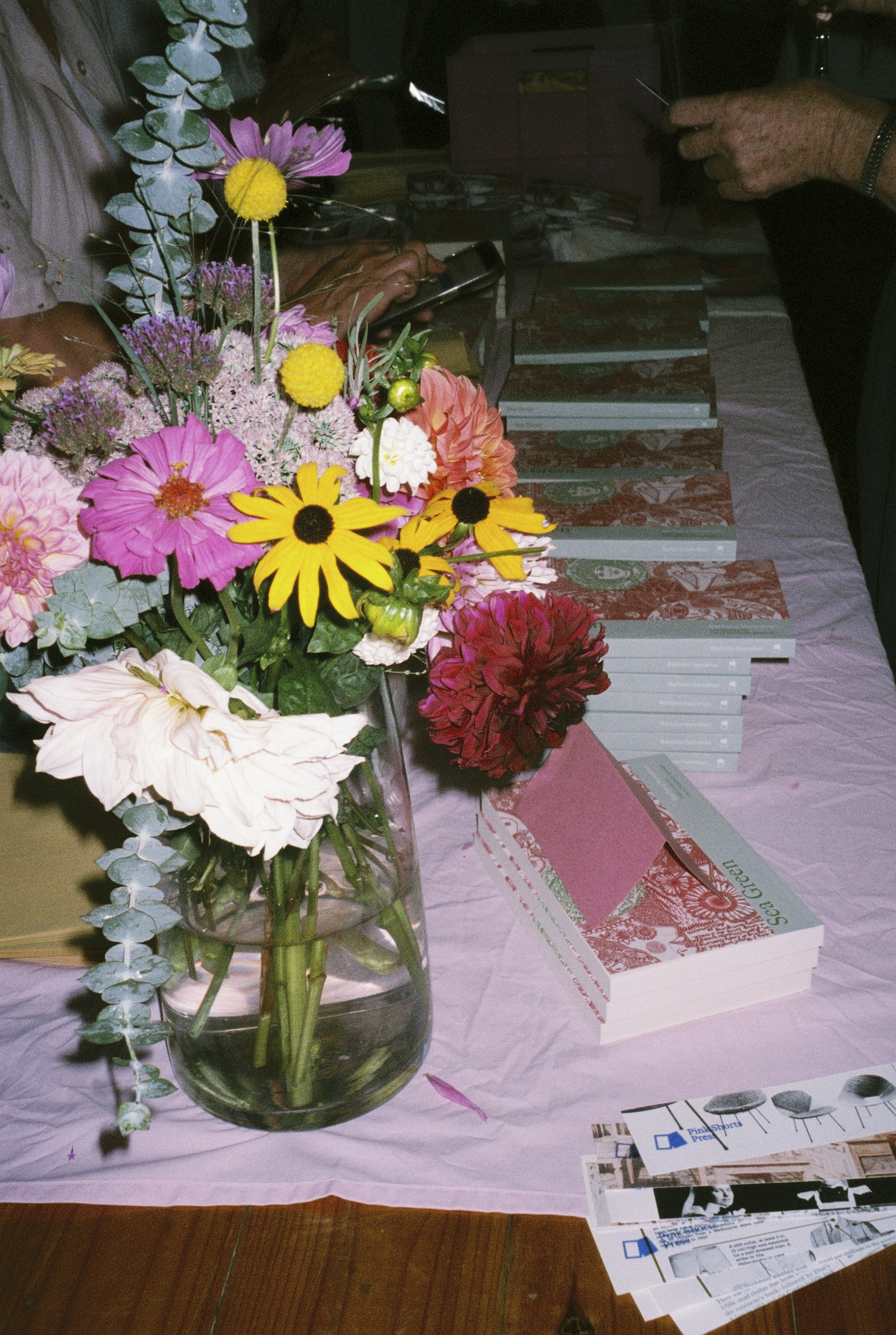
I came properly to Hanrahan’s diaries after a stimulating but exhausting Adelaide Writers’ Week last year, where I’d attended the launch party for new Adelaide publisher Pink Shorts Press. Its first book was a gorgeous new edition of Sea Green, Hanrahan’s 1974 semiautobiographical second novel, with a contemporary introduction by Australian novelist Laura Elizabeth Woollett that appreciates the “upside-down rules of Wonderland” in Hanrahan’s “childlike and existentially troubling” work.
When I got home from the launch, I reached at last for the diaries. Then worrying over my own just-published book and my depleted social battery spent promoting it, I sank into a delicious companionship with Hanrahan’s detailed worrying over critical reception and her social self. (“I hate this part of a book being published. It upsets my mind.”) As a neurodivergent woman, I also – without armchair diagnosing anyone – identified with many traits and patterns revealed in the diaries.
“I’d love to have someone to feel close to,” Hanrahan wrote in 1960, aged twenty, in the diaries’ early pages. She describes never fitting in at school, being “twisted inside – coiled up and bent to fit into a mould that was not mine”. Until she meets Jo, her true companionship outside the trinity of her family was with the work of fellow artist-outsiders who struggled with mental health, like Janet Frame, Leonardo da Vinci and Virginia Woolf (though the latter’s “middle-class” diaries disappointed her).
Even then, she felt chronically different. In 1977: “I really feel I have been put into the world like, say, an unfinished person lacking something all other humans have. It is as if I have an inner lacking – that corresponds with no eyelashes, no nose, no mouth. Only what I lack is unseen; the lack is my mind or my soul, some place like that.”
But from an early age, when she worked on her art, “the voice that each day told me I was queer, odd, peculiar was silenced,” Hanrahan wrote in her diaries. (This line is given to her stand-in, Virginia, in Sea Green, too.) “I just worked and felt happy in the room,” she continued. “It was a feast – the only ecstasy in my life.”
Throughout the diaries, she veered between feelings of inferiority and superiority. This tussle seemed to be both her weakness and her strength; it is an integral ingredient in her work. She was at once ashamed and proud of her working-class upbringing in Thebarton; her autodidactic education, which included art school (“I hate the cleanly trained University mind very much); and the art-life immersion that freed her from ordinary adult life.
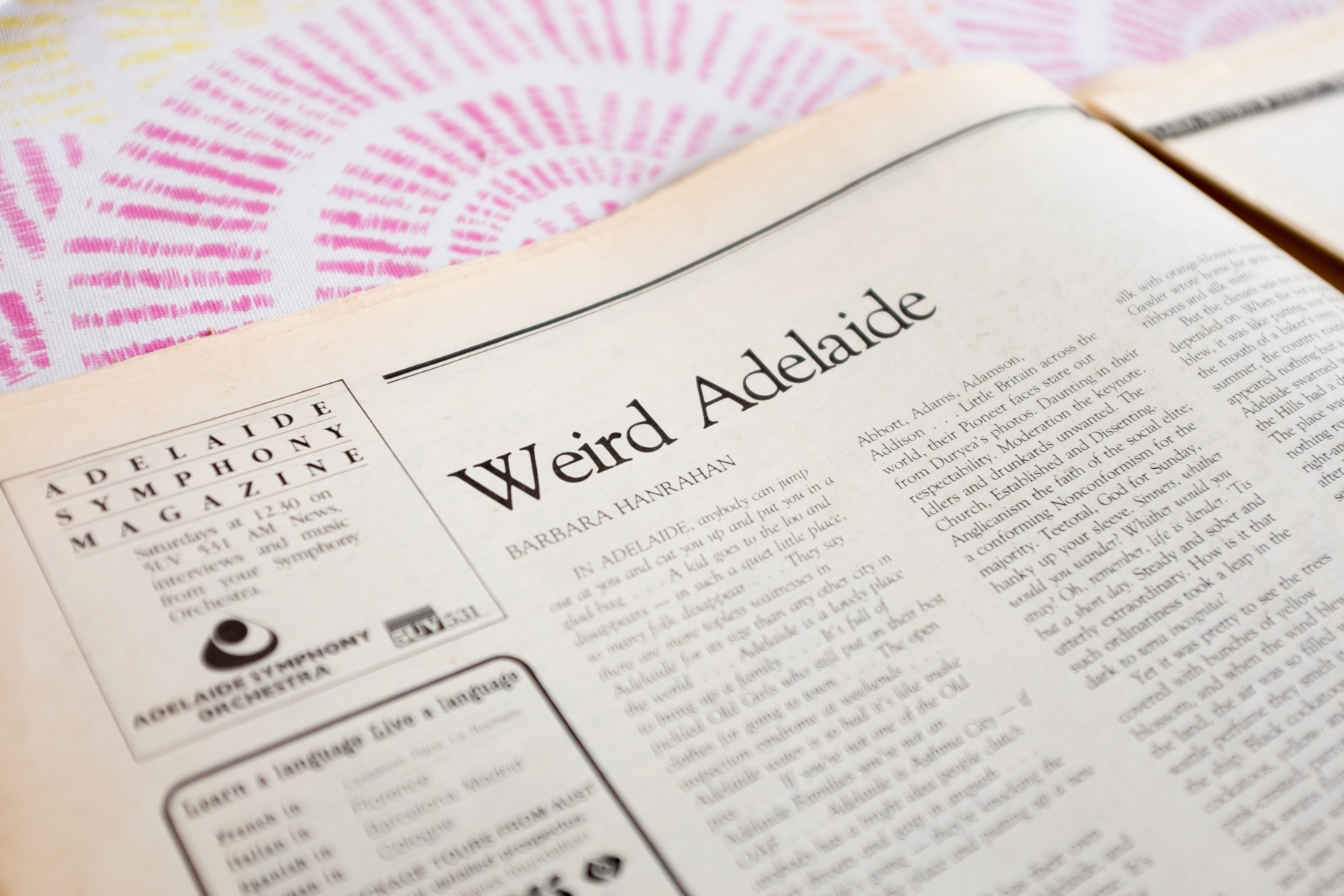
It’s unsurprising that one of the pieces Hanrahan is remembered for is the wonderful essay ‘Weird Adelaide’, published in The Adelaide Review in 1988 (evocatively revisited by writer-performer Tracy Crisp in 2020). It came four years after Salman Rushdie described Adelaide as an ideal setting for a Stephen King novel.
Subscribe for updates
Sea Green, the novel that finally led me to open the diaries, is an account of six weeks at sea between Adelaide and London, where Virginia moves between art school and her basement boarding room. She navigates grudging friendship, deep loneliness and variously disturbing first sexual encounters (“Only then – when he is spent, and the thing that was hard and thrusting has turned limp as a coiled worm – am I safe”), before finding communion and stillness with Jem, a stand-in for Steele.
The netherworld of the ship is a vehicle for her bewildered development as a sexual being; she loses her virginity to an Italian crew member, who makes promises before fading back into his life at home. And in a sense, Virginia remains at sea – floundering in isolation, suffering sordid relationships with “dangerous” men and an abortion – until Jem. In the novel’s closing pages, he lies beside her on a Cornwall beach, “like a Christ with arms outstretched, palms turned upwards”. She writes: “I crossed the sea in a ship. And on the ship I lost something … But now all that blackness has turned tame again.”
Finding Jo seems to have been what she wished for – though it came with the compromise of no marriage or babies, sometimes resulting in meltdowns Hanrahan describes as “fits”. It gave her the gift of not just an ideal companion, but a patron of sorts. His devotion allowed her to concentrate on her art while he took care of practical concerns. “I don’t somehow feel I can function in the world as an adult,” she worried in 1985. But thanks to him, she didn’t much have to.
Elaine Lindsay first met Hanrahan in 1978. She wrote in The Adelaide Review that she approached them “thinking I knew a fair bit about her. Instead, I met a completely different person to the one I thought I knew.” She worked with “cartons of material” to make her selections, admitting this meant “I had to emphasise certain aspects of Hanrahan’s personality and interests at the expense of others”.
I can’t help but wonder how Hanrahan might have structured it herself, if she’d had the chance, like Garner, to look back from a judicious distance later in life. We can’t know. Though Garner, as her diaries demonstrate, has always been able to see herself from the outside and inside at once – despite writing, comparing herself to the “incredible detachment” of third husband Murray Bail (who Hanrahan, incidentally, disliked), “I’m close in, all the time”.
Hanrahan, on the other hand, could be so deeply, painfully, permeated by the world – its noise and opinions, its tragedy and ugliness – that she often blocked it out to dwell with nature, art-making and Jo. “There’s that world and there’s this one,” she wrote in the diaries after being upset by reading about Auschwitz. “So I can’t ever again allow myself to read or look at anything about it. I know the terrors and get obsessed by them.” Another time, she wrote “yesterday was awful mentally for me because I read a Patricia Highsmith book and her world is so cold and rational – and quite frightening to me”.
Even Hanrahan’s friends seem to have been kept at a safe distance. She rejoiced in them when they didn’t threaten her sense of the world or herself, but recoiled – or lashed out – at even mild criticism or competition.
She was annoyed by “real world” politics encroaching on the territory of literature and in 1986, vowed never to return to the Edinburgh Festival, “where they treat the writers as if they are social workers”. But she did care about “terrible outside world obscenities”, even if she didn’t record them or get involved. It seems she had too little skin to protect herself. “The only way I can influence the world is by being small by being true to me and the real world of Nature about me. Like a monk, like a hermit who works through prayer.”
In her own way, she did care. Her fealty was to her family, her community – working-class, inner-west Adelaide – and the ever-eroding past. And of course, to the art life.
She was passionate, in the second phase of her writing career, about writing “the language of women like my grandmother, to set down a culture that would soon be gone forever”.
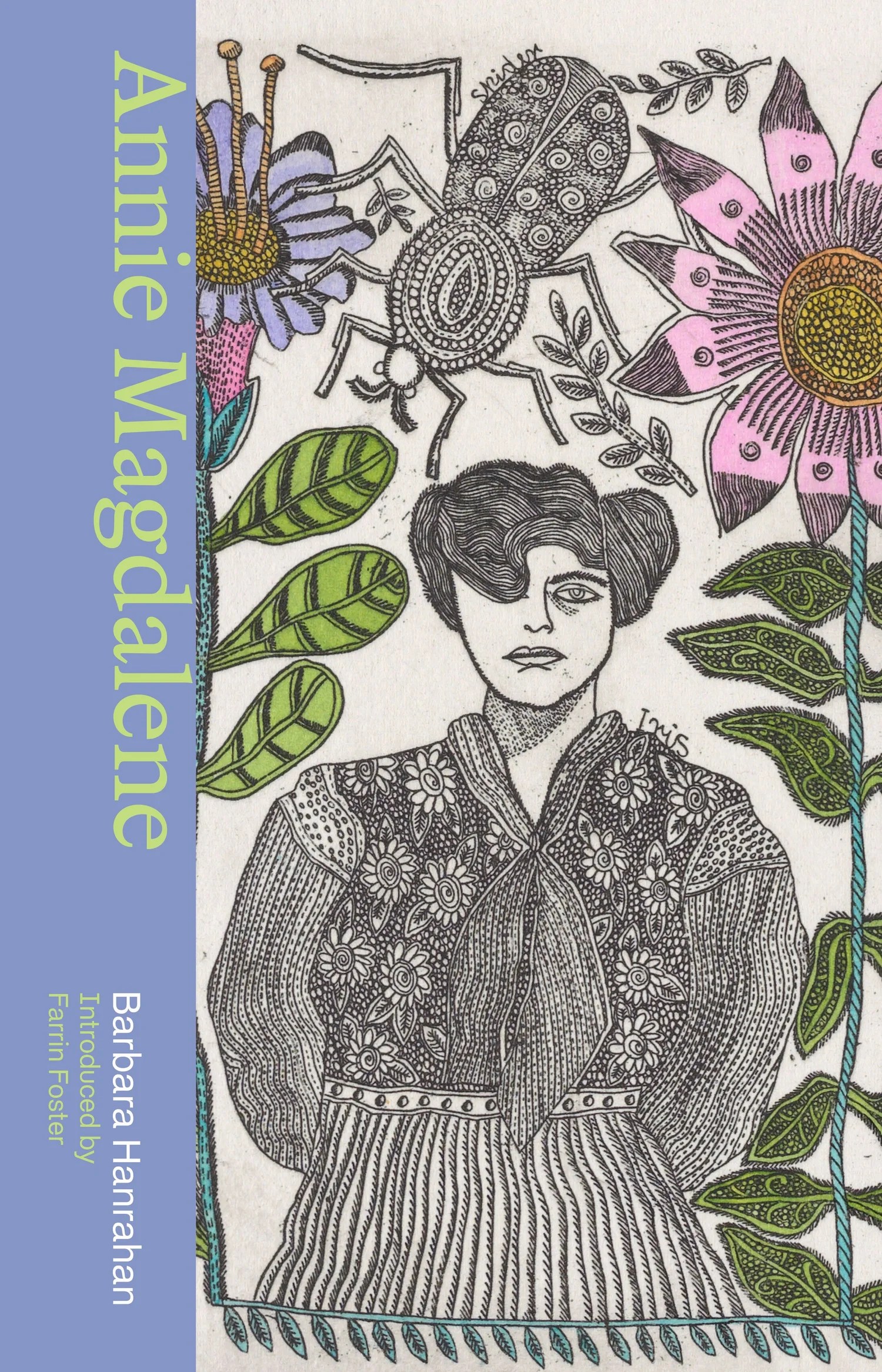
This is what she did in the second of her novels reissued last year by Pink Shorts, for a contemporary readership. Annie Magdalene, which spans 1908 to the late 1970s, was based on Hanrahan’s interviews with a Thebarton woman who lived near her studio there. “It is her life – a sacred thing – I record,” she wrote in the diaries. “I must do it justice.”
The novel inhabits an independent woman making a life centred on family and friends, resisting men and marriage, taking pleasure in swims at Henley Beach and picnics in the Hills, as well as the sewing she made her living with. It also remembers the 1919 flu epidemic, when “people in Adelaide wore masks in the street” and working at Holdens. In its closing pages, she is invited over by neighbours to share the new wonder of television. The recently demolished Coca-Cola factory has just “come to the Port Road” and the gardens of the Brewery, about to be a housing development, were “floodlit at night”.
As Farrin Foster writes introducing Annie Magdalene, its pages are a “rest … from screaming out in rage” and a tribute to “making a little space to revel in our aliveness”. These times demand screaming out in rage. But what Hanrahan’s art and writing offers us is that other thing: deep communion with the things in life we’re fighting to preserve.
New editions of Sea Green and Annie Magdalene (Pink Shorts Press) are out now. The Diaries of Barbara Hanrahan remains out of print.
Jo Case is a writer and editor who lives on Kaurna Yarta. She is co-editor, with Clem Bastow, of Someone Like Me: an anthology of non- fiction by Autistic writers(UQP). She was a monthly books columnist for InReview for five years. Jo is senior deputy editor of Books & Ideas at The Conversation.
Want to see more stories from InDaily SA in your Google search results?
- Click here to set InDaily SA as a preferred source.
- Tick the box next to "InDaily SA". That's it.
Free to share
This article may be shared online or in print under a Creative Commons licence