If Whyalla’s cuttlefish disappear, there’s no bringing them back
Extinction is what lies before us – not necessarily of a species, but of a truly unique natural phenomenon in the Northern Spencer Gulf, writes ecologist Greg Taylor.
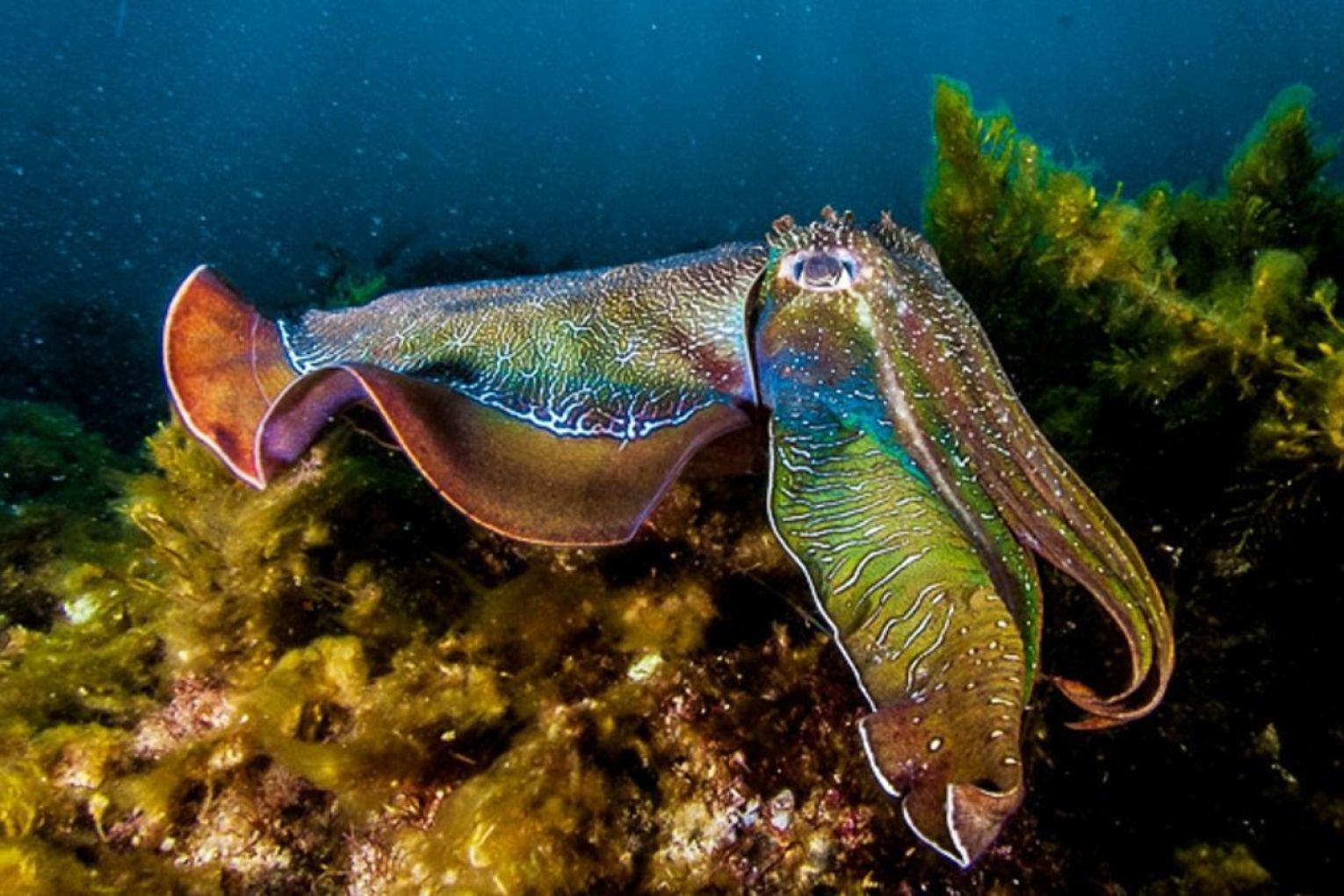
Giant Australian cuttlefish are found across Australia’s southern coasts, from Western Australia to New South Wales. Just one population forms a breeding aggregation: that in the Northern Spencer Gulf.
This population does not interbreed with others, and breeds only at a single, 64 hectare reef near Whyalla. If this population disappears, so, too, will the world’s only giant cuttlefish breeding aggregation.
The above information is essential knowledge if the population’s current precarity is to be fully appreciated. Before this year – and before the arrival of Australia’s worst algal bloom on record – the Northern Spencer Gulf population of the giant Australian cuttlefish reached its lowest level in 2013, when 13,500 individuals arrived at Whyalla to breed.
At the time, it was a worryingly low number. Normally, the breeding aggregation consists of many tens of thousands, and often hundreds of thousands, of individuals.
This year, an estimated 50 have returned. Not 50,000. Just 50.
You might like


After giant Australian cuttlefish breed, they die. But the situation is complicated by a degree of variation in the age at which individuals breed: Some do so in their first year, while others do so in their second. This means that, even with just 50 returning to Whyalla this year, next year’s cohort may return in larger numbers. Of course, it may also return in smaller numbers.
The Northern Spencer Gulf population has, in the past, been capable of recovering from poor years. Following the low of 13,500, the population steadily rebounded, and in 2020, more than 247,000 arrived at Whyalla.
But 50 is an entirely different matter. Even rebounding by a factor of 20 would leave the population at a still highly concerning 1,000 individuals.
That climate change is having a strongly negative impact on the giant Australian cuttlefish comes as no surprise. Cuttlefish research published in 2023 predicted as much. Going forward, marine conditions will likely only increasingly favour the development of algal blooms.
Stay informed, daily
Without serious action, the breeding aggregation faces extinction. Such action could take the form of captive breeding, which was on the table last year when the algal bloom first developed. A bubble curtain ended up being the chosen option, and while this can play an important role in protecting eggs from the bloom, it can only protect a subset of these. It provides no defense for adults.
Extinction is indeed exactly what lies before us – not necessarily of a species, but of a population and its unique quality of forming a breeding aggregation. Yet there have been efforts to have the Northern Spencer Gulf population’s biological uniqueness recognised by the Australian government.
In 2011, a proposal to list the population as a species was reviewed by the federal environment department. In science there exists no single definition of “species,” but the proposal was based on the “biological species concept,” which defines a species as a group of individuals which does not, whether for reasons behavioural, anatomical, or physiological, interbreed with other such groups.
Ultimately, the proposal was rejected, citing the lack of a “formal” recognition of the Northern Spencer Gulf population’s biological uniqueness – for example, via the publication of a research article describing the population as a species.
Beyond a captive breeding program – an option which is unproven and offers no guarantee of success – the only other means for preventing the extinction of the Northern Spencer Gulf population and its globally unique aggregation is the rapid phasing-out of fossil fuels. South Australia has made great strides in doing just this (if not always in the most sensible or consistent manner).
It therefore possesses considerable leverage which could be used to push the federal government to commit, for example, to increasing investment in electric vehicle charging stations; or to ending the nation’s largest fossil fuel subsidy, the fuel tax credit scheme; or to ending fossil fuel extraction and export by 2050.
Along with the United States and Russia, Australia is among the world’s three largest fossil fuel exporters. To keep global temperature rise below 2°C, one of these three will need to provide leadership. But with the United States having exited from the Paris Agreement for the second time, that leadership must either come from Russia or Australia.
The time has come for our country to show the world what real climate leadership looks like. There is much to be gained if we do, and much to be lost if we do not.
The Albanese government has, furthermore, committed to no new extinctions. Yet if the Northern Spencer Gulf population disappears, and the world’s only giant cuttlefish aggregation along with it, will the federal government recognise it as an extinction?
Regardless, Australians deserve to know what they are at risk of losing. The giant Australian cuttlefish aggregation is facing permanent disappearance. The time to act is now. Right now.
Greg Taylor is an ecologist with a research specialty in behavioural and evolutionary ecology. He has a PhD in ecology, an MSc in conservation, and a BSc in biology.
Want to see more stories from InDaily SA in your Google search results?
- Click here to set InDaily SA as a preferred source.
- Tick the box next to "InDaily SA". That's it.