Matthew Abraham: SA risks stumbling toward zombie democracy
Voters acting like dazed extras in a zombie movie risk saddling the state with a “ridgy-didge zombie democracy”, political commentator Matthew Abraham argues. He says all it needs is “an ‘elected leader’ who is an autocrat”.
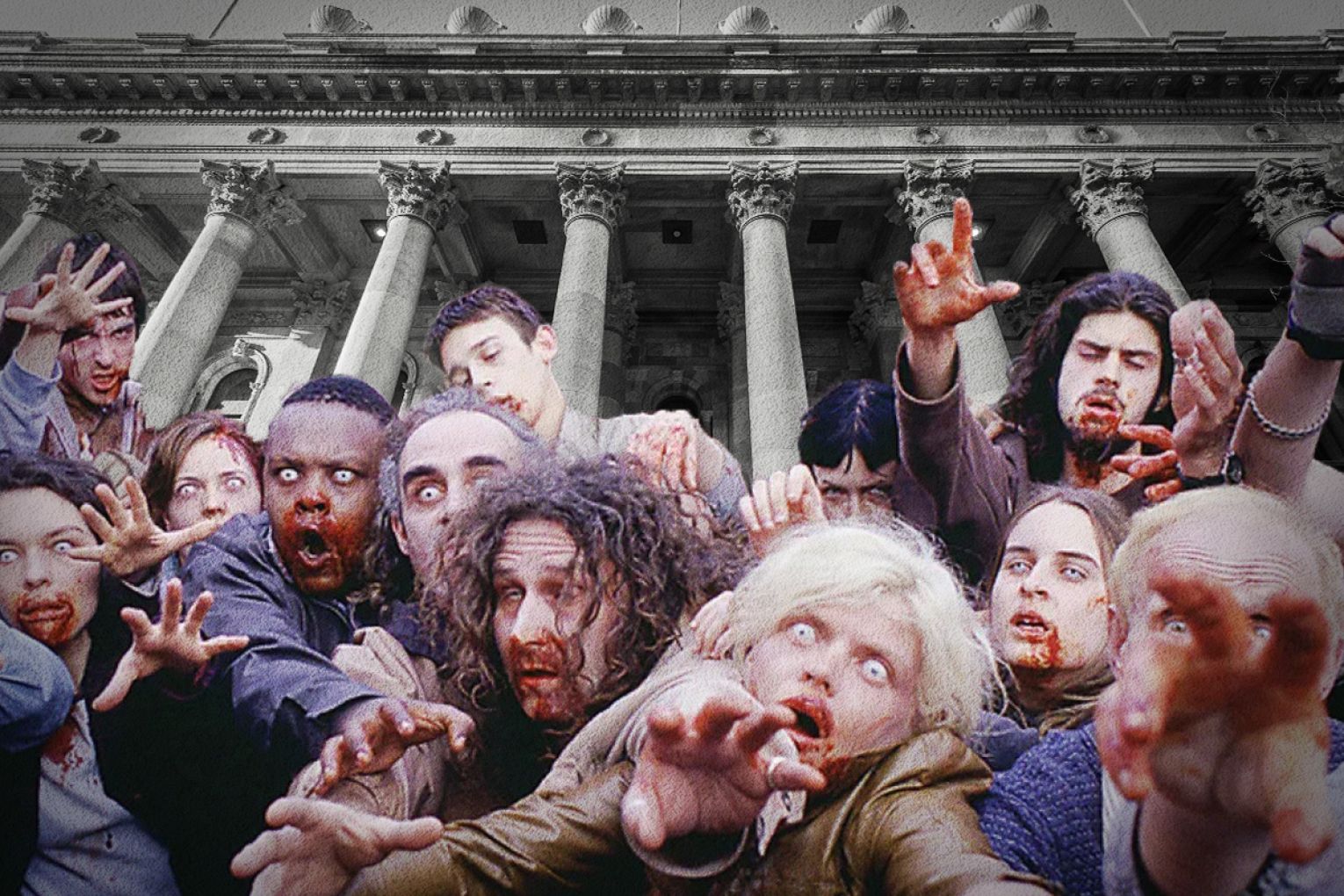
Zombies. They’re the gift that keeps on giving.
Right now, South Australians are innocently stumbling toward the March 21 South Australian election, like dazed extras in the shlock zombie movie Shaun of the Dead.
Who can blame us?
The war with Iran that is consuming the Middle East is a planet away in terms of air miles, but right next door to our everyday lives, posing a real threat not just to petrol stocks, but grocery prices, inflation, home loan interest rates, superannuation nest eggs, you name it.
Most voters are understandably more worried about petrol gauges than the horrors buried beneath the record field of 388 House of Assembly candidates chasing our votes.
It’s a ridiculous number, clobbering the tally of 240 wannabe MPs who put their hands up at the 2022 state election.
Three hundred and eighty-eight this time round. Who are all these people?
The real and present danger is that South Australians wake up after polling day finding themselves in a Down Under version of a zombie democracy.
The Human Rights Watch describes a zombie democracy as an empty democratic ritual.
This election has felt like that from day one.
The organisation says a growing number of autocrats “still hold periodic elections since their people have come to expect them, but they do not even pretend that these empty rituals are free or fair”.
“The result has been the proliferation of what might be called ‘zombie democracies’ – the living dead of electoral political systems, recognizable in form but devoid of any substance,” it says.
Does this sound at all familiar?
You might like
A ridgy-didge zombie democracy needs one essential element – an “elected leader” who is an autocrat.
An autocrat is briefly defined as a ruler who has absolute power.
Synonyms include despot, dictator or tyrant.
All the credible published opinion polls show Premier Peter Malinauskas rolling toward a mind-bending election victory come March 21.
For months now, the polls haven’t wavered, putting Labor’s two-party preferred vote at roughly 60 pc to 40 pc for the Liberals. It’s a killer.
Newspoll puts the ALP primary vote at an impregnable 44 pc against a risible 14 pc for the Liberals, themselves being outpolled by a surging One Nation on 24 pc.
If these polls hold up, and they will, Labor will win a victory to sustain it for at least the next 12 years in power, untroubled by a ragtag opposition that will consist of a bare handful of lucky Liberals, conservative independents and maybe, just maybe, a One Nation MP. Or two.
Election night will be a crazy, unprecedented, preference bun fight.
Talk about zombies, like the movie’s bewildered Shaun Riley – his character was a shoppie by the way – Liberal leader Ashton Hurn is trying to kill them off with a cricket bat but they just keep coming.
No-one would argue that Peter Malinauskas is a dictator, or a tyrant. He’s whip-smart, thoughtful, ethical, empathetic when he needs to be, buff and popular.
But even with his present, comfortable majority, over the past four years he has increasingly shown us a nice line in ruthlessness.
What Peter wants, Peter gets.
This may not be a bad thing.
But does it help explain why some of his senior Ministers have chosen to jump ship, dog paddling away from a leader who could guarantee them all jobs for life?
The most puzzling of these is the former Treasurer Stephen Mullighan, best buddy of Peter Malinauskas since their university days, when the Premier says they’d spend many an hour in the Uni Bar talking about how they’d change the world for the better.
Instead, Mullighan, young by political standards, resigned as Treasurer, quitting politics altogether at this election, leaving behind state debt now approaching $50 billion. It’s the State of the Walking Debt.
On the day the Premier visited the Governor for the issuing of the election writs, Mullighan posted photos of ripe tomatoes and capsicums being made into traditional Italian sauce.
“Nothing better shows the closing of that chapter of my life than spending the day not on the campaign trail, but instead with family making sauce at Nonna’s,” he wrote on X, once Twitter.
Good on him. If there’s any sugo to spare, send a bottle my way, Stephen.
The late, great SA journalist Stewart Cockburn’s brilliant 1991 biography of former Premier Sir Thomas Playford was titled “Playford. Benevolent Despot”.
Stay informed, daily
At the time it struck me as an odd choice of words to describe the man who was SA’s Premier for 26 years and 226 days, the longest reign of any premier in the history of the British Commonwealth.
The veteran journalist knew a thing or two about benevolent despots. He once served as press secretary to Prime Minister Robert Menzies.
In his book, he explains that his description of Playford as a despot “expresses a fundamental aspect of Playford’s personality and style”.
“He was a natural leader – strong, self-confident, courageous and clear-thinking – and he understood intuitively how to use the power which his parliamentary colleagues had placed in his hands at the outset of his commanding Premiership”.
“In the vernacular; he chose to keep them all guessing,” he wrote.
Or, to put it another way, what Tom wanted, Tom got.
Well then, if Peter Malinauskas gets the thumping election victory the polls say he’ll get, will South Australia find itself governed by a benevolent despot?
If so, will that be a good outcome over the long term?
Devotees in the Mali Cult see him as a political Messiah, but when it comes to some of his party’s signature policies from the last election, he’s been just a naughty boy.
His signature 2022 promise to fix hospital ramping has failed miserably. His promise to build a $593m green hydrogen power plant in Whyalla – the centrepiece of his “Project Prosperity” – has vanished up its own clacker, along with $280m in taxpayer cash.
And his promises to lower the cost of living? In February 2024, he said when a politician says they’ll try to reduce the cost of groceries, or petrol, “nine times out of 10 it’s all bullshit”. Correct.
Here’s the rub.
Peter Malinauskas is Playfordesque, but unlike Playford, he won’t hang around for 26 years and 226 days.
Sometime in his third term, he’ll almost certainly move into federal politics.
Who will be Malinauskas 2.0?
With the exception of Treasurer Tom Koutsantonis, who surely must be looking to a life after politics, nobody in his current team has the chops for the job. Maybe the next Labor leader is still in high school.
Without Playford, the Liberal Party quickly began to fall apart at the seams. As, more slowly, did an economy built on rust-bucket industries.
The ideologically screwed up, hopelessly divided, amateur and ineffective South Australian Liberals who are begging for your vote today are Playford’s political legacy.
So, it might be worth having a good look at the selection of the 388 candidates who’ll land on your voting slip this election. Try to work out who they really are, what they believe and what they have to offer.
This applies to candidates from Labor, Liberal and Greens, along with One Nation, the Australian Family Party, other minor triers and your assorted local independents.
Choose wisely.
Eliminate the drongos, because just like Zombies, they have a nasty habit of rising from the grave.
Matthew Abraham is a political analyst with 5AA.
Want to see more stories from InDaily SA in your Google search results?
- Click here to set InDaily SA as a preferred source.
- Tick the box next to "InDaily SA". That's it.