Qantas loses ground in ranking of world’s safest airlines
Australia’s national carrier has slipped down the list of the world’s safest airlines, according to a yearly survey.
Source: Qantas
Qantas has slipped two places down the coveted list of the world’s safest airlines as a Gulf carrier took top spot for the first time.
Etihad nabbed No.1 spot on the Airlineratings.com’s annual safety list when it was released on Tuesday.
Airlineratings.com noted its top six airlines – Etihad, Cathay Pacific, Qantas, Qatar, Emirates and Air New Zealand – were separated by just over a point.
“Less than four points covered positions one through 14, and at the very top the margins were even tighter, with just 1.3 points separating positions one through six in the full-service category. We may be reaching a point where traditional rankings risk being misleading, and where grouping airlines into performance tiers provides a more accurate reflection of reality,” chief executive Sharon Petersen said.
“All airlines in the top 25 are world leaders in aviation safety, and claims that one is significantly safer or less safe than another are both sensationalist and false.”
Among the criteria Airlineratings uses to come up with its rankings are incident rates (adjusted for total flights), serious incidents, fleet age, pilot training and international safety audits.
You might like


“One change for this year is that we are placing a greater emphasis on turbulence prevention, as it remains the leading cause of in-flight injuries,” Petersen said.
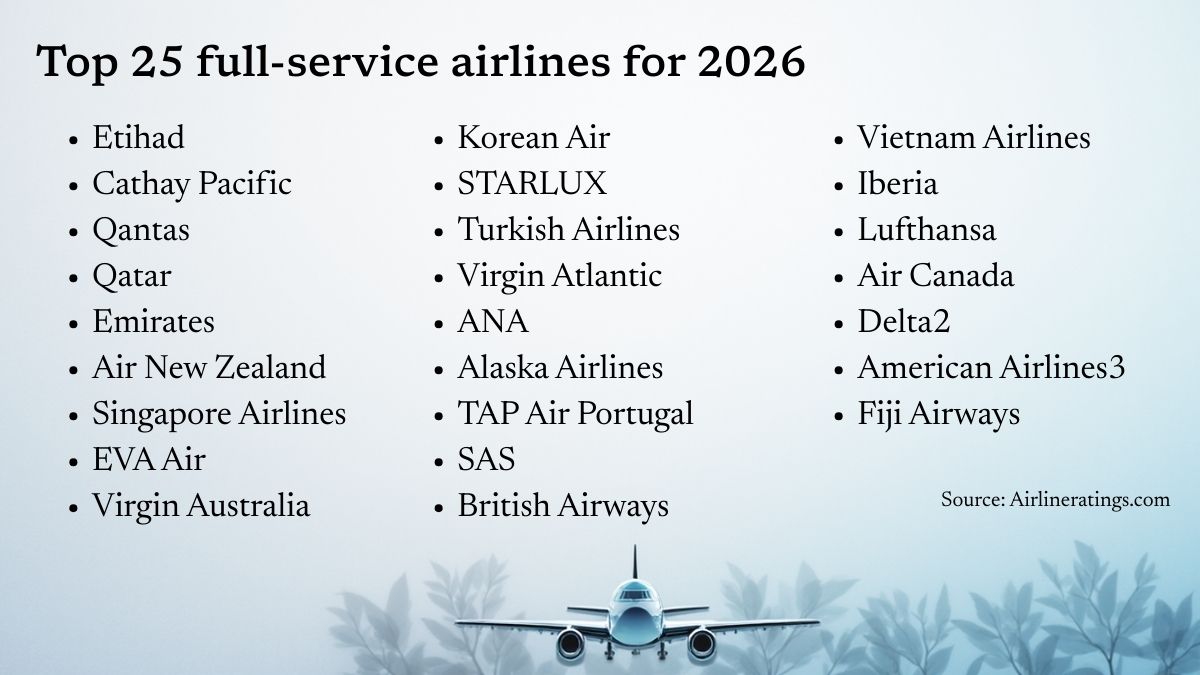
Qantas last topped the list in 2023 and held second place in the past two years – with that ranking attributed to its ageing fleet.
The national carrier is in the middle of a fleet renewal program and has introduced significant numbers of new planes since 2023. They include several models of Airbus aircraft as well as more long-haul Boeing 787 planes.
Air New Zealand topped the survey in 2025, but was pipped this year by Etihad – a first for a Gulf carrier.
“Etihad achieved this through a combination of factors: A young fleet, advancements in cockpit safety, particularly around turbulence, a crash-free history, and the lowest incident rate per flight of any airline on the list,” Petersen said.
Stay informed, daily
“The airline also participated in our independent onboard safety audit and demonstrated excellent adherence to turbulence management in the cabin.”
Etihad has enjoyed significant growth in recent years. It carried 22.4 million passengers in 2025 – 21 per cent more than in the previous year.
Singapore Airlines returned to the rankings after being excluded last year following the serious turbulence incident that left one person dead and more injured, some critically, when one of its planes plunged 2000 metres mid-flight.
“After visiting their safety and training centre and holding extensive discussions with their operations team, we are pleased to have them back on the list,” Petersen said.
Airlineratings.com also ranked discount airlines, with Qantas’s low-cost arm Jetstar runner-up behind Cathay Pacific’s budget carrier, HK Express.
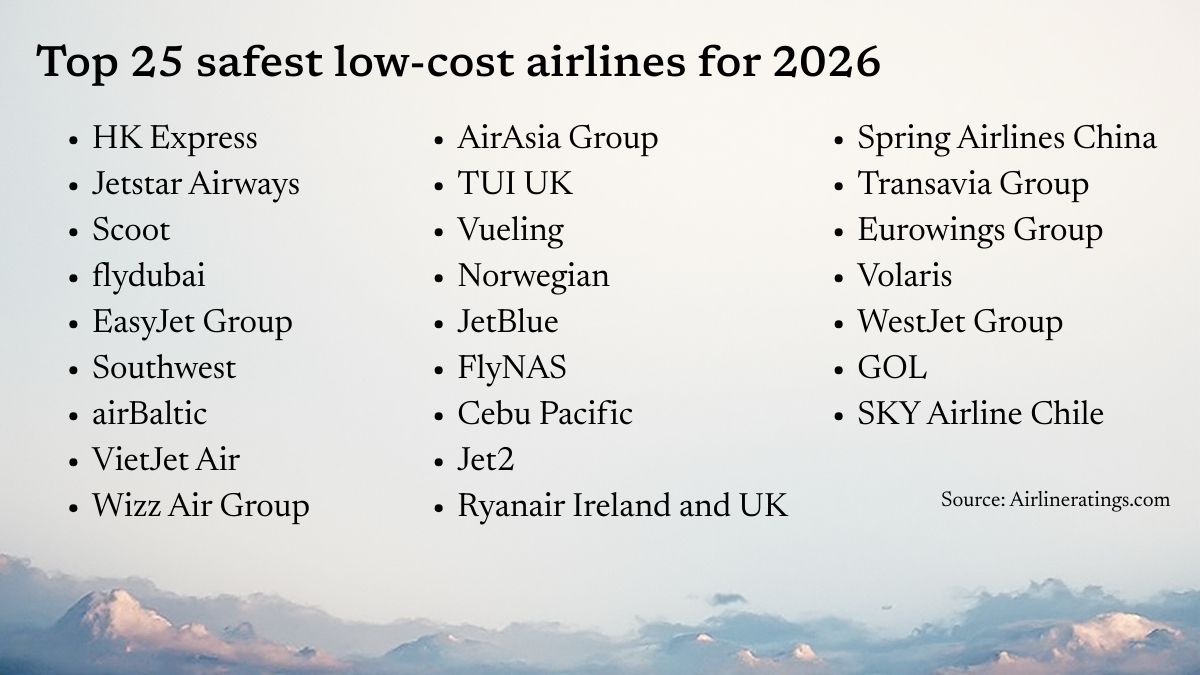
“HK Express claimed the top accolade for a second time, driven by a modern fleet, exceptionally low incident rate, and an almost flawless onboard safety audit,” Petersen said.
“Given Hong Kong’s stringent incident reporting requirements, this low incident rate and absence of serious incidents genuinely reflects a highly disciplined and well-run operation.”
She said every airline on the 2026 lists had recorded incidents in the past two years – “from tail strikes to on-board fires and engine shutdowns”.
“Yet the actual incident rate per flight sits between 0.002 and 0.09 across the airlines, which is a true credit to the industry as a whole,” she said.
Airlineratings said serious incidents remained rare in modern aviation, meaning its top 25 reflected “not just excellence in aircraft and operations, but the crucial role of skilled aircrew and robust safety practices across the airline”.
“Safety today is defined by consistency, culture, adaptation and effective risk management across millions of flights,” it said.
Want to see more stories from InDaily SA in your Google search results?
- Click here to set InDaily SA as a preferred source.
- Tick the box next to "InDaily SA". That's it.