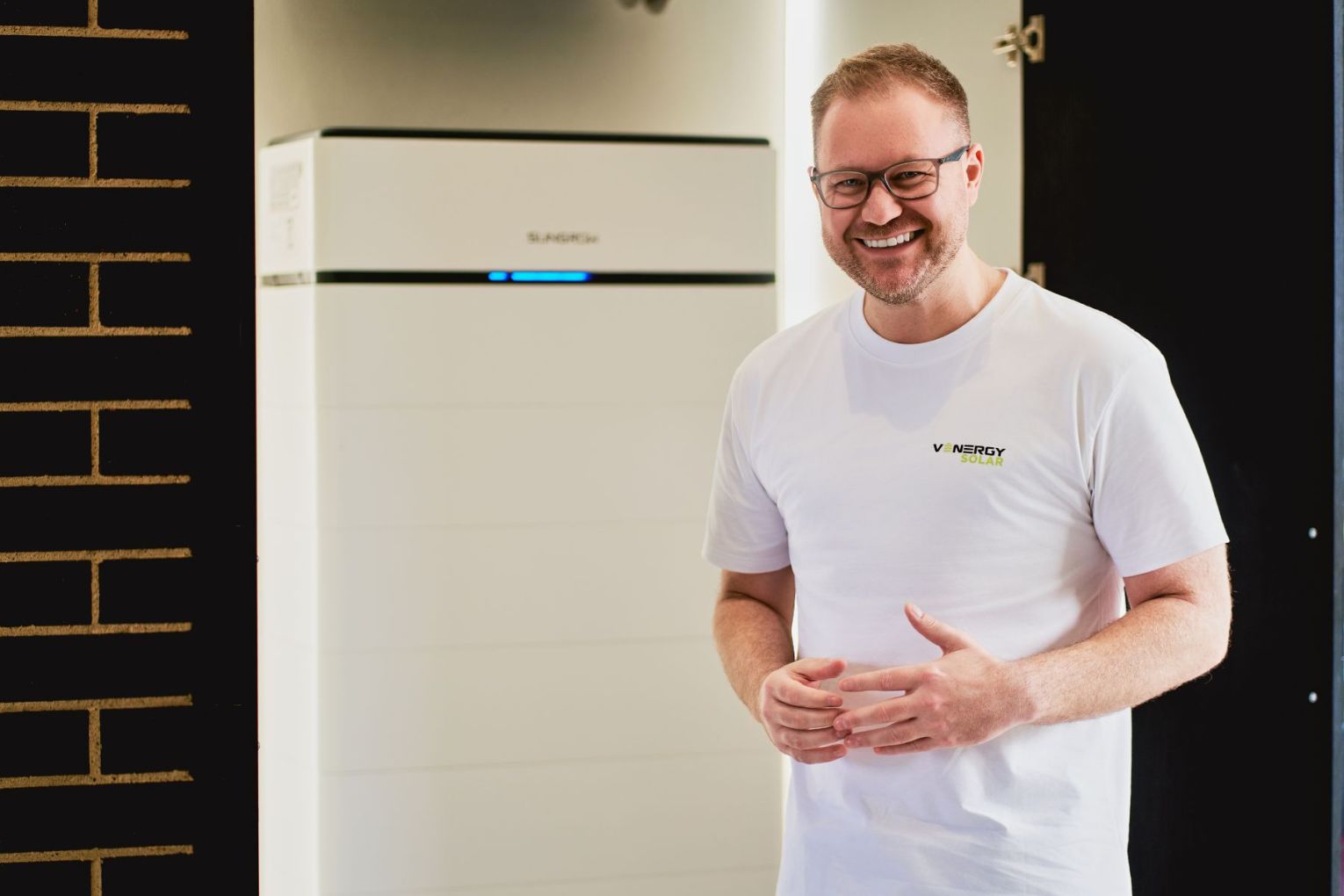
10 minutes with… Venergy CEO Matthew Wilkins
Hindmarsh-based Venergy is working on innovative new ways to bring solar to more households and businesses. The CEO and 40 Under 40 alumni sits down with us to talk about these projects and why he “would probably never start another solar business again”.
You’re from the Murraylands – how did you get started in the industry?
I did my apprenticeship in the Murraylands, working with all the farmers. And I got to a point where I was enjoying what I was doing, who I was working with, but wasn’t really finding the purpose behind it.
Around 2008/9 is when solar was really starting to kick off. It’s when the federal government put a supercharger on the Renewable Energy Target, they put all these multipliers in, and were heavily advertising it and advocating for early adopters and all these things.
It caught my attention. It’s not just electrical work. It’s actually changing the world we live in. It was this new idea. And what a lot of people failed to realise was that it’s actually serious construction work. You’re going to someone’s house, you’re putting a considerable amount of weight onto someone’s slapping it on there
By about 2014 I had assumed full control of the business and as Managing Director and major shareholder.
You might like
What does Venergy sell?
We’re mainly selling commercial solar, and we’re also doing residential solar. The split is nearly 50/50, now. We really help on the commercial side, businesses that are navigating the challenges of rolling out complex, multi-site solar. We do that across Queensland, New South Wales, Victoria, South Australia, and WA and we try and focus on some of these really big energy users, because I think that’s, ultimately, where we’ll make the most impact.
It’s a stacked industry and very saturated. How do you compete?
I would probably never start another solar business again.
Stay informed, daily
The barrier to entry is really, really low or basically zero, right? Why is that for something that is hyper-regulated? There’s not really any regulations on who actually sells it. It makes it hard sometimes, because right now there is a huge incentive for batteries by the government. It’s like pricking your finger and dropping it in the ocean; the shark starts circling. You get people that come into the industry with not very good intentions that are probably looking at it like, ‘Well, let’s start up a business. Yeah, we’ll do it for a couple years.’
What have you seen change about the industry over the last 20 years?
Batteries have become more of the backbone of the overall solution to our transformational process to renewables. They’ve been a bit of a missing piece of the puzzle for quite a long time. I think what the government’s doing – the biggest battery incentive in the world, it’s $2.3 billion – I think from that perspective, it’s really good. The bad part is, again, coming back to that when there’s a lot of government incentives on offer, a lot of sharks start coming through, and there are products that are coming to market that have been hurriedly rushed to market, with not a lot of proving.
How do consumers cut through the noise?
It must be super confusing because there are a lot of options, and there are a lot of providers.
Ultimately, if companies are like us and do their job and educate and advocate for buying solar with a real long-term view, then the only way a consumer can really judge and almost evaluate what their options are in front of them is what everyone does when you when you’re not, when you haven’t been educated. Then the only thing left to do is say, well, it’s this size and this price and then put it from tallest to lowest.
We’ve taken that quite seriously to understand what our responsibility is, and that’s educating the customer.
Where do you see the future of the business?
We’re really working on quite a lot of these larger, what are called land lease communities like Stocklands Haclyon communities in Victoria. We’re going through a housing crisis, and there are some pretty innovative new ways of people getting into home ownership and land lease has sort of been on the cusp. Our first pilot project is around 1200 homes and there are developers with a pipeline of 60,000 homes.
I think for is it’s definitely understanding how the full electrification of homes is playing out. Meaning we’re now not only installing solar, we now look at solar, batteries, EV chargers. We’re now in certain regions also adding heat pumps, so we’ll be removing their hot water system, putting in an electric heat pump.
The future for us is: Australia is going through a big electrification transformation, and how do we be in the forefront of that? How do we make sure that a business like ours is evolving to that next stage?
Want to see more stories from InDaily SA in your Google search results?
- Click here to set InDaily SA as a preferred source.
- Tick the box next to "InDaily SA". That's it.