Growing their own empire
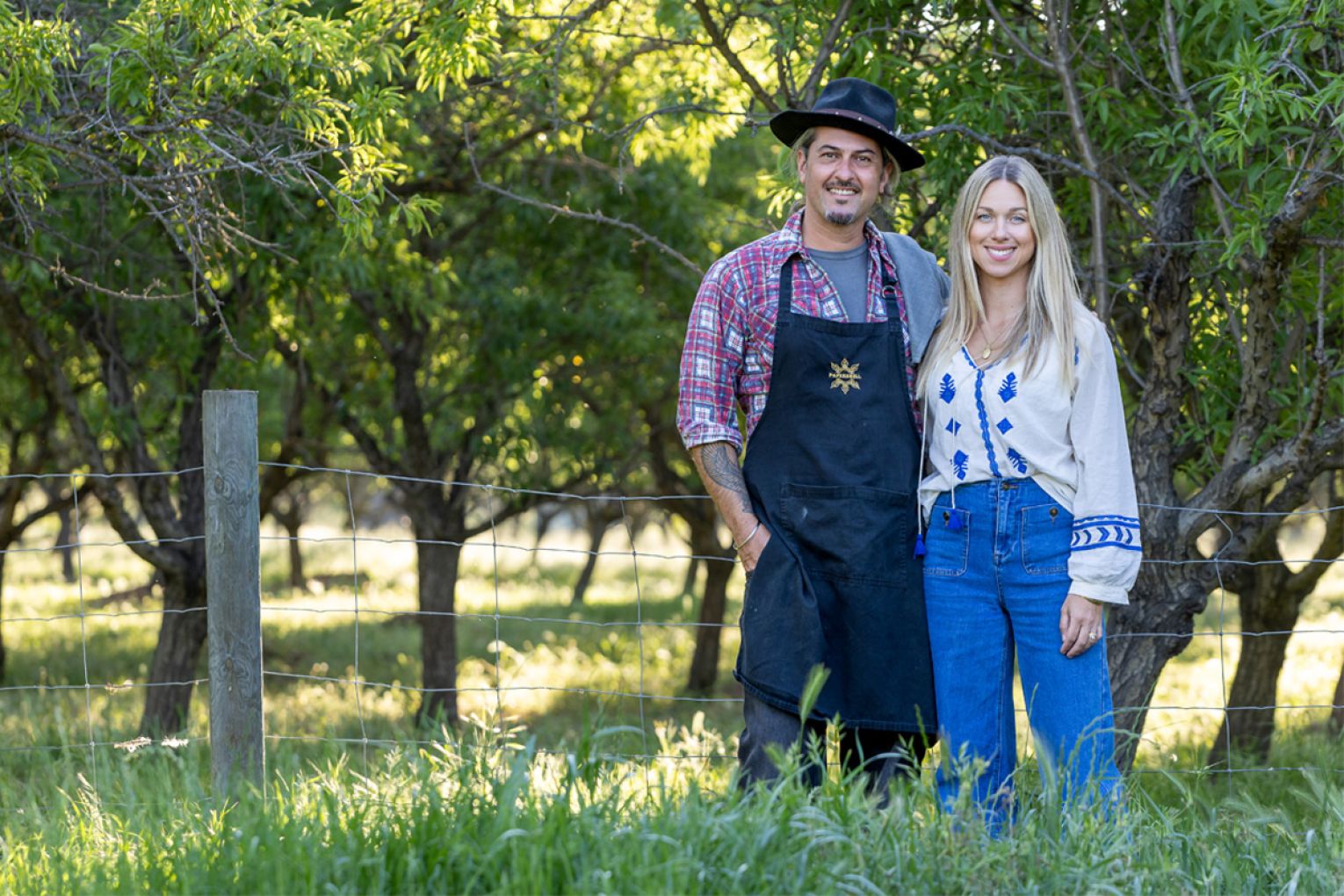
He’s performed at giant festivals from Coachella to Glastonbury, written a song on a number one Usher album and forged his own successful solo career. But for Surahn Sidhu and his wife Jess, life is now measured by the flow of the seasons at their Willunga almond orchard, Papershell Farm.
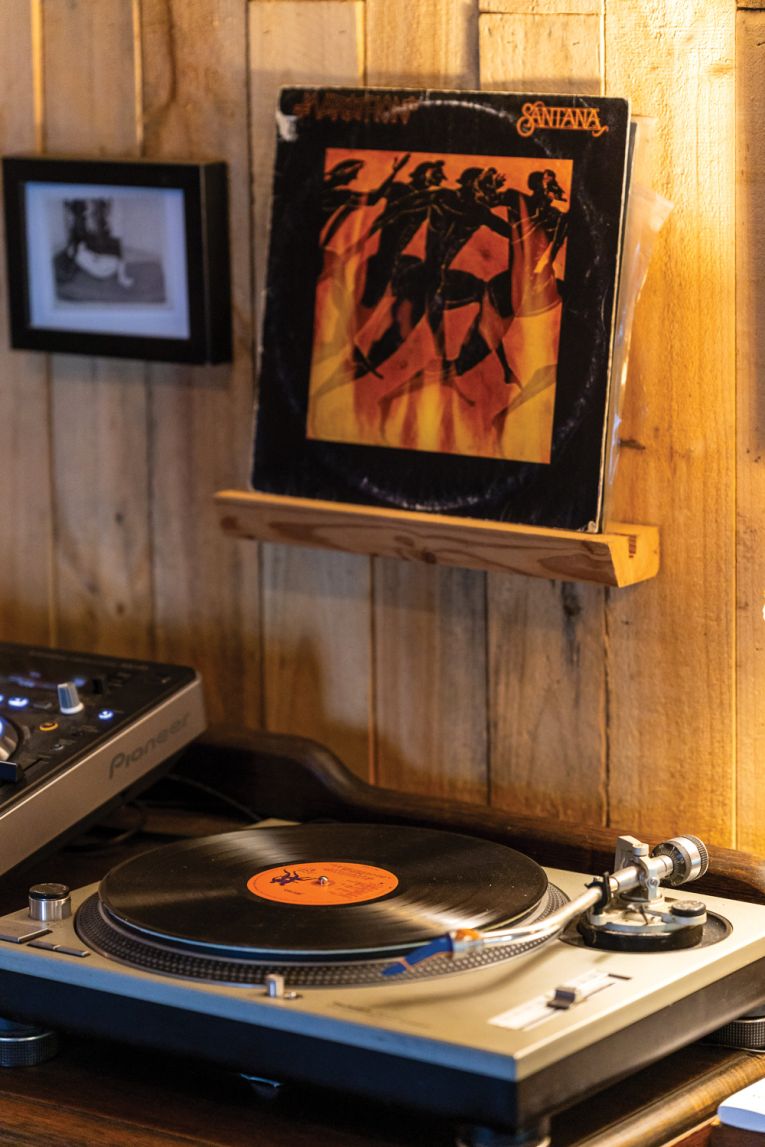
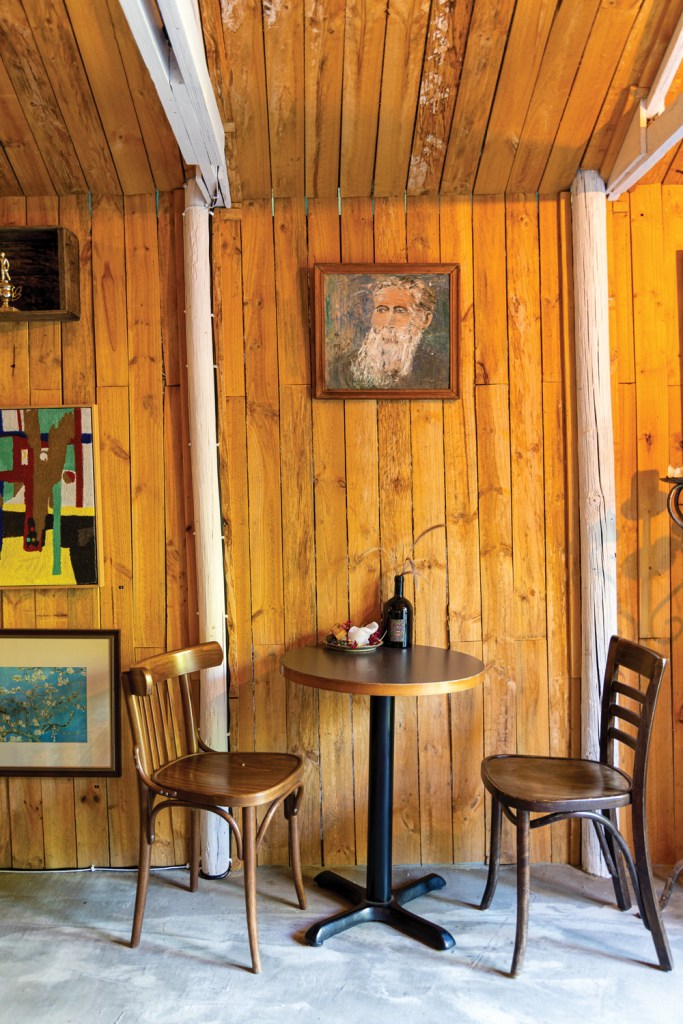
It’s as if you’ve stepped straight off the streets of New York into an avant-garde bar that only the locals know about. Seventies disco emanates from a rare vintage Hi-Fi system. A set of stairs lead down to a larger timber-clad room bespeckled by a spinning disco ball. If Doctor Who was into vinyl records, this would be his Tardis.
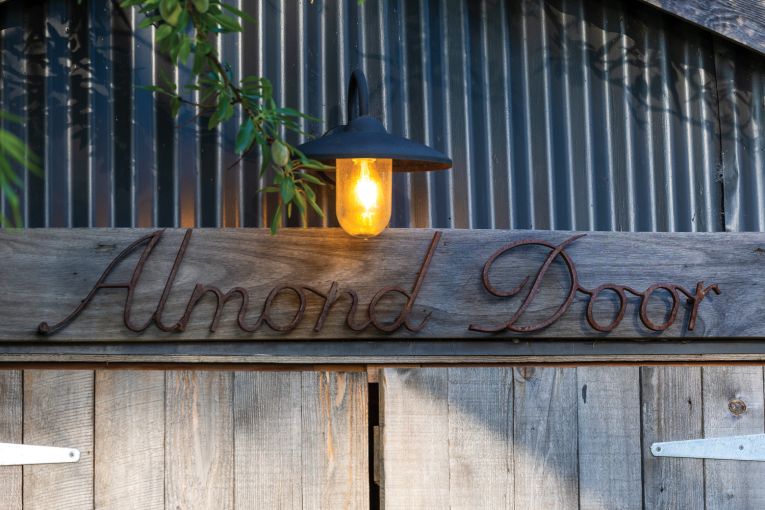
Except this isn’t a Hi-Fi listening bar in New York, it’s a reimagined farm shed on Papershell Farm, the Willunga almond orchard of Surahn and Jess Sidhu.
“Are you allowed to have a drink?”, asks Surahn as we step out of the golden afternoon sunshine and into the listening bar which reveals stacks of vinyl records, vintage listening paraphernalia and a jukebox.
Sure. It’s not every day you have an internationally-accomplished musician serve you a wine he’s made himself. Alhtough, it is at Papershell Farm.
“This is a sacred place of experimentation and devotion to sound,” Surahn explains.
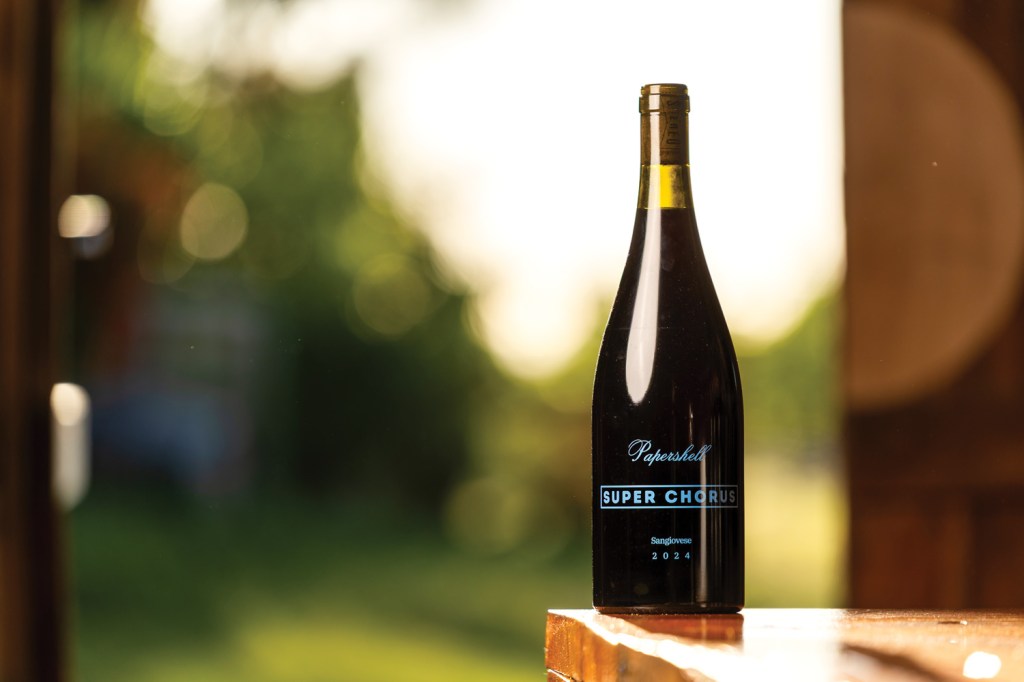
Among his many projects on the go, Surahn has spent the past several years learning how to make wine. This year he bottled his first official drop – a sangiovese dubbed Super Chorus in homage to the guitar pedal of the same name. Surahn pours a glass – it’s delicious.
In addition to showcasing wine, the Almond Door offers curated listening sessions and live performances that have made it legendary, in an underground way. “Word has grown organically, and we have people from all over the world visit here,” says Surahn.
“It is a true listening bar built with a reverence around music, and we have even built the speakers. We might play one artist all night, an entire record front-to-back, or myriad genres. We have an incredible jukebox immortalised with a CD collection gifted to me by a good friend John Lemon, who was Pink Floyd’s sound engineer.”
The venue is open on Thursday evenings for wine tastings, but Fridays are particularly unique as the international muso becomes the bartender, chef, dishwasher and even performs a few songs once the dishes are done.
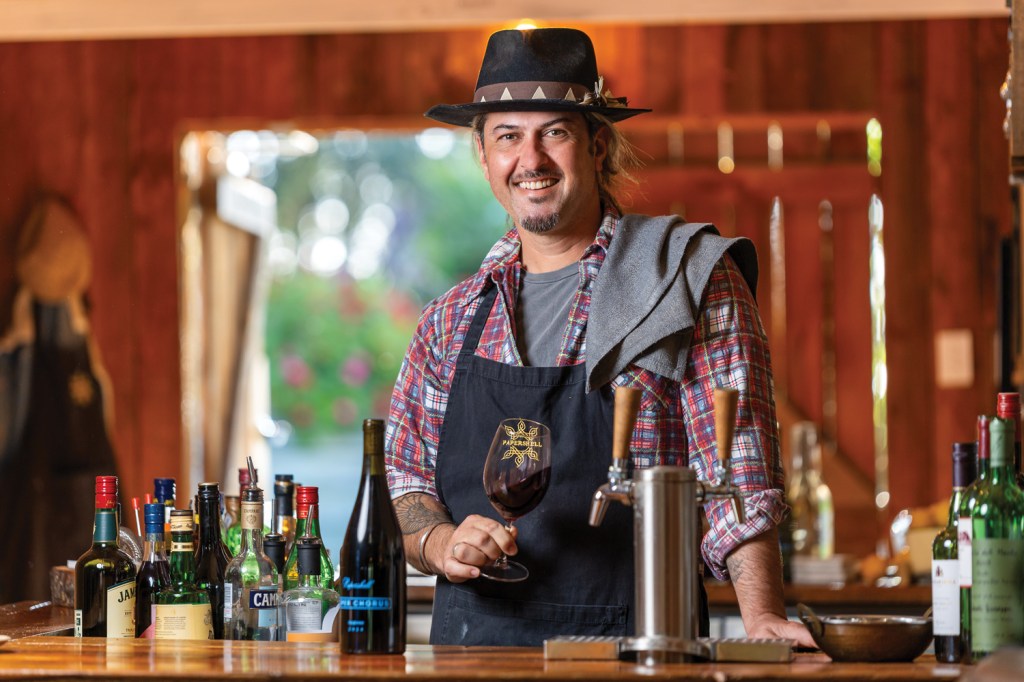
“For me, Friday night is a theatrical performance from start to finish. It’s something that I look forward to every week. Some nights there are 40 people in here and others there have been just two people left by the time I’ve started playing,” he says.
“We only serve one dish, which is chicken biryani; I make a big batch every Friday night. It’s a dish my father insisted I learn to cook before I left home.
You might like

“I grew up as a Punjabi-Anglo-Indian, and in our culture, there is what’s called sevā, which is selfless service. It relates to agriculture too, because you’re looking after soil and microbiology. You’re feeding soils, caring for Country and the environment.”
Surahn invites other top musicians to perform here too, with a raw space designed to push artists out of their comfort zone. These intimate Friday night performances are at complete odds with the musician’s professional alter-ego, having played to crowds of up to 80,000 people.
Surahn’s career kicked off when he and high-school friends, keyboardist Luke Godson and drummer Tony Mitolo formed Adelaide disco-funk band The Swiss and signed their first record deal.
Two of them went on to form the rhythm section for Empire of the Sun, one of Adelaide’s most successful music exports, and toured relentlessly from 2008 to 2015. This included playing to enormous crowds at mega-festivals Glastonbury and Coachella, as well as on prime-time US television.
While Surahn shows SALIFE around the Almond Door, the couple’s youngest children can be heard playing in their backyard, which is separated from the farm by a set of heavy timber doors that create a portal between home life and the business.
“Jess is very much the sounding board for every major decision made here and a constant inspiration. I see the work that she does humbly as a mother, and as a farmer,” says Surahn.
“She is qualified as a teacher and an architect, and her IQ is a lot higher than mine. She let me win one game of chess when we first started dating, and I’ve never won a game again,” he laughs.
Jess and Surahn first met at Adelaide live music venue Jive, where one of Surahn’s early bands was playing. Life took them separate ways, and they reconnected five years later.
Jess began her career in landscape architecture, before studying teaching, and is now focused on growing “humans and trees alike”, as she explains.
“With Surahn, I’ve had some wildly fun experiences and met interesting people over the years, but on the flip side I’ve also spent large amounts of time on my own with the kids, keeping our sanctuary running,” Jess says.
The years Surahn spent performing with Empire were exciting, but also gruelling, and he longed to flex his creative muscle as a singer-songwriter. A serendipitous backstage moment saw him strike a friendship with American superstar Usher, which led to him co-writing a song on his number-one-charting 2011 record, Looking 4 Myself.
“I met Usher backstage at Coachella, and we were chatting about our kids, and I invited him out for dinner. It was a moment of confidence when I just said to him, ‘Hey man, let’s go eat sometime’,” says Surahn.
“We swapped numbers, and I ended up sending him a demo, and that changed my life. He invited me to Atlanta for a couple of weeks, and we wrote a bunch of music together. Jess and I both became good friends with him, his family and his team.”
The writing credit on Usher’s album opened doors that in 2012 saw Surahn release his debut solo EP with the New York label, DFA. In 2015, he toured as a guest vocalist for the Sydney electronic group Flight Facilities. Surahn continues to jet off for the occasional run of his own international shows, with Jess looking after things while he’s away.
Under his solo title – Surahn – the musician has garnered millions of online streams with a large international following, while his Australian following is comparatively modest. “Sure, it’d be cool to get played on Triple J every now and then, but do you need that to be successful? I’m content to be able to sing my song to at least one person in this room,” Surahn says.
It was during the relentless pace of touring with Empire that Surahn began dreaming of a more grounded existence. “The double-edged sword of reaching your goals as a musician is the subscription to having to work harder than you’ve ever worked in your entire life, and that you will get up and do it every day; it’s brilliant and awful at the same,” he says.
“I was on the tour bus with Empire, laying there as we drove from Austin to Aspen, and I developed this aspiration to float up and down the River Murray on a houseboat.”
Subscribe for updates
Jess and Surahn lived in New York for a brief period, but the Big Apple didn’t work out for them and they returned to South Australia. The day before their wedding, Surahn went and looked at a houseboat for sale. “Jess said to me: ‘I don’t know if the wedding’s going to happen if you buy that thing’,” he laughs.
The couple instead bought a run-down asbestos shack at Goolwa and went about renovating it. Then, in 2017, the almond orchard caught their interest.
“I went and had a look at this orchard that was for sale, thinking maybe I could make some wine there – it’d be fun,” he says. The couple became first-time farmers, working tirelessly to restore the dilapidated property, while planting native vegetation and a small vineyard.
“I’m Adelaide born and bred, and as a boy I spent a lot of time with my aunties and uncles who worked in agriculture. Being out in the country gave me the most incredible sense of freedom. That pull has always been there for me,” says Surahn.
“We have invested all our energy and our capital – our lives – and it’s been nearly 10 years of feverish work, learning how to balance and re-imagine work and life together.
“One day you’re fixing fences, pruning or weeding, and the next you’re harvesting or planting or looking after children. Then another day, I’m performing.”
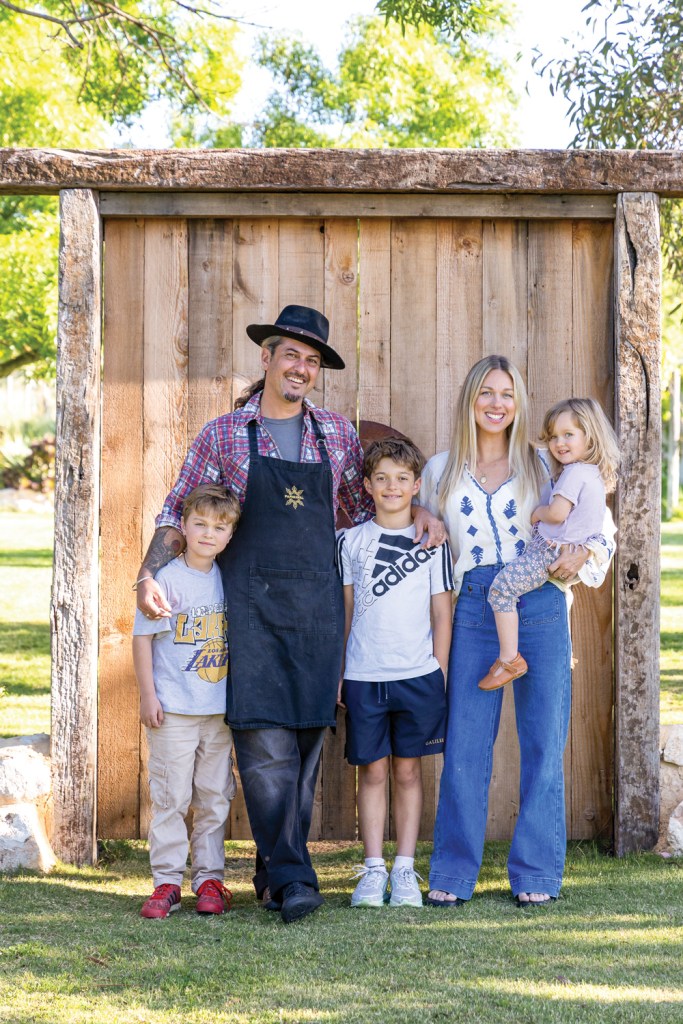
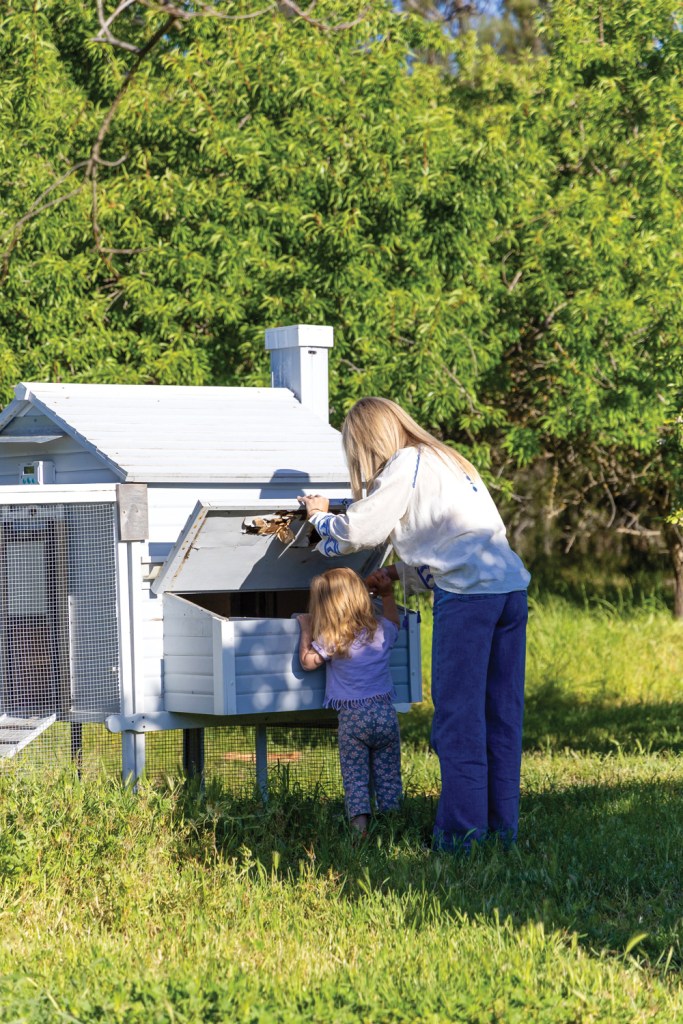
Papershell Farm has provided a grounded upbringing for the couple’s four children, who range in ages from two to 19 years old. “They’re all completely different. We’ve got the carpenter, the athlete, the farmer and our two-year-old daughter will be the CEO. She’s got everyone wrapped around her little finger,” explains Surahn.
Even on a small scale, Jess and Surahn have discovered how emotionally and physically taxing farming can be. “When we first started this venture, we harvested all 2000 trees for six years by hand. And it broke me, and it broke Jess. It was stressful,” he says.
Determined not to use chemicals on their farm, Surahn studied permaculture and adopted organic, biodynamic principles. While navigating challenges – including drought, hail and flooding – the couple refurbished the old almond cracking shed to create their Almond Door.
Now, they are no longer reliant on just their almond harvest for income. They are working with Trees for Life with the aim to plant 1000 trees a year, all endemic species, with the aim to decommission the almond orchard and return it to native bushland.
“We’re letting almonds die and return to the soil, and in their place growing gums and acacias and eucalypts. We’d love to throw some tree-planting parties,” says Surahn.
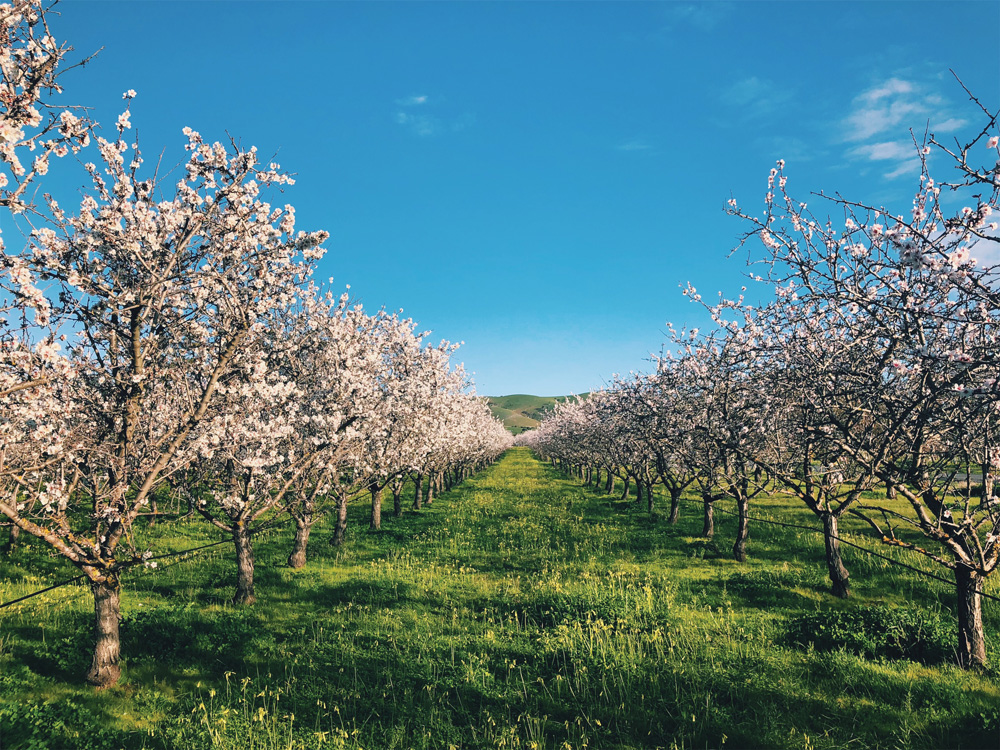
Come blossom season, the property becomes blanketed in a snowy layer of flowers. For Surahn, this season signifies rebirth. “Every year I’m wowed by it. It snows blossoms and the smell is intoxicating,” he says.
“It always happens to work out that we’re going through some sort of dramatic challenge when the blossom arrives. Just when you think things can’t get any lower, the season changes and it carries you up, as if you’re out in the surf and you feel yourself being lifted.”
Right now, it seems to be the Almond Door that is doing the heavy lifting. It’s something Surahn is deeply passionate about and represents a maturity in his mindset as a musician.
“Once you learn how to wield that magic wand to write and synthesise something from thin air, and let that pass through your ego enough times, you realise that it’s even better to listen. As a musician, it’s a big lesson that has taken me the best part of 30 years to learn,” he says.
From hand-building the Almond Door and its speakers to recording his own songs and picking the almonds, Surahn concedes that he has an “obsessive” drive to be entirely self-sufficient. But that seems to be key to the magic of Papershell Farm.
For Jess, it is this relentless creativity that she first bonded with Surahn over and what continues to drive them both. While motherhood and farm life keeps her busy, she hopes to develop her own artistic practice in the future.
“I’m not committed to the idea of a linear career. I move in seasons. Sometimes creating, or learning, or resting, or growing. One day again I’d love to create art,” says Jess.
“For someone who has never met Surahn, I would describe his energy as both magnetic and expansive.
“Like a forest, you can get lost in the many meandering paths of his ideas, dreams and stories, and still come away feeling found.”
This article first appeared in the December 2025 issue of SALIFE magazine.
Want to see more stories from InDaily SA in your Google search results?
- Click here to set InDaily SA as a preferred source.
- Tick the box next to "InDaily SA". That's it.