Think you understand drought? Think again
Believe drought always looks like dust and bare paddocks? Not necessarily. In Australia’s grain-growing regions, the signs can be far less obvious – but the strain is no less real. Find out about the hidden impact of drought and the innovations helping keep food on our tables.
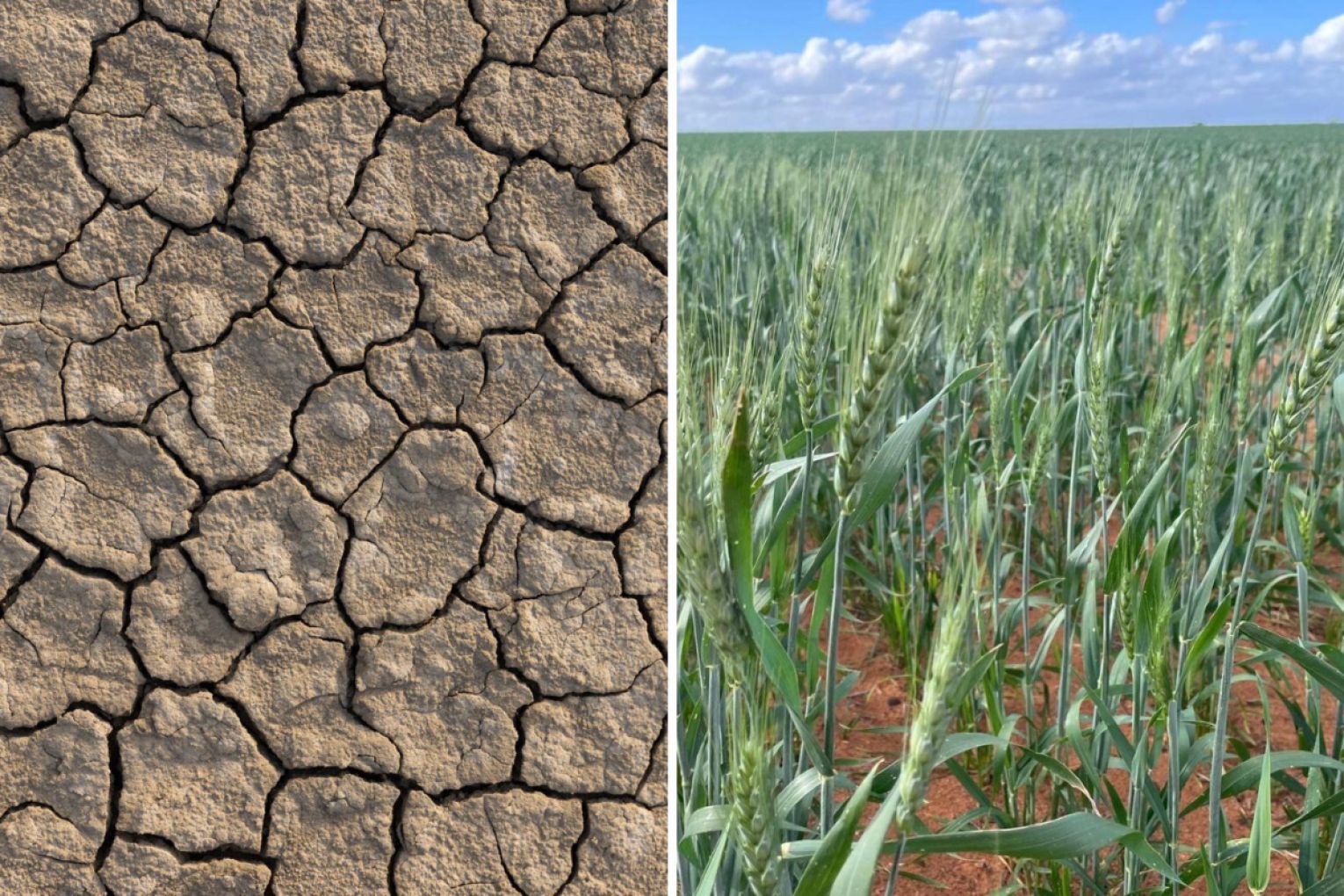
Drought is frequently represented – in how we talk and think about it – by an image of dry, cracked, bare ground, but it can also look like a paddock with a green wheat crop.
I know this, because that is what my family’s farm looked like during drought and, despite the lack of rain, we did manage to grow a decent wheat crop. But just because you may be able to see a green crop in a paddock, it doesn’t mean there is no drought.
Regardless of what you see, when there is drought, the ripple effect is felt by all. It’s felt by every grain grower and their family, every agronomist and their family, every local business and, indeed, the whole community. The effects are also felt by Australians who pay more for food at the supermarket.
The effect of drought does not simply disappear when it rains again, nor does a green crop in a paddock mean a drought has broken. The ongoing effects are felt for many years well after a rain event.
Rainfall: a delicate balance


We know that water is essential for life. We use water from rain to grow the food and fibre that gets put on our table and feeds us every day. But extremes in rainfall have an impact on crop production. Too little rain and crops will often wilt and die. Likewise, too much rain and crops can become waterlogged.
Yet despite these challenges, the Australian Crop Report highlights that we generated 68 million tons of winter crop production in 2025-26, including more than 36 million tons of wheat, 16 million tons of barley and 7.7 million tons of canola.
That didn’t happen by luck. Australian grain growers are innovators. Over many years, they’ve adapted the way they farm to cope with both dry and wet conditions and to make the most of the rain they do receive.
One of the key changes has been leaving more crop residue on the ground and using no-till farming, where new crops are planted without ploughing the soil first. This has helped grain growers stop soil from drying out and blowing away during dry years.
But adapting to variable rainfall is only part of the challenge. Growers are also dealing with higher costs, changing consumer demands, less labour availability in regional areas and the flow-on effects of policy and geopolitical influences on our farming businesses.

As an Associate Professor in Agricultural Science (Agronomy) at Flinders University, I work alongside grain growers and agronomists to develop new and practical innovations that continue to help farming systems better respond to changing rainfall conditions. These innovations range from developing sensors that measure how much moisture is in the soil to adjust sowing depth to help seeds germinate, to understanding soil biology and ways to maintain soil health during dry conditions.
Having been raised on a mixed cropping and livestock property, I’ve seen firsthand how drought affects farmers and the careful daily decisions needed to protect crops and soil. So, next time you see a green wheat crop, don’t assume drought isn’t biting. And remember that, behind the scenes, we are all working hard to keep food production going in both the good and the tough times.
Find out more about Flinders Research That Matters. Changing 10 million lives, here.
Rhiannon Schilling is Associate Professor in Agricultural Science (Agronomy) at Flinders University.
Want to see more stories from InDaily SA in your Google search results?
- Click here to set InDaily SA as a preferred source.
- Tick the box next to "InDaily SA". That's it.