Israeli voters break turnout records in tight election
Israeli voters vote in record numbers as Prime Minister Benjamin Netanyahu unleashes scare tactics.
Source: Benjamin Netanyahu (X)
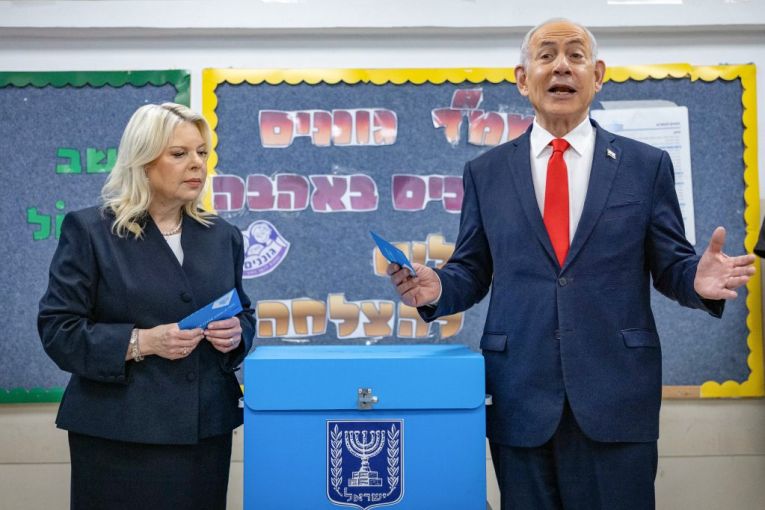
Israeli voters have surged to the polls in record numbers to cast judgment on Prime Minister Benjamin Netanyahu as he unleashed a wave of scare tactics, including warning that Muslims were “stealing” the election.
There were long lines outside voting stations for the first election since the October 7, 2023, Hamas-led attacks, with the polls closing around 7am Wednesday (AEST).
Not only was it a record turnout for an Israeli election, but also the fastest rate on record as voters rushed to the ballot boxes within the first hours of the polls opening.
Israel’s Central Elections Committee reported that 55.7 per cent of the 7.3 million eligible voters had already cast their ballots within the first nine hours, a record by that point in the day with six more hours to go.
In the previous election four years ago, turnout at that point stood at 47.5 per cent.
According to media reports, 70,000 Israelis travelled home from abroad to vote, as most citizens are not permitted to cast their ballots overseas.
The first exit polls on Wednesday morning (AEST) showed Netanyahu’s Likud party as the largest individual party. But neither of Israel’s two political blocs had a majority.
The Kan public broadcaster’s exit poll predicted the anti-Netanyahu bloc, led by Gadi Eisenkot of the rival Yashar party, was projected to win more seats, with 53 out of a possible 120, compared with 50 for the Netanyahu-led bloc, The Times of Israel reported.
Arab-led parties were projected to win 17 seats.
As voting booths opened, Netanyahu posted a barrage of warnings on social media, urging right-wing voters to “get to the polling station”.
You might like


“We’re at war for our home,” he said.
“Muslim Brotherhood supporters are raiding the polling stations and stealing the elections.
“Go out and vote, recover it!!”
Netanyahu also claimed there were huge lines at polling stations in the Arab sector.
“If we don’t wake up now, we’ll find ourselves with a government of Mansour Abbas and Ahmed Tibi [Arab party candidate]. This is the time to wake up and act!” he said.
“The future of our Jewish state is on the line: A strong right-wing government or a left-wing government supported by the Arab parties.”
Netanyahu, Israel’s longest-serving leader with 19 years in office, is an unmatched political survivor.
But the policies of his coalition have been divisive at home and deepened Israel’s international isolation, particularly as the United Nations commission ahead of the election fond Israel has continued to commit genocide in Gaza since last October’s ceasefire.
The UN Independent International Commission of Inquiry also found Israeli forces had committed crimes against humanity and war crimes in the Occupied Palestinian Territory, including extermination, persecution, torture, rape and other forms of sexual violence.
The report, released the day before Israel’s general election, said the country’s forces had targeted Palestinians in Gaza and that the situation in the West Bank had “deteriorated gravely” since the October 7, 2023, Hamas attacks in Israel.
The war in Gaza started after Hamas-led attacks on Israel in 2023, when militants killed 1,200 people and took 251 hostages.
Israel responded with a campaign that has killed more than 74,000 Palestinians and displaced nearly all of Gaza’s population, according to its health ministry.
Last September the UN commission, chaired at the time by 2026 Nobel Peace Prize laureate Navi Pillay, found Israel was committing genocide in Gaza.
Israel’s fragmented system makes it difficult for an array of opponents to force out his coalition of conservative, religious and ultranationalist parties.
Stay informed, daily
His main rival, Eisenkot, is a former military chief of staff. He aims to unseat Netanyahu with the support of parties on the right and centre, as well as the rump of an increasingly marginalised left.
Opinion polls show a close race, with neither leader facing an easy path to power.
Forecasters were hesitant to guess what effect the strong turnout might have on the result.
A surge in votes from Israelis of Palestinian heritage could limit gains for Netanyahu’s coalition while increasing the odds that any government formed to oust him would require Arab parties’ support, a contentious prospect among Jewish party leaders.
If neither Netanyahu nor Eisenkot can form a governing coalition in the 120-seat parliament, Netanyahu could stay on as caretaker until another election is held.
His opponents have managed to wrest him from the premiership only once since 2009, and that took four inconclusive elections in two years.
He was back 18 months later.
For many of Netanyahu’s opponents, the election turns on accountability for the security failures of October 7, Israel’s deadliest day.
Opposition groups have promised to hold an inquiry, which Netanyahu’s government has resisted.
“I am convinced that by the end of today, we will see a change — a new spirit for the state of Israel — that will serve as a rectification for the past three years and for that terrible day,” Eisenkot said during a visit to kibbutz Nir Oz in southern Israel, targeted in the October 7 attacks.
He walked to the polls with Gadi Mozes, one of 251 people kidnapped by Hamas and taken to the Gaza Strip during the attack that killed 1200 people.
Eisenkot says Israel’s response — a war which health authorities say killed more than 74,000 Palestinians — was a failure because Hamas remains in charge.
He repeated his commitment to dismantle or destroy Hamas’ military and governing power in the Gaza Strip within 18 months of forming a government.
Itamar Ben-Gvir, leader of an ultranationalist party in the governing coalition, cast his vote in the Kiryat Arba settlement in the occupied West Bank early on Tuesday.
He predicted Netanyahu would return as prime minister and his own party would serve as the right-wing anchor of the government.
Ahmed Tibi, a candidate from an Arab party, said record turnout from Israel’s Arab minority would “pave the way for an alternative government and change the grave reality”.
Eisenkot has ruled out partnering with Arab parties although some possible scenarios envision him relying on them to prop up a minority government to topple Netanyahu.
About 12,000 polling stations are open across the country, most until 10pm (7am on Wednesday AEDT) when initial projections based on exit polls are expected.
-with AAP/DPA
Want to see more stories from InDaily SA in your Google search results?
- Click here to set InDaily SA as a preferred source.
- Tick the box next to "InDaily SA". That's it.