Ten injured after turbulence hits Brisbane flight to HK
Ten people have been injured after horrifying turbulence aboard a Cathay Pacific flight from Brisbane to Hong Kong.
Ten people have been injured after horrifying turbulence aboard a Cathay Pacific flight from Brisbane to Hong Kong.
Eight people, including two Australians, were taken to hospital after the Airbus A350-900 landed in the Chinese territory on Saturday.
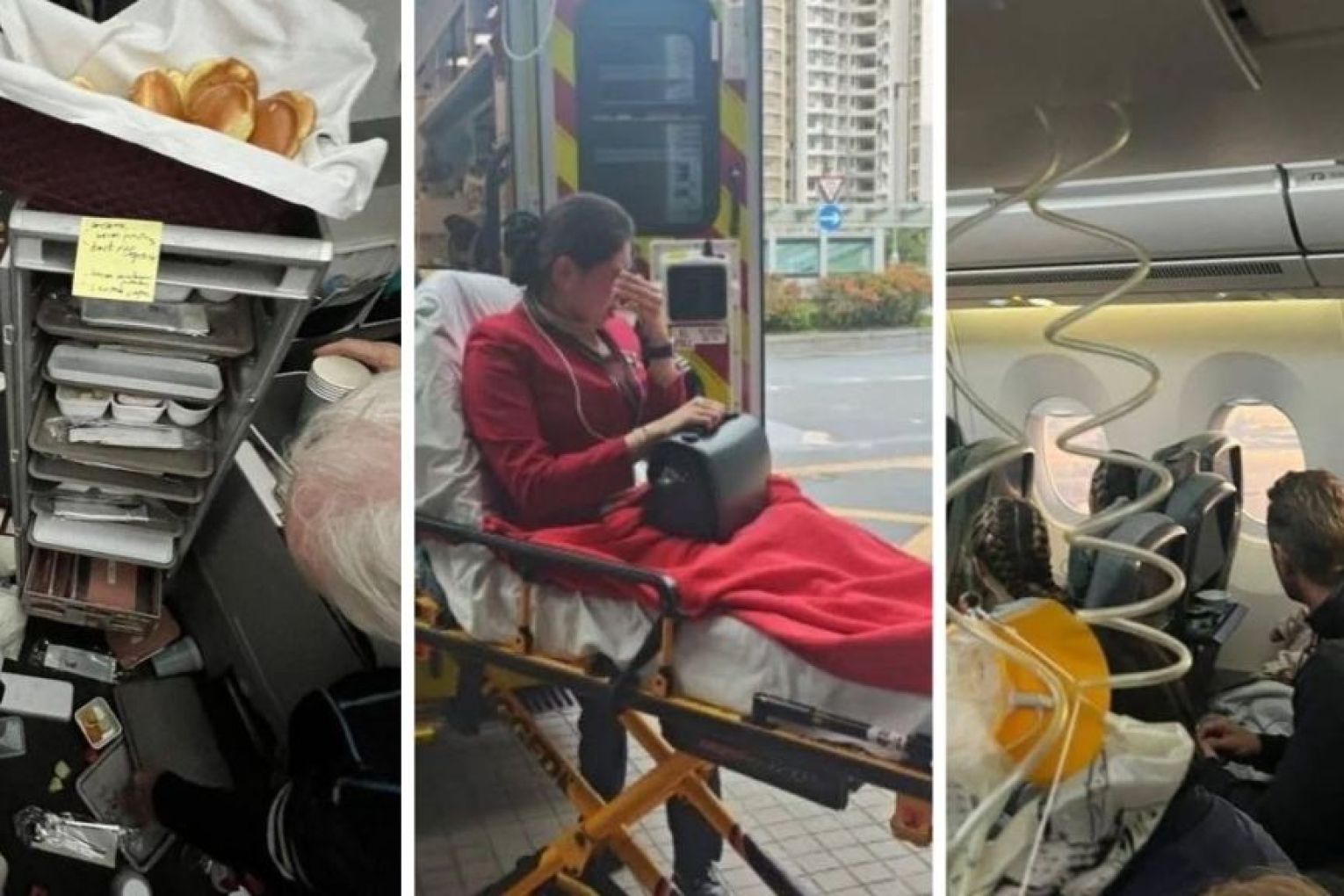
Footage and photographs circulating online and purporting to be from the aftermath of the severe turbulence show food containers, napkins and loose items strewn across the floor of the plane’s cabin floor.
One widely shared image shows an injured flight attendant being assisted on a stretcher while wearing a cervical collar. Another shows a woman crew member wiping her eyes while sitting on an ambulance trolley.
Cathay Pacific has confirmed the incident, in which flight CX15 “encountered turbulence” about two hours before landing in Hong Kong. It came as crew were preparing for a meal service
“The flight arrived in Hong Kong at 6.45 am local time. Medical personnel boarded the aircraft to assess the conditions of a small number of passengers and crew who reported feeling unwell, and they were provided with the utmost level of care,” the airline said.
“Six cabin crew and four passengers reported minor injuries, and eight of them were sent to the hospital for further medical care.”
You might like

It described the injuries to those aboard as “minor”.
One passenger told The South China Morning Post the incident felt like “free-falling from a drop tower” as everyone screamed and items flew through the air.
The passenger said the sudden drop in altitude lasted about two seconds. She said many travellers appeared visibly shaken afterwards, and most stayed in their seats as medical crews worked through the cabin.
Cairns businessman Nicholas Stevenson, who was also among the passengers, said the “plane just dropped”.
“I thought the plane was going down,” he told the ABC.
“There were phones flying, coffees smashed into the roof, food absolutely everywhere.
“People were screaming. There was a lot of people really freaking out.”
Stevenson said the plane plunged twice in quick succession.
Stay informed, daily
“The first one caught everyone completely off guard, and then probably 15 or 20 seconds later it happened again,” he said.
“People who’d just managed to get back into their seats or grab onto something got thrown around again.”
The emergency aboard the Hong Kong flight follows another in May 2024, when a British grandfather died and seven people were critically injured after a Singapore Airlines plane plunged nearly 2000 metres during meal service.
An Adelaide woman on board the fligth suffered a serious spinal injury.
Passengers slammed their heads into the ceiling and overhead compartments when the plane hit severe turbulence about 10 hours into its journey from London to Singapore, forcing the pilot to make an emergency landing in Bangkok, Thailand overnight Tuesday (AEST).
The Boeing 777-300ER jet fell into an air pocket while the cabin crew was serving breakfast before it encountered what was described as “sudden extreme turbulence”.
In July last year, severe turbulence struck a Delta flight from Salt Lake City to Amsterdam, sending service carts and unbelted passengers into the air and forcing an emergency diversion to Minneapolis. In all, 25 people were taken to hospitals.
One passenger described the incident as like being on a 100-metre roller-coaster drop, and said they had completely left their seat.
Experts have previously told The New Daily that while such turbulence is infrequent, it is becoming more common, possibly due to the effects of climate change.
A recent study from the University of Reading in Britain found that hazardous clear air turbulence increased up to 55 per cent from 1979 to 2020. Flight routes over the US, Europe, the Middle East and the South Atlantic also had significant increases in turbulence.
“Following a decade of research showing that climate change will increase clear-air turbulence in the future, we now have evidence suggesting that the increase has already begun,” study co-author Paul Williams, an atmospheric scientist at the University of Reading, said.
“We should be investing in improved turbulence forecasting and detection systems to prevent the rougher air from translating into bumpier flights in the coming decades.”
Researchers believe clear-air turbulence will become even more frequent as climate change grows more intense.
Across the globe, warmer air caused by greenhouse gas emissions increases wind shear in jet streams, which strengthens clear-air turbulence, they said.
Want to see more stories from InDaily SA in your Google search results?
- Click here to set InDaily SA as a preferred source.
- Tick the box next to "InDaily SA". That's it.