How big? SA MP fights boundary change to electorate covering 92 per cent of state
An MP representing SA’s largest electorate is fighting a boundary and name change, saying he already “covers 100,000 kilometres” and gets through “two sets of tyres” every year.
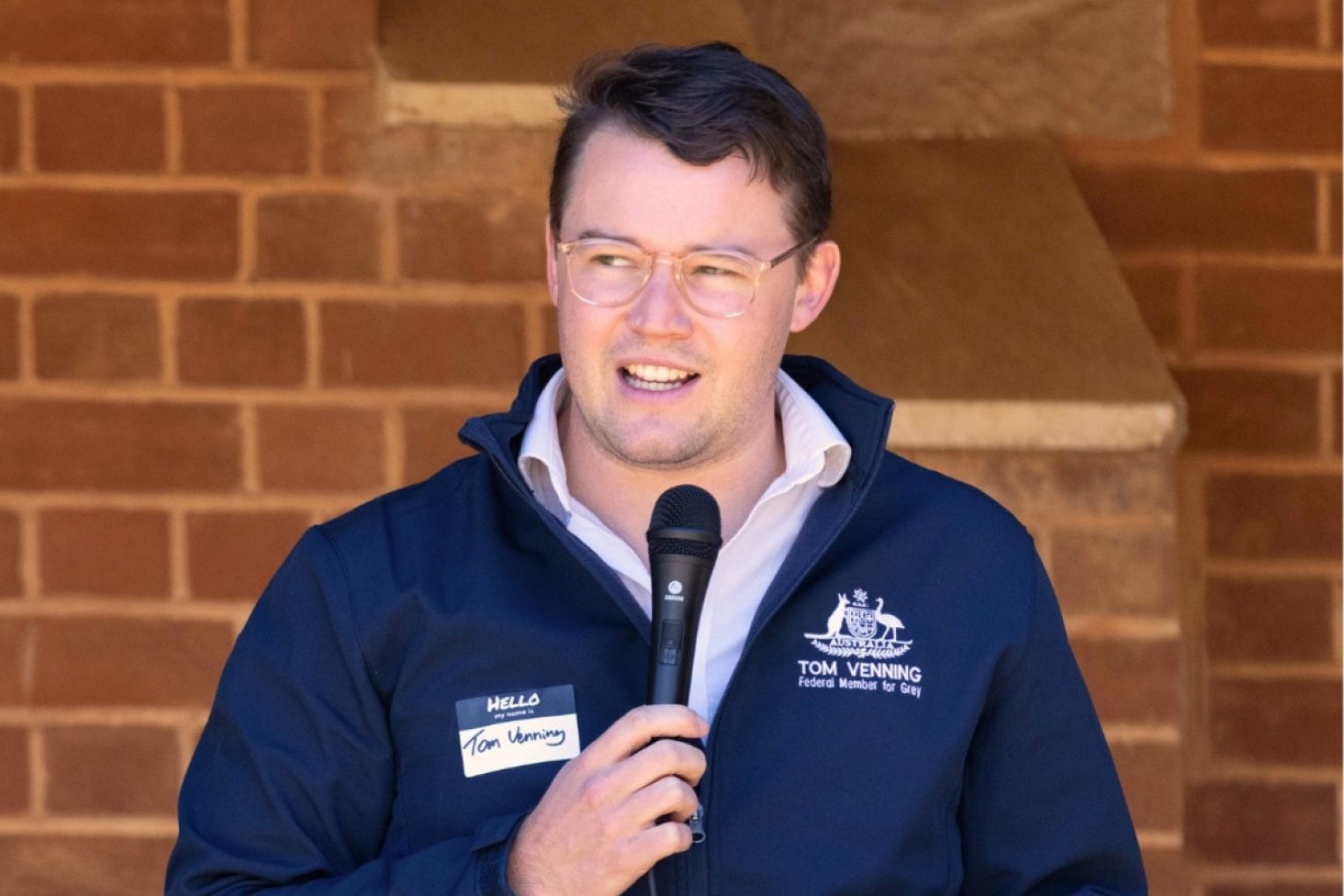
Federal Grey MP Tom Venning has written to the Australian Electoral Commission (AEC) opposing the proposed renaming and redistribution of his electorate that would make it even larger than the existing 92 per cent of the state.
The Liberal MP already spends hours on the road and fears the proposed change will create confusion and make it increasingly difficult for him to represent constituents.
In a submission dated April 17, Venning opposed the expansion of the already 92 per cent of South Australia’s land mass and the renaming of his electorate to O’Donoghue after a renowned Aboriginal leader.
Venning told InDaily that it was a “privilege” to represent Grey, “even if it does mean covering over 100,000 kilometres and going through two sets of tyres” every year.
“I have great respect for both Grey and O’Donoghue, who have both made significant contributions to Grey,” he said.
“However, I am concerned the proposed boundary changes will shift from regional issues by bringing in some of Adelaide’s outer north growth areas.
You might like

“For myself and future representatives of Grey, we represent farmers, fishers, heavy industry hubs, miners and tourism. The demographics do not make sense.”
The electorate of Grey – which is larger than New South Wales and currently covers 904,881 square kilometres – may be renamed O’Donoghue and expanded to include Adelaide’s northern suburbs under proposed changes announced by the AEC in March. It would be increased in size by another 3829 square kilometres.
O’Donoghue, who died in 2024, is a renowned Aboriginal leader whose accolades include being the first Indigenous nurse at the Royal Adelaide Hospital and being integral to negotiations that led to federal native title legislation.
The electorate of Grey was named in 1903 for colonial explorer Sir George Grey, who was governor of South Australia in 1840.
Grey controversially amended the Aboriginal Witnesses Act in 1844 to make unsworn testimony by Indigenous Australians inadmissible in court; however, Venning said Grey was a “product of his time”, with such attitudes common in the 1840s.
In his submission, Venning said that while Dr Lowitja O’Donoghue was “a worthy namesake”, “the name Grey has been in continuous use for over 120 years and is well established”, adding that “the logistical realities of representing Grey cannot be understated”.
Stay informed, daily
“Expanding Grey to include parts of the cities of Salisbury and Playford would exacerbate the already significant logistical task of representing Grey and dilute its focus on regional, rural, and remote communities,” he said.
“The sheer geographical scale of the electorate places demands on the sitting member that do not exist for MPs whose electorates can be traversed in a matter of minutes.
“The proposed expansion of Grey would add a fourth dimension of representing Adelaide’s outer north growth areas, abating the voices of regional, rural and remote South Australians.”
Addressing the proposed name change, Venning wrote it was “not only incongruent with AEC guidelines, which favour stability for Federation electorates, but would also impose unnecessary costs and confusion”.
“The name Grey is well established among the communities it serves and is among the most geographically recognised electorates in Australia, given its scale, profile and enduring history,” he said.
“Renaming the electorate carries unnecessary costs, with signage, stationery and voter communications all requiring updates. It also creates confusion for electors, particularly given the longstanding association of Grey with a significant proportion of South Australia’s land mass.
“The most fitting way to honour Dr O’Donoghue’s legacy with a federal electorate name is to reserve that name for a new electorate when one is created in South Australia.”
The Australian Electoral Commission declined to comment due to the ongoing retribution process.
The AEC’s Redistribution Committee previously recommended the changes, saying the renaming was appropriate due to O’Donoghue’s “strong connection to the APY Lands, which are largely located in the electorate of Grey”.
“The proposal also suggests renaming the electorate of Grey to O’Donoghue, in honour of Dr Lowitja O’Donoghue – a Yankunytjatjara woman who was the first Indigenous nurse at the Royal Adelaide Hospital, and championed health equity and Indigenous rights,” AEC Committee Chair Jeff Pope said.
The AEC is currently consulting on proposed boundary changes for the federal electorates of Barker, Boothby, Kingston, Makin, Mayo and Grey.
Venning was elected to represent Grey at the 2025 federal election, having covered 85,000 kilometres during the election campaign.
He comes from a long political dynasty, with his uncle Ivan Venning having held the state seat of Schubert for 17 years, while his grandfather Howard Venning represented Rocky River from 1968 to 1979.
Want to see more stories from InDaily SA in your Google search results?
- Click here to set InDaily SA as a preferred source.
- Tick the box next to "InDaily SA". That's it.