Ceasefire tested after Israeli strikes cause confusion over Strait closure
A ceasefire between the US, Israel and Iran has been thrown into jeopardy after Israel launched a wave of strikes and Tehran blocked ships’ passage through the Strait of Hormuz.
Source: Fox News
The US has slammed “false” reports that Iran has already closed the Strait of Hormuz in the shaky first 24 hours of a two-week ceasefire.
Iranian state media was reporting that the Strait of Hormuz was considered closed in response to Israel’s latest barrage of deadly strikes in Lebanon.
Israel pounded Lebanon with its biggest attacks yet, killing 254 people according to Beirut.
Lebanon’s Office of the President slammed Israel’s wave of strikes across the country — targeting Hezbollah — as “barbaric” and a “new massacre”.
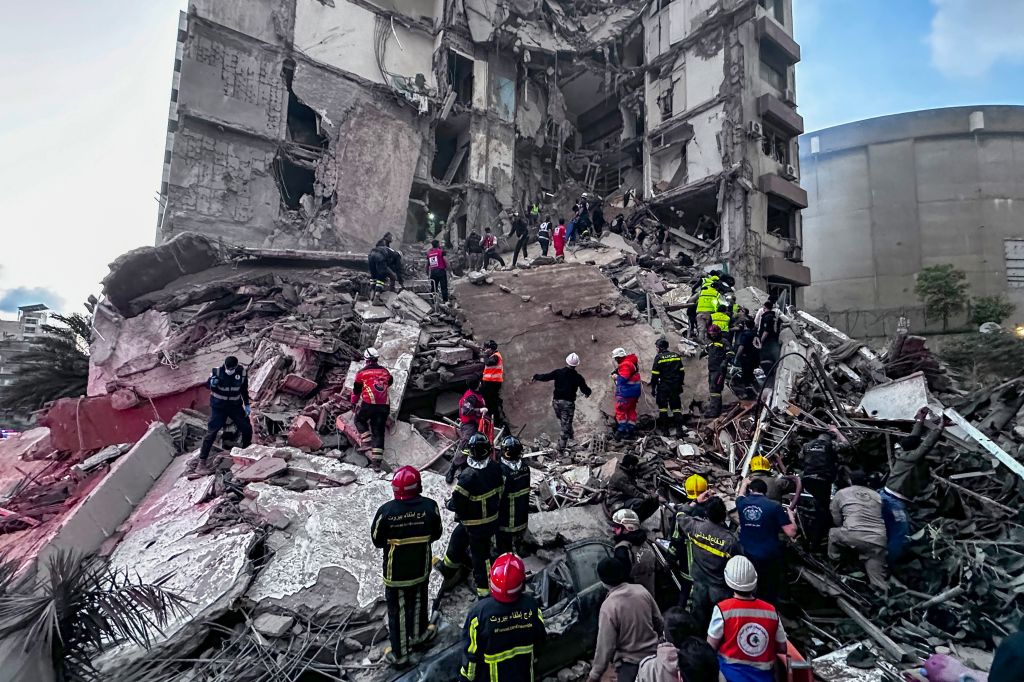
Looking for missing people under the rubble of a residential building in Beirut. Photo: AAP
Israel says Lebanon is not included in the conditional ceasefire agreement to pause fighting, which was struck between the US, Iran and allies at the 11th hour on Wednesday (AEST).
However, Pakistan Prime Minister Shehbaz Sharif, when announcing the deal, said the immediate ceasefire included “Lebanon and elsewhere”.
Australia’s Foreign Minister Penny Wong told ABC’s 7.30 on Wednesday night that the ceasefire should apply to Israel’s action in Lebanon.
You might like


“Our position is that the world expects that the ceasefire should apply to the region.”
While it was uncertain whether the Strait of Hormuz was open or not, White House Press Secretary Karoline Leavitt on Thursday insisted that reports of a closure were false.
She claimed that there had actually been an “uptick in traffic” in the strait. She said it was US President Donald Trump’s expectation that it would be “reopened immediately”.
Meanwhile, Trump will despatch his Iran negotiating team, led by Vice President JD Vance, to Pakistan for the first round of negotiations on Saturday.
World financial markets rose after Trump announced the ceasefire, two hours before a deadline he had set for Iran to open the blockaded Strait of Hormuz or face the destruction of its “whole civilisation”.
But even as Israel and the US paused their attacks on Iran, Israel escalated its parallel war with Iran-aligned Hezbollah in Lebanon, sending huge columns of smoke above Beirut as buildings crumpled.
Israeli Prime Minister Benjamin Netanyahu said the ceasefire did not include Hezbollah and that Israel would “continue to strike them”.
Netanyahu said Israel had achieved many of its objectives in the war with Iran but still had others to accomplish.
He said that those could be reached either through a US–Iran agreement or by resuming the military campaign, stressing that Israel had its “finger on the trigger” and was prepared to return to fighting at “any moment”.
Iran’s Tasnim news agency cited an unnamed source warning that Iran would withdraw from the ceasefire if attacks on Lebanon continue.
Stay informed, daily
Lebanon’s civil defence service said 254 people had been killed in Israel’s strikes across Lebanon.
The highest toll was in the capital Beirut, where Israeli strikes killed 91 people, it said.
Residents said some of the Israeli strikes had come without the usual warnings for civilians to leave.
Despite concerns over the durability of the ceasefire, Brent crude — which had risen by more than 50 per cent since the war began — was down about 14 per cent on the day, at $US95.20 a barrel on Wednesday.
Strait of Hormuz uncertainty
As part of the ceasefire, Iran said it would offer safe passage in co-ordination with its armed forces.
However, its coastguards warned on Wednesday that any ship attempting to sail without permissions would be “targeted and destroyed”.
The first vessel had transited the Strait with Iran’s permission following the ceasefire, state TV said on Wednesday.
The ship’s identity was not immediately clear but MarineTraffic data showed two Greek-owned and one Chinese-owned bulk carriers passing through since early Wednesday.
Iran has previously agreed safe-passage arrangements with several countries, including India and Iraq.
Major shipping companies remained cautious.
Ship tracker Kpler indicated 187 laden tankers carrying 172 million barrels of crude oil and refined products were inside the Gulf as of Tuesday.
The Wall Street Journal newspaper on Wednesday quoted a crew member of a ship as saying that a radio message had stated that authorisation from Iran’s Sepah navy would have to be obtained for a passage.
Without authorisation, the ship would be threatened with being destroyed, he said.
The Sepah navy is the maritime arm of Iran’s Islamic Revolutionary Guard Corps.
-with DPA
-with AAP
Want to see more stories from InDaily SA in your Google search results?
- Click here to set InDaily SA as a preferred source.
- Tick the box next to "InDaily SA". That's it.