Inside the bizarre and disturbing trend of ‘looksmaxxing’
It may sound like a harmless term for making the most of the face you were born with – except extreme followers are offering spurious and sometimes dangerous tips for transformations.
Source: 60 Minutes Australia
Looksmaxxing. It may sound like a harmless term for making the most of the face you were born with – except that some of the most extreme followers of this dangerous trend use hammers to try to reshape their jawlines.
Most looksmaxxers are teenage boys or young men, with the term first emerging more than a decade ago on misogynistic “incel” (involuntarily celibate) forums.
Its popularity has soared more recently thanks to TikTok and other social media forums, where users share tips on how to maximise their looks in terms of perceived masculine ideals – including everything from taking steroids and surgery, to even more bizarre and dangerous practices.
Nonetheless, the first many people will have heard of looksmaxxing is when one of its controversial stars, Clavicular – or “Clav” – made headlines in mainstream media this week.
The 20-year-old was livestreaming at a Miami nightclub on Tuesday night (US time) with fellow looksmaxxer “Androgenic”, an Australian, when he suffered a suspected overdose and had to be taken to hospital.
Clavicular, whose real name is Braden Peters, also went viral earlier in the week when he stormed out of an interview on 60 Minutes Australia.
He took offence when journalist Adam Hegarty asked him if he identified with the incel community, then ended the interview when questioned about why he spent time with controversial figures like “manosphere” influencer and accused rapist Andrew Tate.
You might like

“I see you want to make this political,” he told Hegarty, adding that it was “too bad” he hadn’t had time to find out more about the interviewer and “potentially, you know, who your wife cheated with”.
When Hegarty replied he wasn’t married, Peters bit back with: “So I could teach you about looksmaxxing, and then maybe you could switch that up,” before abruptly ending the interview.
Peters, who has more than a million followers across his various social media platforms, has admitted to taking a range of controlled substances, including testosterone, which he began at the age of 14, and stimulants to suppress his appetite.
On the 60 Minutes program, which also featured interviews with other looksmaxxers as well as medical experts, Peters also spoke about the practice of “bone-smashing”.
“It’s exactly how it sounds – you’re just creating microfractures in specific areas of your face,” he said. “And the idea behind it comes from Wolff’s Law, right, so when you break down a bone it comes back stronger.”
According to a recent article in Psychology Today by Heather Widdows, other looksmaxxing techniques for self-improvement range from “softmaxxing”, such as basic beauty hacks and “mewing”, to “hardmaxxing”, which includes cosmetic surgery.
Mewing, for the uninitiated, involves flattening your tongue against the roof of your mouth to try to define the jawline. “Unfortunately, scientific evidence supporting mewing’s jawline-sculpting claims is as thin as dental floss,” says the American Association of Orthodontists.
Needless to say, bone-smashing is also not recommended.
Stay informed, daily
When it comes to the kind of masculine beauty ideal that looksmaxxers aspire to, Peters considers American actor Matt Bomer is be the gold standard.
“The looksmaxxing community prefers people who look like Mr Bomer: lantern-jawed, symmetrical, white,” said a recent profile of Clavicular in the New York Times.
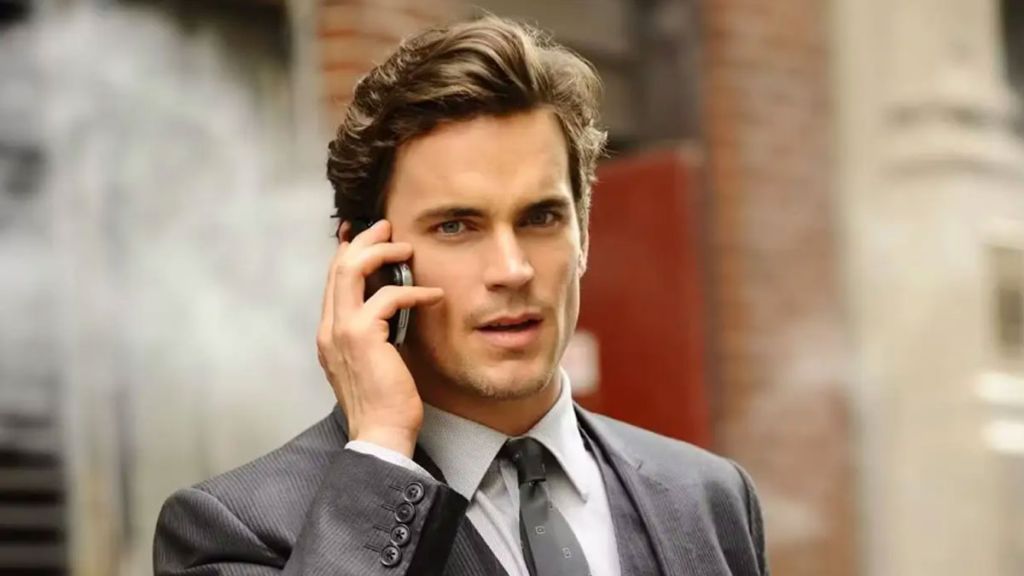
Actor Matt Bomer in the TV series White Collar. Photo: USA Network
Looksmaxxers use a pseudoscientific rating system dubbed the PSL scale to assess a man’s attractiveness to women, with features such as jawline and and physique considered particularly important.
A GQ article based on an interview with a looksmaxxing website moderator explains that the PSL scale rating is based on four criteria.
“They are ‘harmony’, or how well your features work together; ‘dimorphism’, how distinct you look from the opposite sex; ‘angularity’, how sharp you look, correlating to low body fat; and ‘miscellaneous features’ – your individual features taken alone, namely eyebrow thickness, skin clarity, nasolabial folds, colour, contrast, nose shape, teeth, and more.”
Discussing the PSL scale this month on The Conversation Weekly podcast, Jordan Foster, an associate professor of sociology in Canada, said it emerged from discussions on three now-defunct incel forums about what features constitute attractiveness.
“So there might be notions, for example, that a strong brow bone or a stronger jawline is going to communicate a certain amount of testosterone and that this is going to suggest something about your virility or your fitness,” Foster said.
Young men seeking to “ascend” – a looksmaxxer term for improving their attractiveness – will find myriad forums, apps and websites offering spurious and sometimes dangerous tips for transformation.
Widdows believes the rising popularity of looksmaxxing is concerning not only because of its “misogynistic underpinnings”, but also because it shows how male beauty ideals are becoming “more defined and demanding”.
“Young men aspiring to these ideals believe they must be muscular, tall, and chiselled. Importantly, how well they measure up can be supposedly measured through attractiveness scales, jawline angles, and ratios between features,” she said.
Meanwhile, although Peters took offence at being questioned about looksmaxxing’s manosphere links, the New York Times profile claimed young men of the “very online right” have claimed him as their own.
It also gave further disturbing insight into his views and behaviour, including chanting the lyrics to Kanye’s West’s Heil Hitler, and sharing videos of himself “mercilessly appraising women’s looks” and “mogging” (showing up) men he considers look inferior.
Just a day after being hospitalised, the looksmaxxing figurehead was back on X, sharing a fresh photo and update. He described the experience as “brutal” – but was seemingly most disturbed by the marks left on his face by the life support mask.
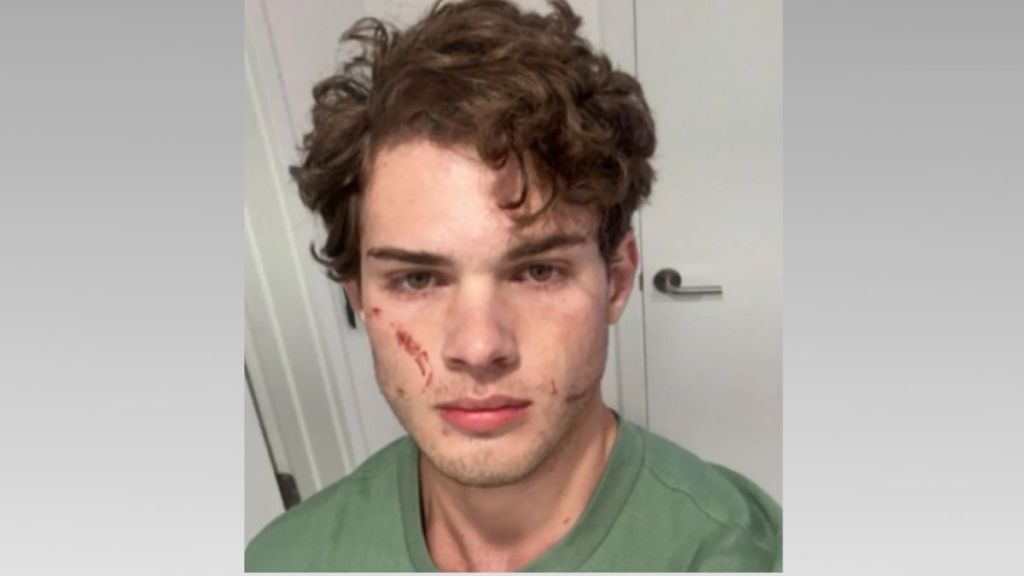
Braden Peters, AKA Clavicular, shared a photo of himself after being released from hospital. Photo: X
Want to see more stories from InDaily SA in your Google search results?
- Click here to set InDaily SA as a preferred source.
- Tick the box next to "InDaily SA". That's it.