SA landscape changes forever in hundred-million-dollar loss to economy
Shock new reporting on the most recent SA wine grape harvest is standing out for all the wrong reasons with data crushing a 25-year record.
The total reported wine grape crush in the 2026 South Australian vintage was the smallest reported crush in the state since 2000.
New data from Wine Australia found the 2026 vintage was 17 per cent below last year’s total tonnes crushed, down more than 100,000 tonnes to 573,252 tonnes.
And there were 1440 hectares of vines less than the same time last year in South Australia, as growers rip up plantings as they try to save their industry by correcting an oversupply of grapes in the market that’s depressing prices across the board, particularly for red varietals.
SA still contributes 52 per cent of total Australian grapes into the market but its estimated value of the last crush was $403 million, down 24 per cent from $531 million.
This reflects the decreased crush size combined with a 5 per cent decrease in the overall value of grapes, which fell from $700 per tonne in 2025 to $668 per tonne.
“It’s still very challenging for grape growers and winemakers across all regions to make the right decisions on what’s been grown, where it’s been grown, what wine we’re making it into, and what our target market wants,” Angove Wines joint managing director Richard Angove said.
You might like

He said that over the past decade Angove had torn up half of its vines; a “big decision”.
“It’s such a long-term commitment to plant a vineyard,” Angove said.
“It’s 10 years before you get a nice 10-year-old vine that’s producing really good premium wines.”
Despite the gloomy figures, he was remaing positive about the quality of his latest vintage saying it was “fantastic”, even if the size of the vintage was much smaller than usual.
Angove said the cool and mild weather in February and March delivered fresh whites and a “fantastic” colour for his reds.
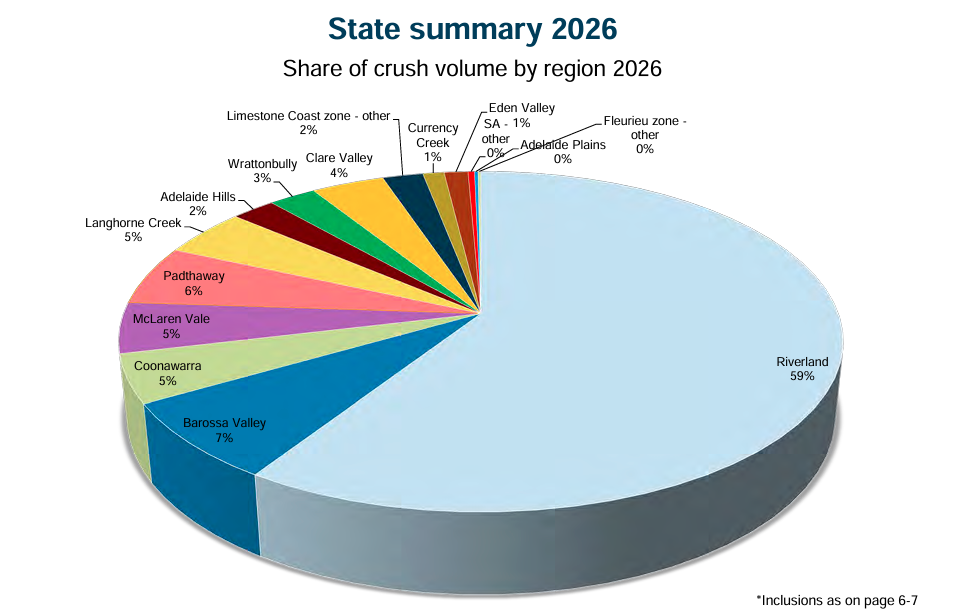
Angove grows grapes in both McLaren Vale and the Riverland wine regions, the latter seeing its smallest reported crush since 2010 and down 16 per cent year-on-year to 339,195 tonnes.
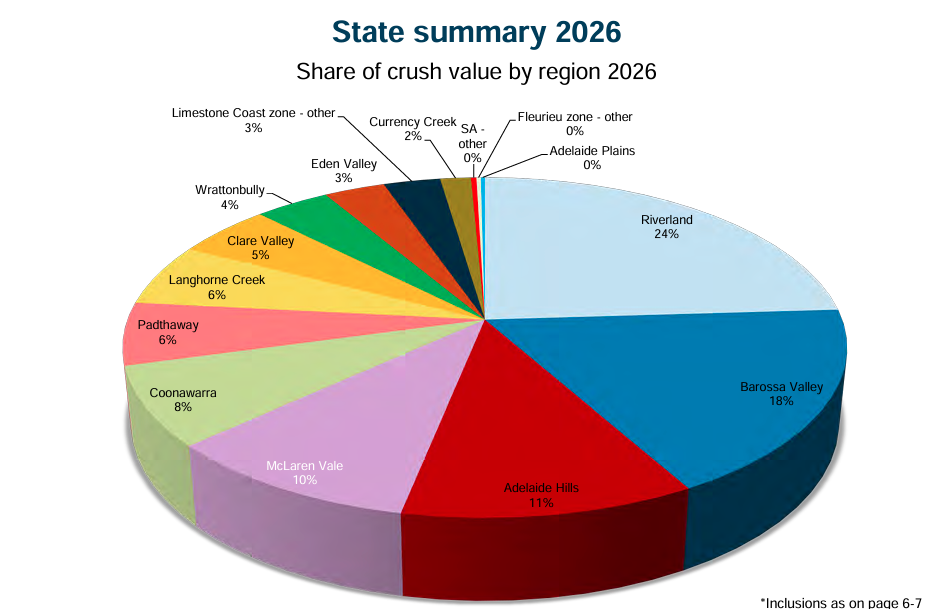
Data shows devastating results for Riverland growers in particular as they feed 59 per cent of grapes into the system that only make 24 per cent of the total value.
Stay informed, daily
But it only made up 24 per cent of the total crush value by region; the Barossa Valley was close behind on 18 per cent while the Adelaide Hills was in third at 11 per cent.
Angove told InDaily he “actually hoped that it may have been a smaller vintage than what it actually was”.
“The supply-demand equation is still not optimal,” he said.
The South Australian crush data was consistent with national figures showing the 2026 wine grape crush fell 300,000 tonnes to 1.27 million tonnes – also the nation’s smallest since 2000.
Wine Australia manager, market insights, Peter Bailey said the main driver of the lower crush was “a deliberate adjustment in response to changing market conditions”.
“There have now been four vintages in a row below the long-term average, suggesting an underlying reset in the tonnage of grapes required by winemakers to meet changing global demand,” he said.
White varietals’ share of the crush increased, with red varieties accounting for 80 per cent of the national decrease.
Whites were the majority of the crush for the second time in the past 12 years, the Wine Australia data showed.
Bailey said this was a reflection of changing consumer preferences towards white wine.
“Globally, red wine has declined at twice the rate of white wine since 2017 and is now nearly 450 million cases lower than it was in that year,” Bailey said.
“The flow-on effect is that demand for red grapes in Australia has reduced by more than for whites.”
Want to see more stories from InDaily SA in your Google search results?
- Click here to set InDaily SA as a preferred source.
- Tick the box next to "InDaily SA". That's it.