Grievance politics is easy. Dignity is trickier – and, all too often, missing
Unlike traditional politics, which revolves around political parties, grievance politics relies on the power of personality, writes Amy Remeikis.

At the centre of most political grievance is a demand for dignity. This is easily exploited; it is easy, and, in this climate, fruitful, to claim that whatever indignity you are facing – economic pressure, the inability to get ahead, housing insecurity, education gap, disconnect from community – is because someone else is receiving more than you.
The British political theorist, Bernard Crick, defined traditional politics as “the activity by which differing interests within a given unit of rule are conciliated by giving them a share in power in proportion to their importance to the welfare and survival of the whole community”, offering up politics as a “solution to the problem of order which chooses conciliation rather than violence or coercion”.
But grievance politics revolves around the opposite. It relies on people choosing violence, be that social, cultural or physical in service of their own individual needs.
It is fuelled and flamed by politicians deliberately fanning the licks of fear and anger they know exist and exploiting them for political gain. And through that anger and fear, they grow their own personal political movement. Facts don’t matter here, only feelings.
Nigel Farage promised an unstoppable Britain with Brexit. But, now, with most of the country admitting the Europe exit was a failure and has caused long-term harm to the nation and its people, Farage – one of the architects of the mess – is enjoying a resurgence as the man to fix the problems he created. It doesn’t matter that he has no answers – he has fingers and he knows how to point them.
Grievance politics is lucrative for those who know how to funnel anger. There is a reason one of the highest-paid TV personalities in Australia is pivoting to platforming Australia’s leading grievance politicians in a private podcast and YouTube stream.
Karl Stefanovic lives a life of wealth and privilege 90 per cent of Australians will never achieve and is long-term friends with billionaire James Packer, which makes him the perfect media poster boy to spearhead Australia’s embrace of grievance politics. Unlike traditional politics, which revolves around political parties, grievance politics relies on the power of personality.
You might like


It’s the same for media, something the avaricious Stefanovic understands well. By and large, people believe the story you tell them and if you’re telling them they are right to be angry, well, you don’t need much else.
We are taught to look at grievance politics through the eyes of the right. These (mostly) white people have “legitimate grievances” we are repeatedly told, which we need to “take seriously”.
Progressive grievances of not addressing issues like the climate crisis, systemic racism and inequality are “woke” and to be treated, at best, as the ignorant rantings of the young and elite. These concerns are not to be taken seriously.
Take the recent Greens victory in Britain’s Gorton and Denton byelection. This was supposed to be part of Reform’s unstoppable march to government. As polls edged closer, the Greens looked like having a slight edge over the governing Labour Party, which had held the seat for close to 100 years. In the end, Reform came in second, Labour third and the Tories a distant fourth. The Greens didn’t just flop over the line, they built on their 2024 result by 28 points – they romped it in.
Hannah Spencer, who won the seat for the Greens, is a local plumber. Afterward, she addressed why she believed she won. The first two sentences similar to what Reform, or in Australia, One Nation would run. The third, giving a reason and a solution that wasn’t punching down on the vulnerable is where the rhetoric, and the grievance, shifts.
“Working hard used to get you something. It got you a house, a nice life, holidays, it got you somewhere. But now working hard, what does that get you? Because talk to anyone here and they will tell you, the people work hard but can’t put food on the table, can’t get their kids school uniforms, can’t put their heating on, can’t live off the pension they worked hard to save for, can’t even begin to dream about ever having a holiday, ever.
“Because life has changed. Instead of working for a nice life, we’re working to line the pockets of billionaires. We are being bled dry.”
Both UK Labour and the last-place Conservatives dismissed the victory. The upset also received little coverage in Australia, although we could all guess what would have happened if Reform pulled it off.
Stay informed, daily
In the latest British YouGov nationwide poll, the Greens sit within the margin of error behind Reform, ahead of Labour.
This is worth noting, because both of Australia’s major political parties have proved they remain stuck in the past, playing politics as if nothing, let alone the world, has changed remarkably in the just the past couple of years.
The leaked Liberal election review contains lecturing tones about voters falling victim to “scare” campaigns around the climate and nuclear, as if voters, particularly young voters, are incapable of actually seeing through bullshit.
The Coalition’s first parliamentary week with Angus Taylor at the helm included: A poorly workshopped gotcha moment with Saturday Paper journalist Jason Koutsoukis (a former Labor adviser) whose reasonable question around why another country should take care of Australian citizens trapped in Syria and “why are they another’s country’s responsibility and not ours” was greeted with “are you an activist or a journalist?”, a warbling shadow treasurer making basic mistakes over excise, a cost-of-living crisis press conference held in one of Canberra’s richest suburbs and a complete lack of strategy on how to offer voters in the 21st century something other than Half-off Howard and Cut-price Costello from the last century.
Not that Labor shows any more inclination for governing for this new world and new politics. We had the slavish devotion to an illegal war without any guidance on they whys or hows, a deference to how the US and Israel use Australian troops, a public (at least) refusal to see that the US’s shock and awe approach is a 20th-century tactic being fought in this new world, and little wriggle room for Australia to stand independent of imperialist powers making catastrophic decisions.
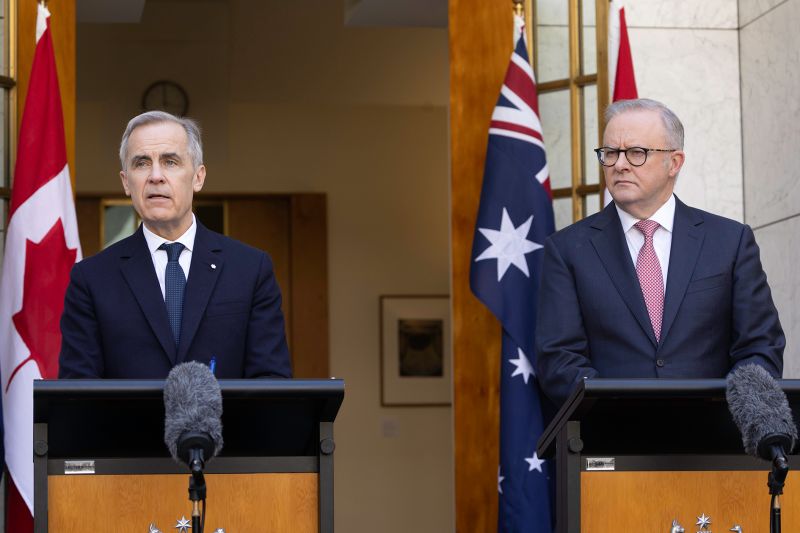
Canadian PM Mark Carney addressed the Australian Parliament this week. Photo: Mike Bowers
All this while the Canadian prime minister stood in the parliament and pleaded with Australia’s leaders to recognise the old world order (if it ever existed) was gone.
The politics of grievance is timeless – and fairly predictable.
Australia’s political establishment is responding as if the old world still exists, and ignoring shifts in voters who are moving on. There is no dignity in trying to maintain a world or politics that no longer exists.
Trying to pretend business as usual – domestically or internationally – will do anything other than create a larger vacuum for grievances to fill, is foolish at best.
Australians deserve dignity. Some dignified leadership that responds to the world as it is, not as it was or pretended to be, might help them find it.
Amy Remeikis is a contributing editor for The New Daily and chief political analyst for The Australia Institute
Want to see more stories from InDaily SA in your Google search results?
- Click here to set InDaily SA as a preferred source.
- Tick the box next to "InDaily SA". That's it.