Adelaide at crossroad over 38-storey ‘tower of regret’
Opinion: Festival Tower Two is deemed “under construction” despite there being no final development approval and intense opposition from a high-profile group, including a former Premier. Heritage expert Elizabeth Vines warns that Adelaide stands at a defining moment for the city’s civic heart.
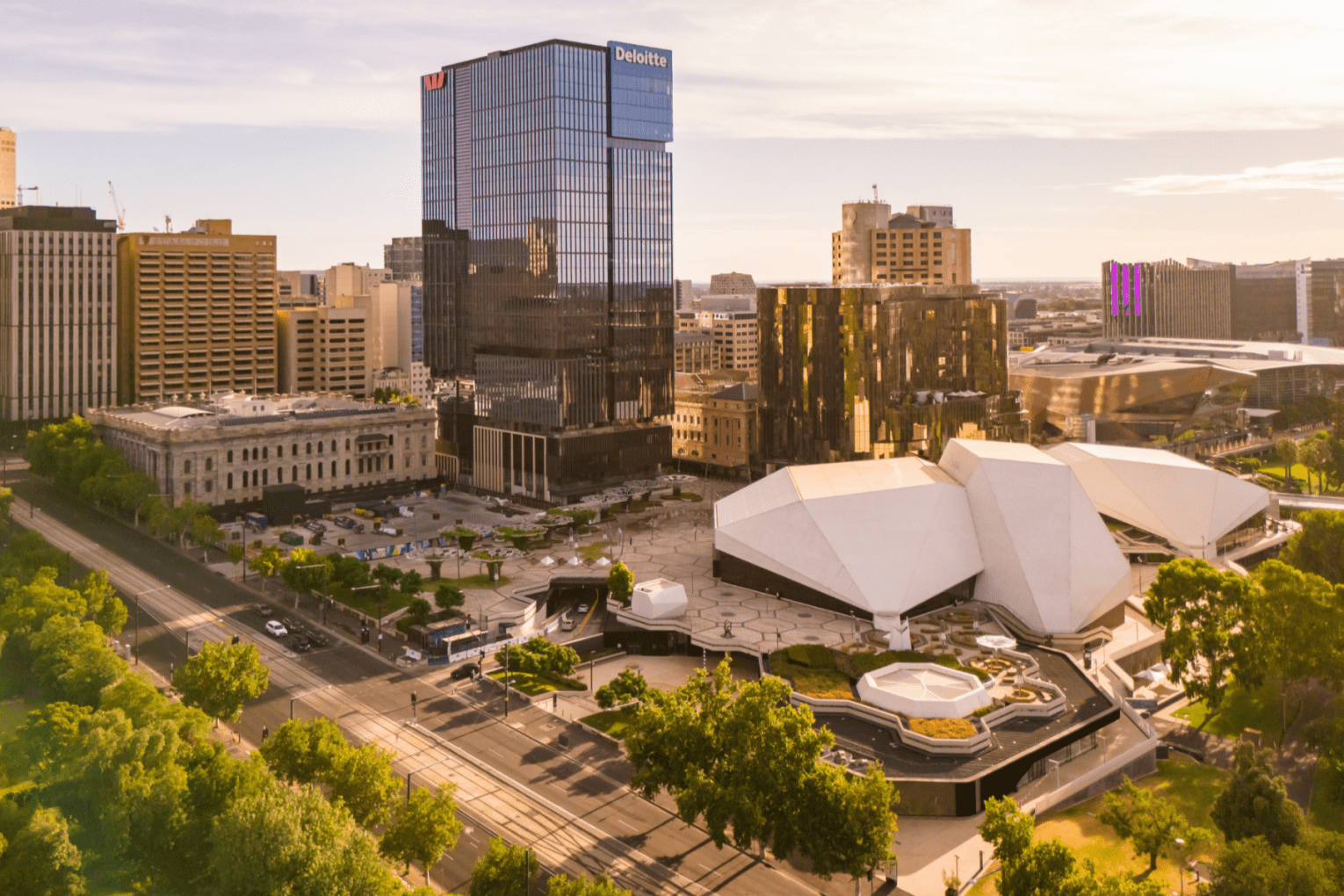
Adelaide stands at a defining moment. Cities rarely lose their character overnight; they erode through a series of decisions that gradually reshape the places people cherish.
The proposed 38‑storey Walker Corporation tower at Festival Plaza is one such decision—one that will determine the future of Adelaide’s civic heart for generations. This is not a debate about architectural taste or height. It is a question of public land, democratic integrity, heritage protection, and the long‑term liveability of a city whose identity is rooted in Colonel Light’s visionary plan.
A public asset handed over for $1 a year

Few facts have shocked our community more than the revelation that Festival Plaza—public land at the symbolic centre of Adelaide’s civic life—has been leased to Walker Corporation for one dollar per year. The Registrar‑General’s records confirm a lease granted in 2018 under the former Liberal government, running until 2085, and then extended by the current Labour government in 2022 to 2116. This means a private developer now controls a prime civic space for nearly a century at negligible cost.
This is not a standard commercial arrangement. It is an extraordinary transfer of public value into private hands. Other developers must purchase or lease land at market rates. Why is this publicly owned plaza – abutting Parliament House, adjacent to the Festival Centre, and National Heritage‑listed Adelaide Park Lands – being effectively given away?
No government has yet provided a credible justification. And it is the Malinauskas government, elected in March 2022, that changed the proposed three-storey building to a 38-storey high rise on public land, via a flawed planning process and the lease for an additional 30 years.
You might like


A tower in the wrong place
Festival Plaza is not an empty development site. It is part of Colonel Light’s original city layout, a civic forecourt to Old and New Parliament House, and a key component of the nationally recognised Adelaide Park Lands and City Layout. It is a place of democratic symbolism, cultural memory, and public gathering.
Placing a 160‑metre commercial tower on this site is incompatible with its heritage significance. The proposed building will sit just 8.7 metres from Parliament House, overshadowing a landmark central to South Australia’s democratic history—including the pioneering achievement of women’s suffrage in 1894. It will dominate views from the Park Lands, alter the scale of North Terrace, and permanently change the character of a space intended for public use and cultural life.
The argument that Adelaide “needs” more office space is unpersuasive – CBD vacancy rates are at around 20 per cent. Adding another 55,000 square metres of commercial floorspace is not a response to demand. It is a speculative development placed in the wrong location.
A planning process that failed the public
Perhaps the most troubling aspect is the process that enabled the development. The Festival Plaza Code Amendment—responsible for increasing allowable height from three storeys to 38—was not publicly advertised in accordance with the government’s own Community Engagement Charter. A draft media release was prepared but never issued. Only 87 submissions were received, and 71 per cent opposed the change. The Kaurna Yerta Aboriginal Corporation received only a letter, and no meeting was held.
Despite this, the Planning Minister deemed the change “not significant” and resolved not to seek advice from the State Planning Commission. Exceptional powers were used to give legal force to the draft amendment from the day consultation opened, not after it closed — evidently to facilitate the advancement of the commercial tower.
When the State Commission Assessment Panel (SCAP) approved the development on June 11, 2025, it was not subject to public notification. Heritage reports failed to reference the National Heritage listing of Parliament House. The Australian Heritage Council wrote to the Planning Commission the day before the meeting, highlighting federal obligations under the EPBC Act. The letter was not tabled. This is not how planning process in a democratic society should function – and appears to have been structured to facilitate a predetermined outcome.
Stay informed, daily
A community that has spoken clearly
Adelaide residents have mobilised in a way rarely seen. Two rallies on the steps of Parliament House, Saturday’s rally (attended by nearly 300 people in pouring rain!), hundreds of letters to state and federal politicians, a full‑page open letter in The Advertiser with more than 650 signatories, and sustained advocacy from the Save Festival Plaza group all demonstrate widespread concern.
Former Premier Lynn Arnold has warned of a “tower of regret.” The Greens moved a motion to halt the development in Parliament in June 2025.
Yet the project continues, with excavation and car‑park expansion already underway and the tower building deemed “under construction” (announced on February 14, 2026), despite there being no complete and final development approval in place.
A better path forward
There is no shortage of alternative sites for equivalent high‑rise development. Government‑owned land at Victoria Square—already in need of renewal—could accommodate a landmark tower in the central area where new high-rise should be located – without compromising Adelaide’s cultural core.
It could also incorporate much‑needed residential development. Instead, the government appears committed to placing a commercial tower on the most symbolically important civic space in the state.
Adelaide’s identity has always been tied to its Park Lands, its democratic institutions, and its human‑scaled city centre. Once these are compromised, they cannot be restored. The question now is whether the government will listen to the community it serves and protect the city’s cultural core—or whether Festival Plaza will become a case study in how cities lose the very qualities that make them unique.
Adelaide deserves better.
Click here for more stories about controversial Adelaide Park Lands Developments
Elizabeth Vines OAM is a conservation architect, partner at McDougall and Vines, Conservation and Heritage Consultants, a former Adjunct Professor at Deakin University, Melbourne, former visiting Professor at the University of Hong Kong, former member of the Australian Heritage Council, an SA Presidents Medal Institute of Architects winner, and member of the Save Festival Plaza Group.
Want to see more stories from InDaily SA in your Google search results?
- Click here to set InDaily SA as a preferred source.
- Tick the box next to "InDaily SA". That's it.