SA advocates call on Canberra to solve ‘invisible crisis’
Terminal patients with three months to live face a 12-month wait for aged care funding, one advocate claims. She hopes their stories will convince Canberra ministers to make a change.

While hundreds of older South Australians are “stranded” in hospital waiting for aged care beds, one advocate claims thousands more can’t get help – including terminal patients with three months to live and a 12-month funding wait.
Council of the Ageing (COTA) CEO Miranda Starke told InDaily she was aware of “a very large number” of older South Australians with high needs who face a “standard” 12-month wait time to access support at home, causing an ‘invisible crisis’.
Starke said COTA’s care team advocated for an older person with a brain tumour who faced a 12-month wait for care, despite being given three months to live.
She said a team of oncologists and palliative care workers appealed the wait time and it was reassessed, but it still took about six weeks.
“When someone only has three months to live, six weeks without the appropriate support feels like an eternity,” Starke said.
“That person in particular has since died, and what we have heard from their spouse, their widow, is the terrible stress that they experienced and that their family experienced in their final weeks.”
She claimed another couple in their 90s were also facing a 12-month wait. In that situation, the wife was caring for her husband with dementia, and “she needs daily medication management”.
You might like


“That means that unless someone helps her to take her medication, she won’t take it, and that is going to have flow-on effects, including to the care of her husband,” Starke said.
Starke said she would present stories like the above to Federal Aged Care Minister Sam Rae in Canberra on Tuesday.
She was expected to join 12 other aged care and health professionals, including ambulance workers, advocates, unions and industry leaders led by SA Health Minister Blair Boyer to meet with Rae and federal health minister Mark Butler tomorrow.
The meeting was set after SA held crisis talks earlier this month over new aged care projections, prompted by the state government’s calls for the federal government to intervene in aged care funding.
Rae was unable to attend the talks, with the state government leaving an empty chair and place card for him and telling the media that Rae’s urgent intervention was needed. Rae said he could not attend due to a scheduling conflict, and was given four days’ notice.
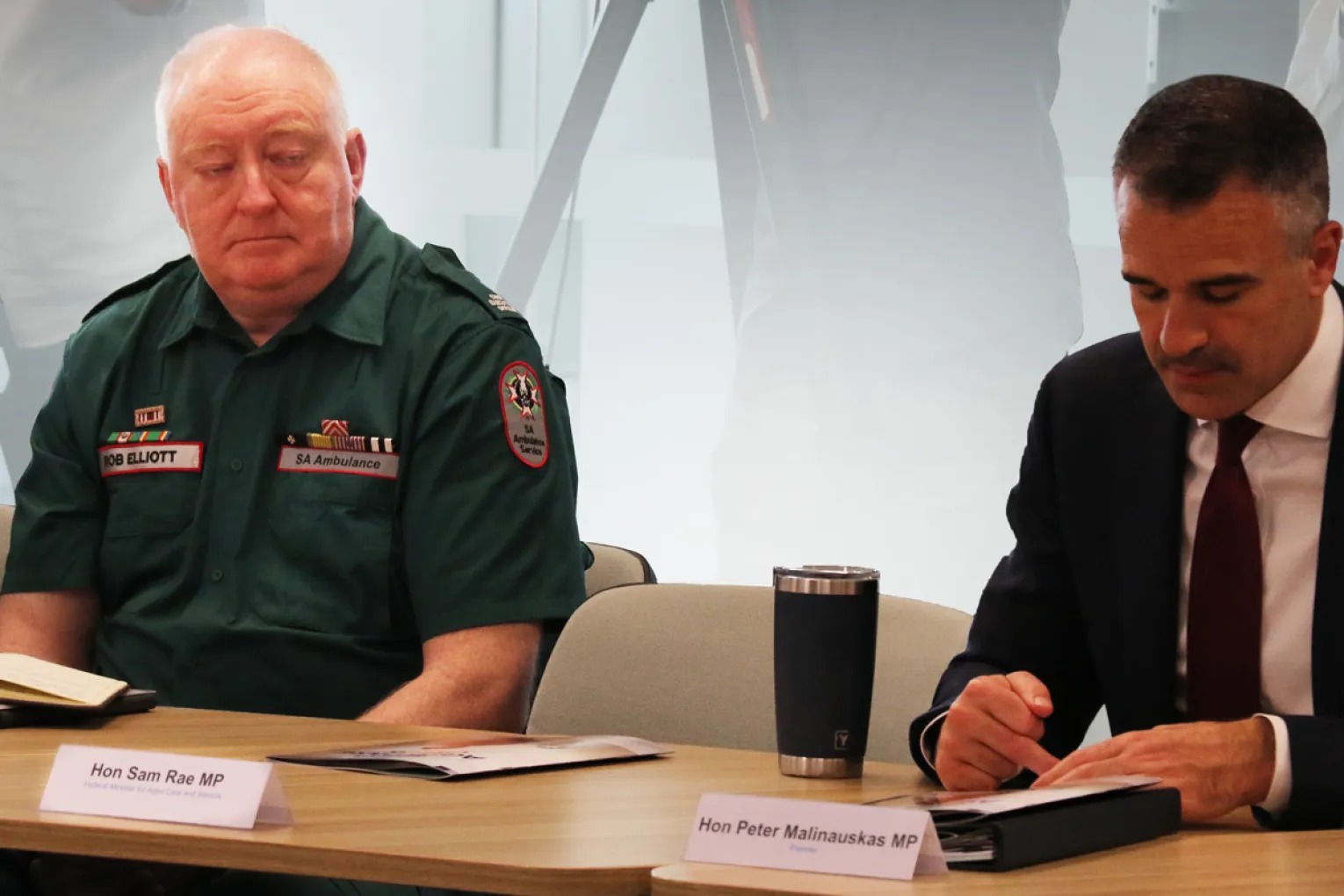
Starke said that when she had spoken with Minister Boyer and South Australian stakeholders about these cases in the past, “everyone is shocked and stressed at those stories, and they should be”.
“Everyone should be, and I’m hoping that it’s the stories of real people and the pressure and the stress that they’re under because of systems that aren’t working…that the [federal government] will hear those stories and understand that something needs to change.
Stay informed, daily
“One of the key points I’ll be making in Canberra tomorrow is that the federal government cannot instantly create new aged care facilities overnight. We know that it takes four or five years to do that, or more.
“But what they can do really, really quickly is provide funding for people to start getting support at home services. They can do that instantly.”
Aged Care Rights Advocacy Service CEO Anna Barton, who is also a part of the delegation to Canberra, agreed that “early intervention is a non-negotiable” to “slow the flow” of patients to SA hospitals.
“We need a system where patients in hospital are prioritised, the aged care services and home modifications are expedited, and that it happens very early on in when they’re admitted,” Barton said.
“Most people going into hospital are going from their home into hospital and then determine that they can’t retain return safely at home because they don’t have the systems and support.”
SA Health Minister Blair Boyer said the state government had “invested hundreds of millions of dollars to manage the consequences of aged care shortages, but the only lasting solution is for the Federal Government to significantly increase aged care capacity”.
“The people travelling to Canberra see the impact every day. They see older South Australians remaining in hospital unnecessarily, families waiting for support and health services under pressure,” Boyer said.
“Together, we will be making the strongest possible case for more aged care beds, more home care packages and more transition care places.”
Barton said there was a crucial need for both state and federal governments “to work collectively for older people, because we need to take the pressure of our health system”.
“At the moment, we see a division with the federal and state governments, hence the delegation over there,” she said.
She said she would “love to see both governments working collectively… for older people, because we need to take the pressure off our health system.”
Want to see more stories from InDaily SA in your Google search results?
- Click here to set InDaily SA as a preferred source.
- Tick the box next to "InDaily SA". That's it.