More Red Sea chaos amplifies global oil risk
Disruptions in the Red Sea are continuing as Washington accuses Tehran of not taking peace talks seriously, and President Donald Trump reiterates threats.
Source: The White House
Four more tankers have changed course in the Red Sea after Iran-aligned Houthis in Yemen threatened the southern route out, highlighting a new risk to global oil supplies from the intensifying war between the US and Iran.
US Secretary of State Marco Rubio said Iran was not serious about peace talks.
Pakistan, which has been mediating, condemned the disruption to a second critical energy route.
Both Rubio and Pakistan said they still backed the idea of negotiations.
Meanwhile, US President Donald Trump has threatened on social media to destroy a bridge or power plant in Iran any time it shoots at a ship in the Strait of Hormuz.
The threat comes as the bodies of four American service members killed during the Iran war have returned to the US, watched by Trump and their families.
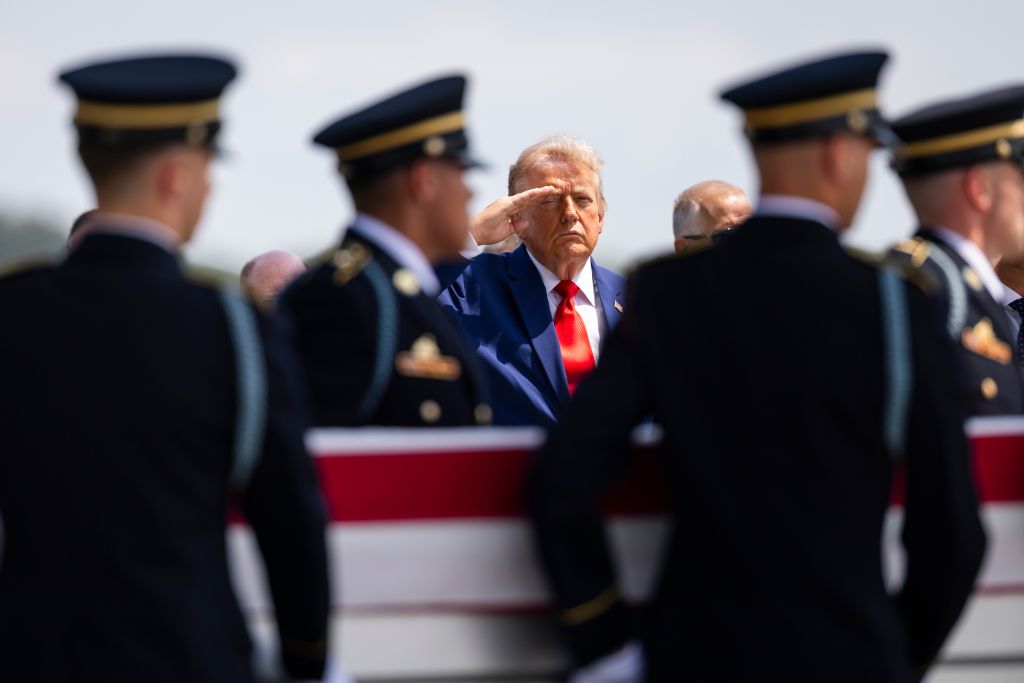
US President Donald Trump and Defence Secretary Pete salute at the body transfer. Photo: AAP
The Houthis’ threat on Tuesday to Saudi oil shipments heading south to the Bab el-Mandeb Strait past areas of the coast they control comes on top of Iran’s near-total blockade of the Strait of Hormuz in the Gulf.
You might like

Oil prices rose to a near six-week highs.
An Iranian health ministry official said 53 civilians had been killed and 592 wounded this month. The US says it never targets civilians.
Iran had strengthened its military in anticipation that its adversaries would break agreements, Army Commander-in-Chief Major General Amir Hatami said.
Iranian media also cited parliamentary National Security and Foreign Policy Committee spokesperson Hasan Qashqavi as saying Trump was in a “quagmire”.
One route left
Millions of barrels of Saudi oil a day have been heading to Saudi Arabia’s Red Sea port of Yanbu to avoid the Strait of Hormuz.
If shipments cannot pass through the Red Sea’s southern Bab el-Mandeb Strait, they have only the northern route out via the Suez Canal. It adds weeks to the journey.
Iran has hit vital water desalination and energy plants in Kuwait and says it has targeted US military assets there and in Bahrain and Jordan.
Rubio said the US would protect its interests.
Stay informed, daily
“The problem we’re having right now is that they’re not serious about talks. If they’re serious, we’re serious. If they’re not, then we will do what’s necessary to protect our interests, and also the interests of our allies,” he said at a meeting of South-East Asian foreign ministers in Manila.
Mediators have presented Iran with a proposal for a 10-day ceasefire, a senior Iranian official told Reuters on Monday.
Analysts said the threat to shipping from the Houthis on Tuesday was a tactical move by Iran.
The proposal aims to salvage an interim ceasefire agreement signed by Washington and Tehran in June.
Iran’s Interior Minister Eskandar Momeni visited Pakistan this week and asked it to continue its mediating efforts. Pakistan said on Wednesday that it would, but that the safety of shipping must be assured.
Iran has insisted on maintaining control over the Strait of Hormuz that it established during the war launched by the US and Israel on February 28.
Rubio said allowing such control would set a dangerous precedent for the world, including South-East Asia, where many countries have territorial disputes with China in the South China Sea.
The war has killed thousands of people and Iran’s restrictions on energy shipments from Gulf states have driven inflation worldwide.
Three locations in Iran’s Bushehr province, home to Iran’s only nuclear power plant, were hit, an official told Iran’s state news agency IRNA, including an electricity post close to the plant. Iranian media also said the US targeted locations in Kabudarahang county in the central Hamadan province, giving no details.
Iran’s army said it struck the US Al Azraq Air Base in Jordan, targeted warehouses and aircraft maintenance hangars at Sheikh Isa Air Base in Bahrain, and also targeted Camp Doha in Kuwait.
Trump said earlier that 18 US service members had been killed in the war so far, including four in Iranian attacks on US military bases in Jordan and Iraq over the last few days.
—with AAP
Want to see more stories from InDaily SA in your Google search results?
- Click here to set InDaily SA as a preferred source.
- Tick the box next to "InDaily SA". That's it.