Fuel excise halved, SA rules out free fares
UPDATED: Taxes on fuel will be slashed as part of an Australia-wide coordinated fuel response, while the SA government has given an update on how much fuel the state has and spruiked an app for motorists to check petrol station supply.
The federal government will halve the fuel excise and pause road user charges for trucks for three months, Prime Minister Anthony Albanese said following a national cabinet meeting today.
The measures are expected to reduce the cost of fuel by 26.3 cents per litre and will cost the federal budget $2.55 billion, Treasurer Jim Chalmers said.
The changes will come into effect from Wednesday and would save motorists about $19 to fill a 65-litre petrol tank.
Chalmers said the individual states would “work through the mechanisms” of GST relief, and state-based announcements would come “in due course”.
SA Premier Peter Malinauskas said the national cabinet would continue to discuss remediating the impact “of any additional GST revenue that is raised on the back of the escalation of prices at the fuel pump”.
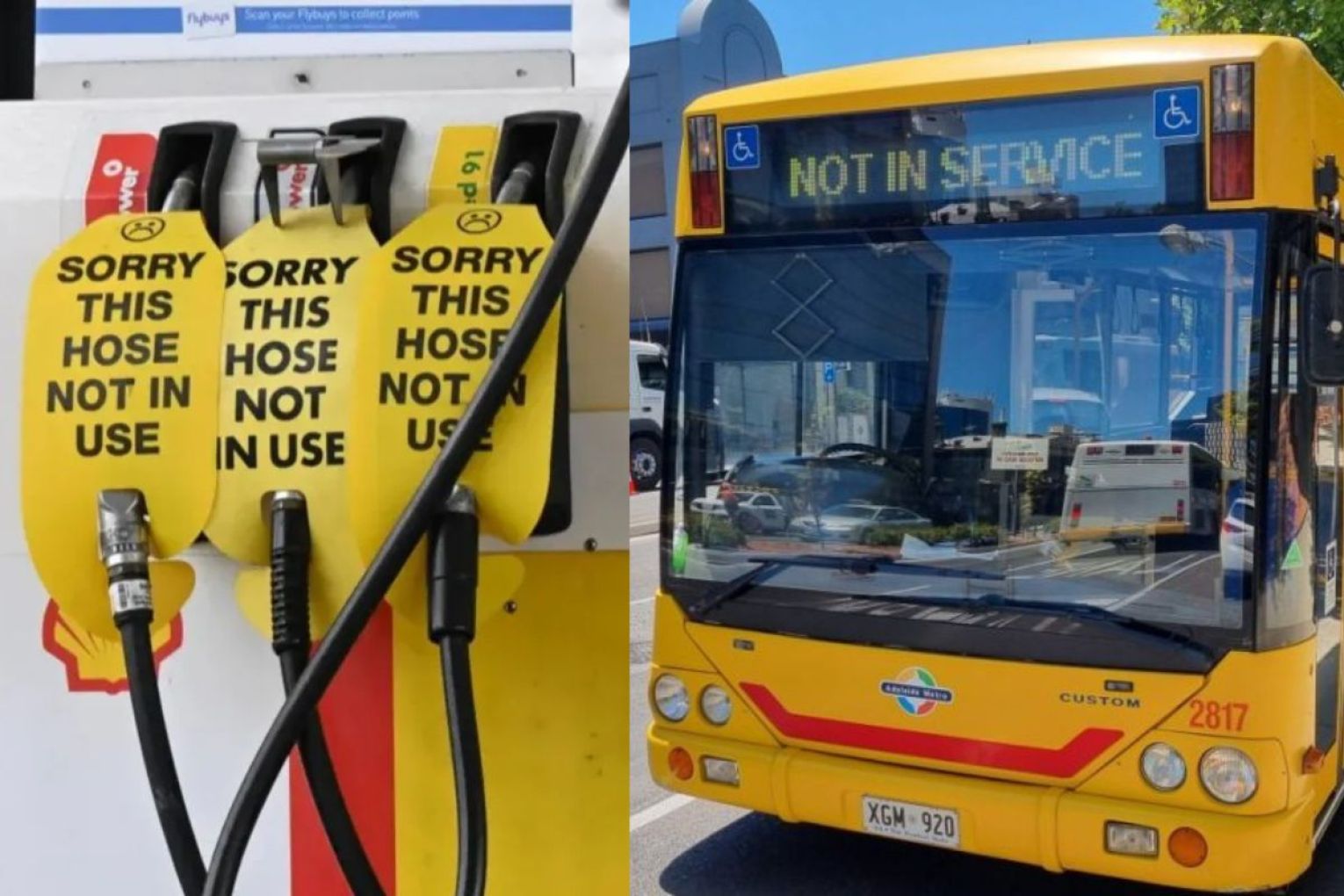
Giving a fuel update on Monday afternoon, Malinauskas said that 78 of South Australia’s more than 700 service stations reported they were out of one or more types of fuel due to local distribution and other issues.
“We continue to see shipments on their way to the Port of Adelaide, where we received the overall bulk of our fuel supplies on time and as scheduled. We saw a significant tanker last week, and we anticipate there will be more in the coming days as scheduled,” Malinauskas said.
“Distribution to regional communities, where there has been particularly strong demand for diesel, remains the priority, and work is very much underway to see that occur.”
Malinauskas said the government had partnered with the RAA’s real-time fuel price monitoring app to give motorists more information before heading to the bowser.
“Any South Australian can download the RAA app and see exactly how many stations throughout the state are out of diesel or out of unleaded at any particular point in time, but most importantly, see which ones do have stock, rather than it being a question about those that don’t.
“As things stand right now…we see South Australian petrol stations with diesel and unleaded fuel, which is obviously very important.”
The Malinauskas government’s election commitment to crack down on fuel price gouging is also in effect, which includes doubling existing penalties for retailers who fail to update fuel prices appropriately.
You might like


The news came as Albanese announced National Cabinet had today agreed to “the National Fuel Security Plan to coordinate a consistent response” across the country.
It is a four-stage plan that dictates roles and responsibilities between governments and industry partners.
Albanese said the country is currently at level two, “keeping Australia moving”, having transitioned through the “plan and prepare” stage.
He said Australians should not cancel their travel plans for the Easter long weekend, which is an important part of “keeping Australia moving”.
“People should enjoy their Easter, and it’s important as well that we keep the economy going. This is an important time for tourism destinations, for jobs. They rely upon that,” he said.
He said the supports were specific to truckers and Australians who “unavoidably” had to travel long distances.
“For many trucking companies that are small, they rely upon a cash flow which is under pressure, because they pay for their fuel, and then they get paid down the track in 30, 60, or 90 days, depending upon the contractual arrangements that they have,” Albanese said.
The next stage of the national plan is called “taking targeted action” with a fourth stage called “protecting critical services for all Australians”, he said.
Energy Minister Chris Bowen said the government “don’t expect to move off” stage two for “quite a while”.
“Stage three is about when supply is disrupted and at this point there’s been no disruption to international supply to Australia,” Bowen said.
Bowen said fuel was being delivered to regional Australia at “record levels” and said the country has 39 days worth of petrol, 30 days work of diesel and 30 days worth of jet fuel in reserves.
When asked about rationing, Bowen said the direction remains the same for Australians: “Buy as much fuel as they need, as much fuel as they usually get, not more, not less”.
“Our message to the suppliers and the retailers is, if you do the wrong thing by Australian motorists and Australian truckies, the ACCC [Australian Competition and Consumer Commission] will come down on you like a ton of bricks, and that’s as it should be.
“We’ve empowered the ACCC. We’ve increased their surveillance and monitoring. We’re increasing the penalties. We’ve made it possible for them to issue on the spot fines, and that’s because every cent of this cost-of-living relief that we’ve announced today needs to reach the pockets and wallets of Australian motorists who are doing it tough.”
When asked about the impact of halving the excise and pausing road user charges would have on the federal budget, Treasurer Jim Chalmers said there was “a lot of decision-making still to come” on the final budget position.
“We wouldn’t ordinarily be finished with it [the budget] in the last week of March, but especially when we’ve got more than the usual amount of global economic uncertainty and volatility that we are dealing with,” he said.
The federal budget will be finalised by the second week of May.
Free Public transport ruled out
Stay informed, daily
Prior to the Prime Minister’s announcement, deputy Liberal leader Josh Teague and Greens leader Robert Simms called on the Malinauskas Labor government to ease cost-of-living pressures by making public transport free as the price of petrol continues to rise.
But newly appointed Transport Minister Joe Szakacs ruled out free public transport amid conflict in the Middle East, saying it is still cheaper to catch the bus than drive.
The pleas follow recent announcements from Victorian and Tasmanian state governments making public transport fares free, with Victoria offering relief until the end of April and Tasmania until the end of June.
“People are paying $3.25 a litre for diesel and $2.60 for petrol. Meanwhile, at the bus stop just right here, South Australians are still paying full fares to travel by public transport,” Teague said.
“We’ve seen initiatives taken in Victoria and in Tasmania, and there are varying links to that. We’re saying the same should be applied here in South Australia.
“The Labor government must now act and make sure that public transport is free for the next three months for South Australians, so that we can take that pressure off.”
Greens leader Robert Simms also backed calls for free public transport for the month of April, and for an increase in public bus services.
“As South Australians struggle with skyrocketing fuel prices, free public transport is one way that governments can provide relief,” Simms said.
“We had a new public transport minister sworn in last week. They should hit the ground running by backing this initiative.”
Szakacs said that public transport was cheaper than driving, and encouraged South Australians “to consider jumping on board our buses, trains and trams”.
“A regular 28-day MetroCARD holder who commutes 10 kilometres to work each day could save in the vicinity of $60 a week by leaving the car at home — that’s before taking into account the cost of parking,” he said.
Szakacs said the government had “a broad suite of policies” to assist families with cost-of-living pressures.
“The South Australian Government has made public transport free for seniors and cheaper for school students,” Szakacs said.
“We will also be expanding the Seniors Card, which will provide a further 80,000 South Australians with free public transport, while absorbing the increases to fuel cost across our network.”
The national cabinet will convene on Monday to discuss the Middle East fuel crisis, with work-from-home measures on the cards to save fuel.
Treasurer Jim Chalmers ruled out fuel rationing as shipments were arriving, but added the government was open to support “voluntary” work from home measures.
“If everybody does their bit and if we manage this well, we hope to avoid those kinds of outcomes,” Chalmers told ABC TV.
The rising fuel prices have also led to a 37 per cent increase in fuel thefts, as SA police report 221 fuel thefts in the week ending March 15, up from 162 the week before.
SA Police Commissioner Grant Stevens said the number included “a significant increase in the rate of first offenders”.
“A substantial number of people — 97 — have done it [for] what we would describe as the first time,” he told 891 ABC Adelaide.
Stevens also warned his officers may have to stop investigating drive-off thefts at service stations, unless pre-paid pumps were urgently introduced to stop the “completely preventable” crime.
-with AAP
Want to see more stories from InDaily SA in your Google search results?
- Click here to set InDaily SA as a preferred source.
- Tick the box next to "InDaily SA". That's it.