Wave of algal bloom flare-ups in Yorke Peninsula and KI
SA’s leading algal bloom scientist gives his take as dramatic new footage emerges of the algal bloom impacting beaches on the Yorke Peninsula.
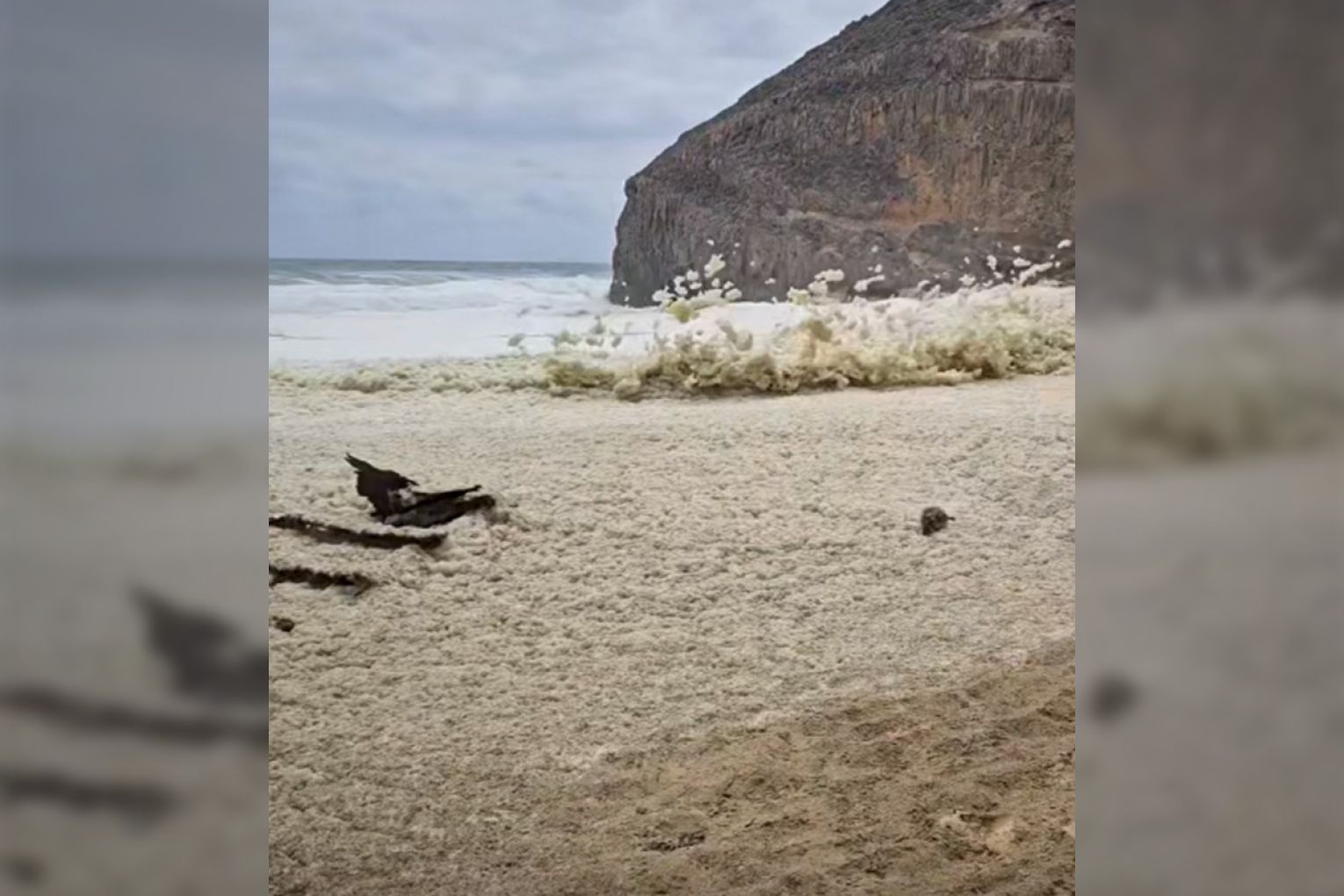
SARDI executive director Professor Mike Steer said the state government was actively monitoring increased algal bloom activity on the Yorke Peninsula and Kangaroo Island regions but he remained “cautiously optimistic” about its lessening impact.
“It’s important that we maintain monitoring and surveillance through summer and into autumn to make sure that we’re on top of it,” Steer told InDaily on Wednesday.
“But the other thing we can say is that, if you compare the data now to where we were a few months ago, it has significantly reduced, which is some form of positive, but we just need to be careful in our interpretation.”
Steer said that the algal bloom has been relatively active over the past couple of weeks around the southwestern end of the Yorke Peninsula, around Innes National Park, extending from around Chinamans Hat Island through to Browns Beach and around Corny Point.
While there was increased activity in the region, he said “the concentration of those cells is reducing, which is good to see”.
Steer said that on Kangaroo Island, SARDI was seeing the algal bloom moving further west to the north of the island around Stokes Bay, “but even there it’s diminishing”.
He warned that Kangaroo Island and the Yorke Peninsula would continue to see dead fish wash up and foaming events.
You might like
“So, we will see dead fish, particularly any gill-breathing organism, are negatively impacted by the algal bloom because the algae itself interfere or damage the gills, through mechanical abrasion and also through biochemical processes,” Steer said.
“The other thing that the algae does is, when it dies, it decomposes, it draws the oxygen out of the water. So, we will see fish in those impacted areas wash up.”
Steer said that foaming events would be most noticeable around the Yorke Peninsula “because it’s a high wave energy area”.
“There’s quite a lot of wave action and tidal movement, and that, coupled with onshore winds, you’ll get that churning organic material, the algal species plus a whole heap of other organic material that’s naturally in there, and that’ll churn up and wash ashore,” he said.
Steer said to follow the latest SA Health advice, which advises people to avoid areas with discoloured water or foamy conditions if they are susceptible to irritation.
Asked about concerns over whether dredging offshore around the state’s coastline contributed to the algal bloom, Steer said that “it’s more around those large ecosystem drivers rather than any point bits of activity along the coast”.
“We’re looking at significant environmental and ecological events like the record-breaking Murray River flood, like our big system-wide upwelling seasons along the coast and also the unprecedented heat wave that we hadn’t experienced for more than 40 years,” he said.
“So, these are really big drivers that are most likely operating, collectively, in combination to stimulate this harmful algal bloom. Little things, like pockets of activity around the coast, would have a negligible impact, if any at all.”
Stay informed, daily
Ian Gibbins, a retired anatomy professor who has been involved in extensive citizen science around the algal bloom, said that while the algal bloom appeared to have mainly cleared up from metropolitan waters, “there’s clearly still some kind of activity going on down around Kangaroo Island and the bottom of the Yorke Peninsula”.
“It also seems to vary from day to day. So, it’s okay for a while, then it seems to come back again, and then it’s gone again,” he said.
“So, it’s very hard to predict what’s going to happen next.”
Gibbins said that despite consistent low or zero levels of Karenia at metro and many regional testing sites, people are still reporting symptoms, including surfers at Seaford last week.
“Some of them are complaining about sore eyes and nose, and there are people still along the metro beaches who are sometimes reporting symptoms like they’ve had when lots of dead fish were around,” he said.
“What people are experiencing is probably not the direct effects of the original algae itself, but the consequence of that.
“So, whether there are toxins still in the water or in the sand and mud offshore, or whether there are bacteria that are associated with the decomposing seaweed, things like that, they’re causing problems.
“No one knows, and it’s very, very difficult to say what’s going on.”
In relation to human health impacts, Steer said that “in areas where there’s no Karenia or relatively low or natural levels, there’s a lot of other things in the water that can create itchy skin”.
“Being a surfer myself, at times, you sometimes come out and feel a little bit crusty with the salt water, or there might be blue bottles in the water.”
Last week, EcoProTem’s principal made “shocking” claims in State Parliament’s Joint Committee on Harmful Algal Blooms in South Australia, alleging that government staff were told not to investigate the cause of the algal bloom until after the March 2026 state election.
Senior bureaucrats were quick to rule out the claims, with Steer saying he was “gobsmacked” by the allegations.
Latest testing results from the week beginning on December 28 showed that 20 out of 21 metropolitan onshore sites recorded no or low levels of Karenia.
In regional areas, testing showed zero or low levels of Karenia across much of the Eyre Peninsula, Yorke Peninsula and Fleurieu Peninsula, with elevated levels detected at Whyalla Jetty (14,000 cells per litre) and Emu Bay Jetty on Kangaroo Island (27,820 cells per litre).
Want to see more stories from InDaily SA in your Google search results?
- Click here to set InDaily SA as a preferred source.
- Tick the box next to "InDaily SA". That's it.