The Stats Guy: Australia keeps urbanising. Maybe it’s finally time to swim against the tide?
Australia’s population is increasingly gravitating to major cities. Here’s why it may be time to reverse the urbanisation trend.

Last week, a wonderful dataset got released that I will dissect for many a column.
Today, we start by understanding the forces shaping the urban future of Australia.
The dataset in question comes straight from the UN Population Division, which gave us the amazing World Urbanisation Prospects 2025.
The WUP dataset not only has a fun acronym but it’s amazing in so far as it is of the few truly comparable, truly global sources that lets us understand where people actually live and where they are moving.
Every few years, the UN takes a deep breath, reviews satellite data, national censuses, thousands of administrative definitions and local boundary changes, then stitches everything together into a consistent global picture.
The 2025 update is full of methodological refinements. Dozens of cities have been reclassified. Boundaries have been harmonised.
The UN now includes more precise estimates of peri-urban growth, small urban settlements and transitions between rural and urban space.
If you want to compare Lagos to London or Launceston to Los Angeles, this is about as close to apples with apples as it gets.
And here is the headline for Australia. Not only are we an urban nation (by some measures, maybe even the most highly urbanised country), but we are still urbanising.
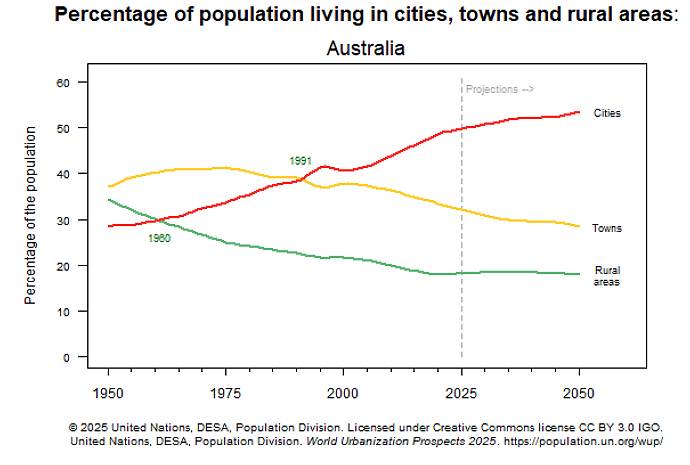
The WUP data confirms that the share of Australians living in cities has climbed steadily for the last seven-plus decades and is projected to rise even further.
You might like

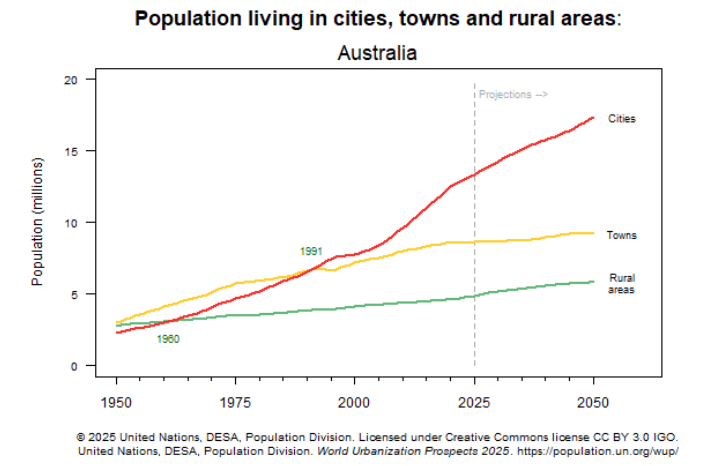
Cities will continue to absorb the majority of population growth.
Rural Australia, in relative terms, remains stable.
The surprise is in the middle – what we tend to casually call “regional Australia”. Our towns are shrinking as a share of the national population.
They aren’t shrinking, but they are losing demographic weight.
The WUP2025 projections show that by mid-century about two-thirds of Australians will live in urban centres large enough to qualify as cities in the UN system.
Many towns will continue to thin out. Rural areas will hold their percentage share, and because the whole population keeps growing, the bush will still add people in absolute terms.
Yet all political, economic and cultural gravitational pull will centre ever more tightly on the capitals and the handful of fast-growing regional cities that behave like mini-metro areas.
Australia already stands out globally. The UN notes that no large country concentrates such a high share of its population in so few major cities.
In the WUP data, we look less like Canada or the US and more like a cluster of city states with a giant hinterland attached.
Does it actually matter where we live as long as we are productive worker bees that produce enough economic growth and taxable income?
Urbanisation is not just about where people sleep. It shapes how nations work. The UN summary of results highlights three global themes that apply very much to Australia too.
- Economic activity is clustering in cities: Productivity, innovation and high-skilled jobs are increasingly urban. This means Sydney, Melbourne, and Brisbane see more population inflow. Great for employers in these cities. Whether this clustering is in the best interest of all workers is a different question.
- Migration flows amplify urban growth: International migrants overwhelmingly settle in cities. Since population growth in Australia heavily relies on migration program (about 70 per cent of our population growth is based on migration), migration is reinforcing the increased urbanisation pattern. Universities and professional jobs are clustered smack bang in the centre of our largest metro areas.
- Small towns face demographic hollowing: The UN notes that globally, small settlements are most vulnerable to population stagnation or decline. Our ABS data and your own regional analysis mirror this perfectly. Australia’s towns are ageing faster, losing young adults and struggling to compete with the career, education and lifestyle opportunities of the capitals. The continued trend towards farm aggregations and new farming technology means we need fewer workers to service the same amount of land. Small ag-towns then lose workers. As the shrinkage starts, some services become unviable and the town becomes less attractive still. This sets off a negative spiral of population decline.
Which brings us to the core question. Is this the right trend for Australia’s long-term prosperity?
Australia needs the big cities, but it also needs the regional towns.
Regional Australia is the country’s economic backbone. It produces our food, our energy, our minerals and our water. It anchors the supply chains that feed the cities. Yet its share of the national population keeps shrinking.
Stay informed, daily
Young adults move to the biggest cities for education and job opportunities. Ageing accelerates. Many towns are slipping below the viability thresholds where local supermarkets disappear, sports clubs fold, employers cannot find staff and basic services like childcare or healthcare struggle to survive.
To grow again, regional towns need stable, dual-income job opportunities, diverse and affordable housing, access to childcare and medical care, reliable digital and transport links, and a climate strategy that keeps them insurable.
Without these foundations, no amount of lifestyle marketing will bring permanent settlers.
These insights from your regional analysis show the size of the challenge and the scale of opportunity for a more balanced national settlement pattern.
I would like to make the case for gentle strategic regionalisation – or decentralisation.
If we want a more balanced national settlement pattern, we must create the conditions that allow some population growth to flow away from the capitals and into regional Australia.
For a regional area to see population growth, at least five basic needs must be provided for.
- Jobs: A regional town cannot grow on lifestyle alone. Dual-income households need stable, year-round employment for both partners, not seasonal or project-based work.
- Housing: Availability, affordability and diversity matter. Aged-care workers need small cheap units near work. Doctors demand larger homes but aren’t as price sensitive.
- Services: Families will move only where childcare, healthcare and schooling meet basic expectations. These are not optional extras.
- Connectivity: Transport links, regional airports and high-speed digital infrastructure are game-changers. If a regional town has them, they become its competitive advantage.
- Liveability: Climate resilience, natural amenities and insurability increasingly shape where people choose to live. Regional places that adapt strategically will attract more Australians.
Regionalisation isn’t about forcing people out of the capitals, it’s about giving people more viable lifestyle options.
For now, the rise of regional housing costs suggests even more rapid urbanisation than forecast by the UN.
As big parts of Asia, Africa, and Latin America become richer, they will see remote populations moving to regional towns in vast numbers. The local metropolises will also boom.
Australia is much more advanced in its economic development, and has a huge population share in the big cities. This is not sustainable forever.
Our cities are already struggling with housing affordability, congestion, infrastructure shortfalls and strained services.
Meanwhile, regional Australia has space, capacity and economic need for larger populations.
Let’s aim for a more balanced future. Urbanisation will continue. That is what the UN projections show. But Australia gets to choose how lopsided that urbanisation becomes.
If we want affordable housing, stronger food security, more workers in essential industries and a more resilient national economy, then the regions must play a bigger role in absorbing future growth.
The 2025 World Urbanisation Prospects remind us that cities will always dominate, but they also show that countries thrive when they invest not just in their capitals but in their middle tier of settlements.
This is the space where Australia still has room to rethink, redesign and rebalance. The regions are not destined to decline. With the right mix of jobs, housing, services and connectivity, they could become the next frontier of national renewal.
And that, perhaps, is the real story hidden in the UN dataset. Urbanisation is not our fate. It is a trend. Trends can be nudged, shaped and steered. The choice is ours.
Simon Kuestenmacher is a co-founder of The Demographics Group. His columns, media commentary and public speaking focus on current socio-demographic trends and how these impact Australia. His podcast, Demographics Decoded, explores the world through the demographic lens. Follow Simon on Twitter (X), Facebook, or LinkedIn.
Want to see more stories from InDaily SA in your Google search results?
- Click here to set InDaily SA as a preferred source.
- Tick the box next to "InDaily SA". That's it.