Coronavirus: What we know today, May 7
Follow this post for rolling updates on the impact of the coronavirus in South Australia, the nation and the world, as well as the latest health information and links to official advice.
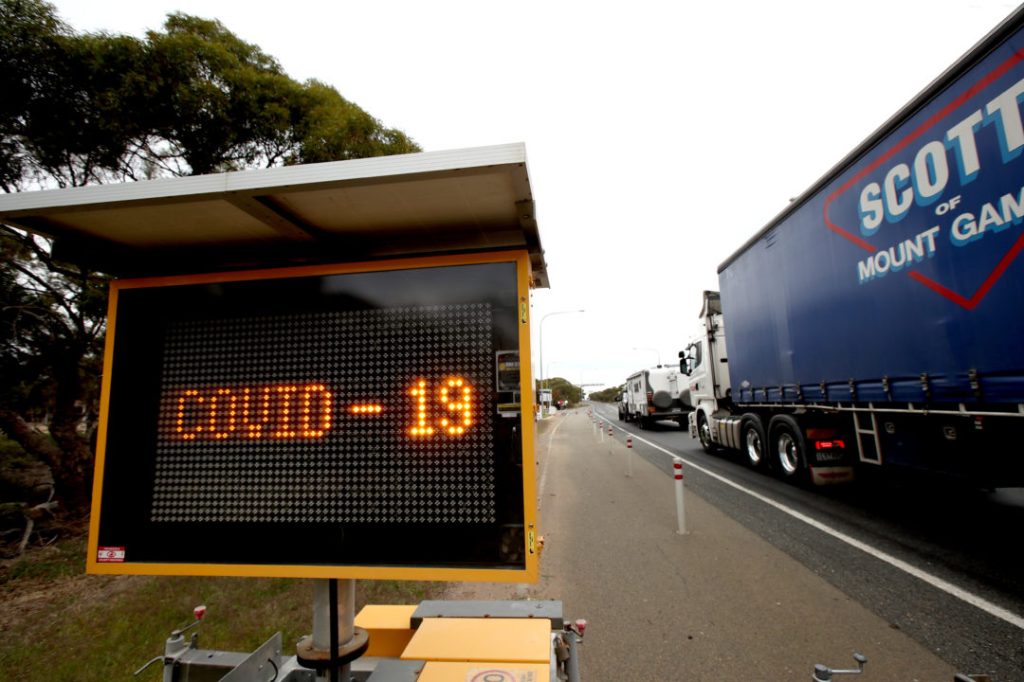
Refresh this page for updates – scroll down for links to official health information.
KEY POINTS
- One new coronavirus case in SA
- Police continue compliance checks
- Interstate transmissions next likely cause of infection
- National cabinet to consider winding back restrictions
- AMA warns against early lifting of lockdowns
- UK virus death toll passes 30,000
- Global toll nearing 260,000, with 3.7m infections
SA records first new coronavirus case in two weeks
A man in his 70s has tested positive for coronavirus in South Australia – breaking the state’s two-week run of no new cases.
The man contracted the virus while in the United Kingdom before immigrating to South Australia on March 20.
SA Health said he was not infectious while on the flight but developed “very mild symptoms” including loss of taste and smell on March 24.
He was tested for coronavirus on May 5 and is currently classified as an “active” case.
The man and five people with whom he came in contact are currently in quarantine.
Chief public health officer Professor Nicola Spurrier said because of the man’s age and his limited contacts in Australia she was “very confident” that it was not a case of community transmission.
“It’s a timely reminder for people that COVID-19 has not disappeared,” she said.
“We will still consider that this gentleman is infectious and he will be in quarantine along with his close contacts because this is when we’ve diagnosed it, but for an infectious disease point of view and in terms of any danger to the community I think that that risk is very low.
“Because this man has been isolating we’re not concerned that there has been any opportunity to spread it.”
There are two active coronavirus cases in the state and an additional two people who tested positive for the virus remain in hospital.
South Australia has now recorded 439 coronavirus cases, with a 95.5 per cent recovery rate.
Spurrier said today’s new case did not make her “nervous” about easing restrictions.
More than 65,000 coronavirus tests have been carried out in South Australia since February, including 1516 tests yesterday.
Police compliance checks continue
You might like
SA Police Commissioner Grant Stevens says 150 fines and 130 formal warnings have been issued so far, mostly to people involved in gatherings larger than 10 people.
Under the state’s social distancing directions, groups of up to 10 are allowed as long as people remain 1.5m apart.
Police are also checking on people required to self-isolate for 14 days.
“There are about 250 to 300 police dedicated to COVID-19 activities and our compliance checking continues at the same rate,’ Stevens said on Thursday.
“That will continue for the foreseeable future.
“When we have international arrivals being accommodated in South Australia, that will increase the number of police dedicated to COVID-19.”
AMA warns against early restrictions lift
Australia’s leaders have been urged not to release the handbrake on coronavirus restrictions too quickly, to avoid a potentially disastrous second infection wave.
State and federal leaders will decide on what rules are to be eased on Friday at a crucial national cabinet meeting.
Deputy chief medical officer Paul Kelly said restrictions would be gradually eased, rather than a wholesale return to life before the pandemic.
“Some things will open – others will not,” he said.
“It will be scaled so that risk of increasing the number of cases is minimised while giving the maximum benefit to the economy and to normalisation of society.”
Australian Medical Association president Tony Bartone warned national cabinet not to feel pressured into lifting restrictions.
“Friday’s meeting should continue to apply medical evidence when putting the health of all Australians first,” he said.
He said reinstating isolation measures after a second wave of infections would be worse for health outcomes and the economy than a cautious relaxation.
“People should not get their hopes up too high at this stage, because rushing to get things back to normal, without caution and safeguards, risks a huge setback for everyone,” Dr Bartone said.
National toll
The death toll is 97 – NSW 46, Victoria 18, Tasmania 13, WA 9, Queensland 6 (includes 2 Qld residents who died in NSW and are included in both the Qld and NSW counts), SA 4, ACT 3.
A Sydney nursing home has seen 16 COVID-19 deaths, while a cluster at a Melbourne abattoir is behind 62 cases, while the national infection rate had its highest increase for more than two weeks on Wednesday when 26 diagnoses were reported.
The effective reproduction number, which measures the ability of the virus to spread, will need to remain below one for eased restrictions to remain in place.
That means an infected person on average passed the disease on to less than one other.
Keeping the growth of infections low and demonstrating an ability to stay on top of outbreaks are other crucial factors.
More than 5.1 million people have downloaded and registered for the government’s COVIDsafe coronavirus tracing app.
The virus has killed more than 258,000 people and infected 3.7 million globally, according to a Reuters tally.
Virus poll
Two out of five Australians believe it’s likely they will be infected with COVID-19 over the next six months, as the nation struggles with the virus pandemic.
In a landmark study, the Australian National University’s Centre for Social Research and Methods collected data from 3,155 Australians in January and February and again in April.
Two-thirds of Australians reported they felt anxious or worried for the safety of themselves, their family members or friends to the the coronavirus.
Significantly, 19.7 per cent agreed there had been too much unnecessary worry about the outbreak.
Researchers Nicholas Biddle and Matthew Gray say the findings paint a picture of “hardship and distress, but also resilience”.
Stay informed, daily
Professor Biddle said Australians had a greater sense of “social trust” as their fellow citizens observed social distancing and other measures to slow the spread.
“The extent to which Australians think most people can be trusted, that people are fair and that people are helpful all increased between February and April 2020,” he said.
Confidence in the federal government increased from 27.3 per cent in January to 56.6 per cent in April.
No cruising for senior health officer
Queensland’s chief health of said five of six Queensland’s COVID-19 deaths are directly related to cruising and the industry has to work hard to make their ships safer for passengers.
When asked if she would take a cruise, Dr Jeanett Young said: “Not with the current arrangements, but I suspect a lot of people wouldn’t.”
“A lot of work has to be done by the cruise ship industry before people will feel safe and be able to return.
“I think it will be difficult for the cruise line industry to reassure people so they need to start that work now.”
WHO urges caution in lifting lockdowns
The World Health Organisation has warned that countries emerging from restrictions to halt the coronavirus must proceed “extremely carefully” or risk a rapid rise in new cases.
Director-General Tedros Adhanom Ghebreyesus said countries needed to ensure they had adequate measures to control the spread of the COVID-19 respiratory disease like tracking systems and quarantine provision.
“The risk of returning to lockdown remains very real if countries do not manage the transition extremely carefully and in a phased approach,” he said at a virtual briefing in Geneva.
UK virus death toll passes 30,000
Britain’s COVID-19 death toll has risen by 649 to 30,076, according to figures announced by the government.
The figures released on Wednesday reflect deaths in all settings following positive tests for coronavirus, cover the period up to Tuesday afternoon.
The UK has become the second country to record more than 30,000 deaths as a result of the coronavirus pandemic.
The UK stands only behind the United States, which has more than 71,000 coronavirus-related deaths.
Italy’s toll is now 29,684 with 214,457 confirmed cases.
OFFICIAL SOURCES OF ADVICE AND INFORMATION
Local updates and resources
State Government central information
Mental health support line (8am to 8pm): 1800 632 753.
National advice and information
Australian Government Coronavirus information hotline: 1800 020 080
Government information via WhatsApp: click here
Travel
Australian Government travel advice: smartraveller.gov.au
Check your symptoms
Free, government-funded, health advice: healthdirect.gov.au
– Reporting by InDaily staff, AAP and Reuters
Want to see more stories from InDaily SA in your Google search results?
- Click here to set InDaily SA as a preferred source.
- Tick the box next to "InDaily SA". That's it.