Designing “progressive” schools
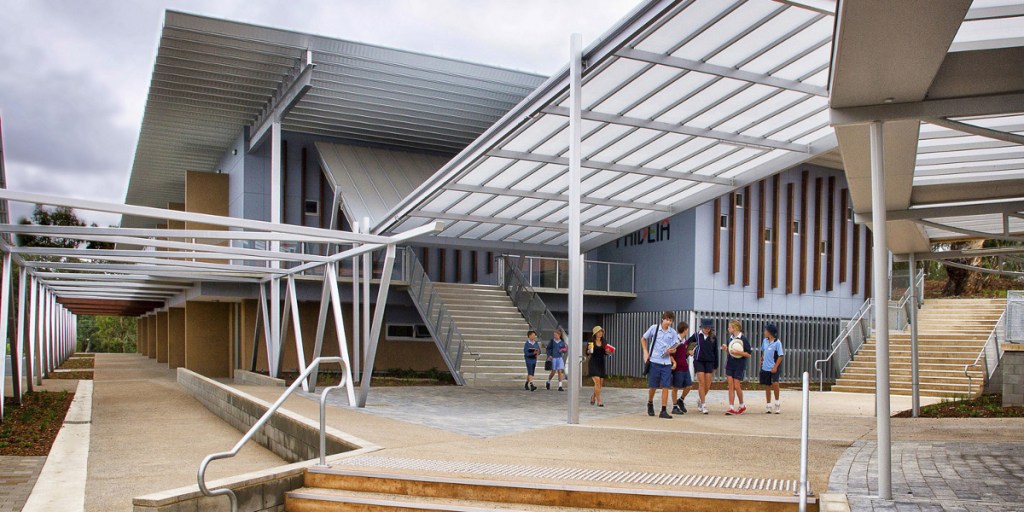
A dramatic rethink of classroom design at an Adelaide Hills school has opened up a new front in the debate between ‘traditional’ and ‘progressive’ education.
A new, $8 million middle school learning centre at Cornerstone College, dubbed ‘Paideia’, features alternative furniture, wide open spaces, flexible, interconnected classrooms and a ‘reading tree’.
Architect Peter Moeck designed the space for the CEFPI Mayfield Project, where teams of architects around the country collaborated with educators to design unique school spaces.
The aim was to create a “welcoming, light-filled, generously proportioned bunch of spaces that were connected together, and that could be easily connected or disconnected from one another,” said Moeck.
Large, glass-enclosed classrooms, which can be opened up for ‘team teaching’ and group activities, are connected by a common area filled with comfortable furniture in bright colours and unorthodox shapes.
Students are encouraged to work in groups using laptops and the internet, in spaces where they feel most comfortable –such as lying down or sitting outside.
It eschews the traditional model of school teaching, where a teacher stands at the front of a classroom giving information to students while they sit at rows of desks.
“Traditional teaching … in some respects, is about spoon-feeding the kids,” said Cornerstone learning director Julie Sampson.
“You give them the information and then they regurgitate it back at an exam.
You might like

“That might mean that they get good exam results, but when they go on, are they critical thinkers?”
According to Sampson, ‘Paideia’ has made students feel happier at school and more enthusiastic about learning.
“The kids love the space,” she said.
“There’s a shift in education [where] teachers are not the holders of all knowledge anymore, because kids have got access to the internet.
“Students can access information, so it’s not about teaching them about information anymore; it’s teaching them about being critical thinkers and about evaluating, reflecting [and] synthesising.”
But, according to education consultant and commentator Graedon Horsell, the ‘progressive’ educational pedagogy is a driving force behind declining student results in Western countries.
“What is emerging is that progressive education is as close as one can get to the root cause of educational failure,” he said.
“Nearly all the developments in education over the past three decades … have focussed on teaching fads, furniture, room configuration, wall colour and other largely impersonal elements.”
Good teachers, according to Horsell, get results for their students in any learning environment, whilst bad ones can’t be saved by a well-designed building.
“While fancy furniture, well decorated rooms, and architectural innovations create a pleasant ambience in those schools which can afford them, the key variable in raising student achievement is the teacher, and good teaching,” he said.
He said “progressive” was the wrong term for current thinking among academics and teacher groups.
“What is lacking is good teaching, evidenced by student achievement.”
Stay informed, daily
Sampson rejected the criticism, telling InDaily the learning environment was an important factor in student development.
“You’re not even going to get started if kids don’t like the environment they’re in,” she said.
“If they’re disengaged and there are negative relationships, then they’re not going to learn.”
The senior teacher, who has worked in schools for more than three decades, said educators were in the process of adapting to new understandings of teaching, which emphasise the discovery of information by students, rather than its delivery by teachers, as well as peer collaboration.
“I think if kids are given a little more control and a little more responsibility, it’s going to encourage them to be life-long learners,” she said.
“These are going to be kids how are going to want to explore and ask questions throughout their life.”
‘Paideia’ was designed by Flightpath Architects in close collaboration with a panel of Cornerstone teachers, who were keen for the building to reflect this new educational philosophy.
During the three-year long design and construction process, students were surveyed to discover the environments in which students felt they learned best.
Most responses from students indicated their most memorable learning experiences occurred at home, outdoors, and to a lesser extent, at school, and mostly in the presence of parents and friends.
“We became aware in the first testing in the traditional setting that people couldn’t think outside of their classroom,” said architect Peter Moeck.
For that reason, he said, the new classrooms were designed to be supremely flexible, comfortable and integrated with the environment outside.
“There have been some terrific comments about how easy it is to use and how pleasant it is to be in,” he said.
Sampson admitted not everybody was comfortable with the new style of teaching, but said that she was seeing better student outcomes from the new environment.
Cornerstone has also experienced an increase in inquiries about middle school enrolment since the building came into use.
“Not everybody’s comfortable. It is a transition,” she said.
“Teachers who have been teaching (for) a long time have come from a more traditional background. It takes time to adjust and to shift your pedagogy and the way you operate in the classroom.
“I’ve been teaching for 30 years, and I’m in that transition too.”
The Council of Educational Facility Planners International (CEFPI) is a world-wide not-for-profit professional organisation which aims to improve learning spaces.
Want to see more stories from InDaily SA in your Google search results?
- Click here to set InDaily SA as a preferred source.
- Tick the box next to "InDaily SA". That's it.