The unsolved mystery of the McAlister Agreement
As Port don the black and white for this weekend’s Showdown, Port member and barrister Patrick McCabe delves deep into the archives to discover an inconvenient truth Collingwood has kept secret too long.
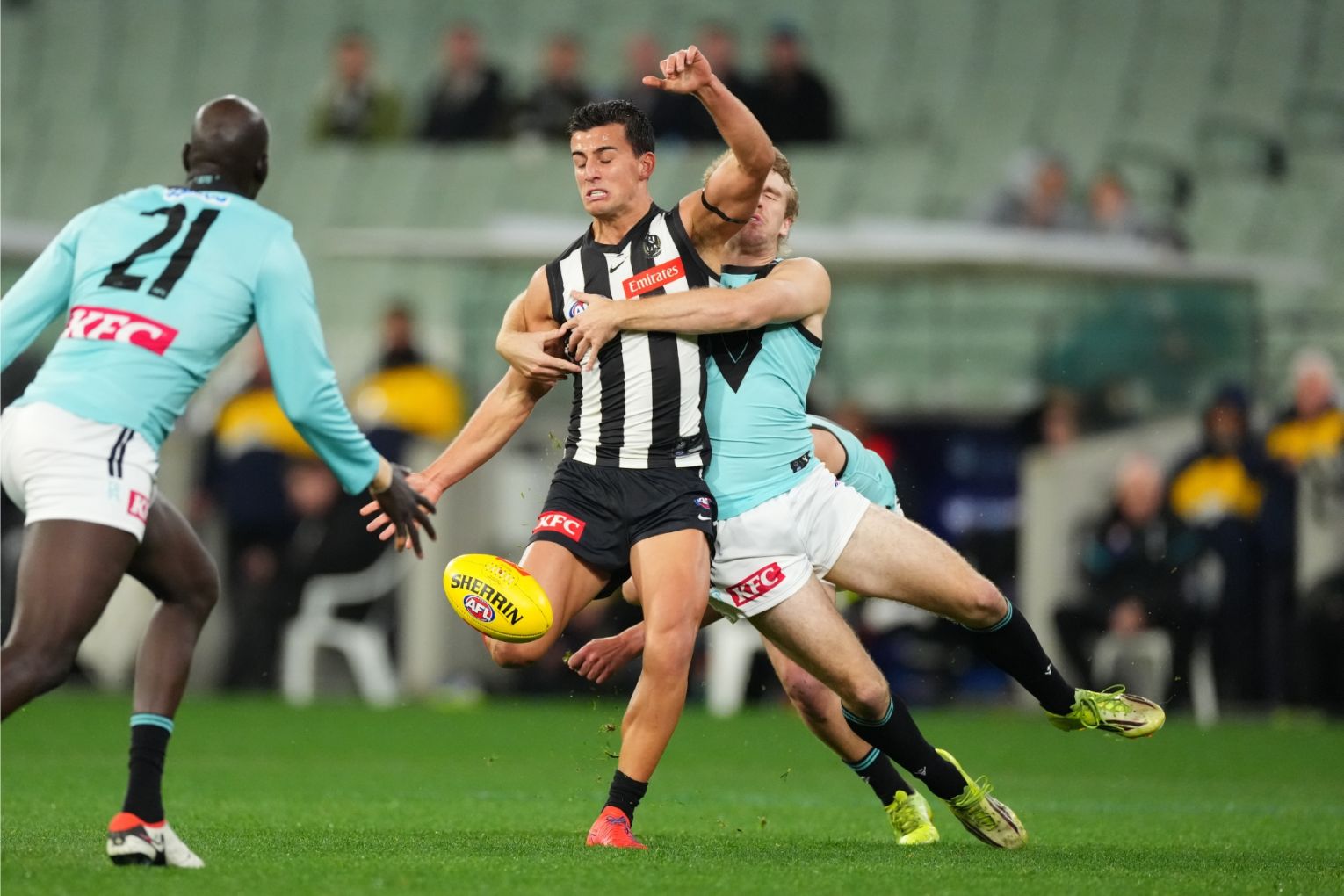
Since at least 1997, Collingwood and Port have been locked in war about Port’s right to wear black and white.
Whenever the conflict conflagrates, both sides rush to rely on a Byzantine collection of contracts, conditions on AFL licences, agreements, AFL rules, and gentlemen’s handshakes, which the other side invariably disputes.
True to form, when the present custom of Port wearing their black and white guernsey at their home Showdown was introduced in 2020, then-Collingwood president Eddie McGuire claimed Port had breached an agreement about only wearing the guernsey in 2019 and not beyond, a 2007 “heritage guernsey” accord, and the terms of their 1995 AFL licence. Port rejected all this.
Yet, in each round of the guernsey war, beneath the sound and fury, a persistent whisper may be heard about another agreement. An agreement that would not only finish the guernsey war forever, but radically reshape the contours of Australian football itself.
The whisper has been stifled, but never extinguished. It can still be heard, in hushed conversations over butcher’s glasses in certain Alberton front bars, in the comments section of certain Port Adelaide fan Facebook pages, and in the late-night scrawlings of footy tragic web forums.
It is an agreement known as the McAlister Agreement.
You might like


The basic facts are these: upon Port joining the AFL, it is said that Collingwood president Allan McAlister wrote a letter to Port chair Brian Cunningham. The letter undertook that, if Port finished higher than Collingwood in three consecutive seasons, Collingwood would cede its right to the black and white. The letter concluded with the searing taunt: “I hope you enjoy black, white and teal for a long time.” But in fact, Port finished higher than Collingwood in 1997, and every subsequent year until 2002.
The Agreement’s conditions were satisfied. Yet the Agreement remains unfulfilled. Why?
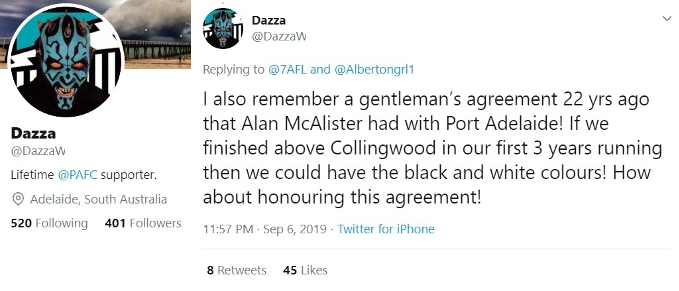
The circumstances of the McAlister Agreement’s creation are murky.
One popular version has it that McAlister wrote the letter after Round 1, 1997, when Collingwood thrashed Port in its first-ever AFL game. While the idea of Collingwood committing to a folly in a fit of misplaced hubris is deeply satisfying, this theory’s problem is that McAlister retired as president in 1995.
More reputable sources cite the letter’s date as 1 September 1995. This is the date sports writer Warren Partland ascribes to the Agreement in a 1999 article in The Australian, in which he claims to possess a copy of the letter. The 1995 dating has the merit of being logically possible, falling within McAlister’s final months as president. But shrewd readers will note implausibilities remain. Why would Collingwood commit to this rash undertaking from which they stood to gain nothing?
Stay informed, daily
Perhaps the letter was part of a wider clandestine compromise struck in a backroom? On 31 August 1995, Port made its historic announcement that it would be known as the Power in the AFL. Maybe this uncanny timing suggests a deal – Port will become Port Power, but in return Collingwood must commit to the McAlister Agreement.
This correspondent has seen a copy of the letter, and it does mention a meeting in the week prior to 1 September 1995. Could that meeting have happened? The Collingwood-mad Victorian newspapers of the day tracked McAlister’s movements obsessively. On each of the first three weekends of August 1995, the newspapers mentioned McAlister attending various pre- and post-match events, all in Melbourne. But where was McAlister over the last weekend, 25-26 August 1995? The newspapers’ silence is deafening. Was that because he was at Alberton, meeting with Cunningham?
The Agreement did not come to the press’s attention until June 1999, in an Advertiser article by Michelangelo Rucci. By that time, Collingwood were well ensconced at the bottom of the ladder, while Port were contending for finals. Cynics might say this was a well-timed moment for Rucci to discover the letter.
But shortly after, Warren Partland also wrote about the Agreement in The Australian. Then a month later, the Advertiser again mentioned the Agreement, reporting that then-Port chair Greg Boulton had written to new Collingwood president Eddie McGuire to remind him of it and to foreshadow Port’s enforcement of it if Collingwood’s fortunes didn’t improve.
The history books confirm Collingwood came dead last that year. But McGuire refused to honour the Agreement. He preposterously claimed it was a fraud, suggesting the hoax was exposed by a supposed misspelling of McAlister’s name in the letter (the copy in my possession spells his name correctly).
It seems Eddie’s obfuscation forced the Agreement underground for a period. But in 2004, another battle in the guernsey wars flared, and the Agreement was again raised. The Advertiser reported that Boulton was considering enforcing the Agreement, but had for the moment decided, for strategic reasons, not to “force the issue”.
So what is the truth of the matter?
In my view, one last crucial piece of evidence clinches the case for Port. In 1993, following Nicky Winmar’s famous stand at Victoria Park against racist Collingwood fans, McAlister made outrageous racist remarks to the press, earning him nationwide condemnation. In 1994, a Darwin man went so far as to announce he had placed a curse on McAlister as punishment. Apparently, the curse was intended to bring McAlister and Collingwood misfortune.
Not a year later, the McAlister Agreement was penned. Surely, the curse forced McAlister’s hand.
Poetically, Collingwood surrendered their right to the black and white as cosmic punishment for its continual deafness to black-white relations. Once Saturday’s Showdown is won, it is high time Kochie takes a trip to the Port Adelaide archives, dusts off the McAlister Agreement from the back of the filing cabinet, and makes preparations for a fully black-and-white 2027.
Patrick McCabe is an Adelaide barrister and Port fan who has worked with many non-profit organisations.
Want to see more stories from InDaily SA in your Google search results?
- Click here to set InDaily SA as a preferred source.
- Tick the box next to "InDaily SA". That's it.