FOI reveals reason why SA uni cast out UN speaker event
In March, Adelaide University ejected a sold-out event focused on the Israel-Palestine conflict from its campus – just one week before a renowned United Nations speaker was appearing. Now, FOI documents reveal why.
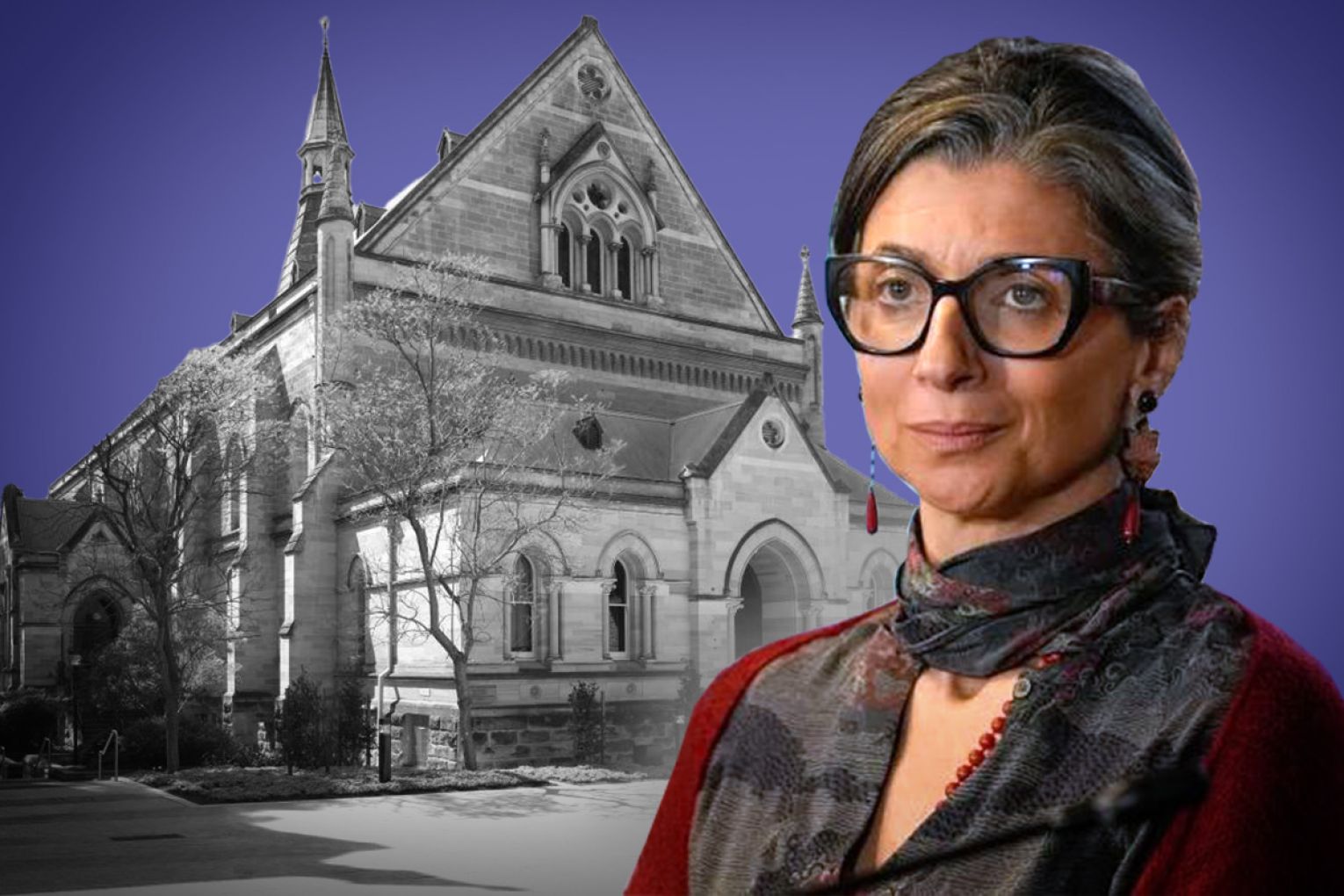
About two dozen Adelaide University staff across its law school and media unit were involved in intensive discussions over an event featuring a renowned United Nations special rapporteur for about a month before the plug was pulled on its campus’ involvement, Freedom of Information documents reveal.
UN special rapporteur on the occupied Palestinian territories Francesca Albanese was due to appear at the event at the university’s Elder Hall as part of the alternative writers’ week called Constellations.
The event – which would have been in the Adelaide Writers’ Week program before its cancellation– was forced to move to Norwood Concert Hall at the last minute after the university pulled out, saying it had been made aware of the event on February 27.
Its cancellation prompted multiple media reports, an influx of social media commentary to the university’s pages and a highly honoured former University Dean of Law writing that she was “ashamed” to be associated with the university.
FOI documents revealed former Law School Dean Rosemary Joan Owens AO wrote in an email to the Law School and Vice Chancellor on March 4 that she had tickets to the event at Elder Hall and expressed her “profound distress” over its cancellation.
“Without knowing the reasons, I am drawn to speculate that the university may have decided that this was a political ‘hot potato’ and, therefore, that it did not want anything to do with it,” Owens email said.
“If that is so, I would like to express my profound distress that this could be the motivation, and my profound disagreement with the decision.
“Indeed, if it is the reason, I am ashamed to be part of this institution.”
The Freedom of Information documents revealed correspondence between the organisers, the Association for the Promotion of International Law, and the university began on February 4 – and Albanese facing sanctions by the Trump administration over her criticism of Israeli war tactics in Gaza was discussed as a concern.
You might like


Event organisers faced their first hurdle to host the event at Elder Hall earlier in February, when venue management asked for a university signatory to back the event booking, prompting Law School heads to say no.
In an email on February 15, Law School Associate Dean Matthew Stubbs wrote to Senior Lecturer Bruno Arpi saying that “the event itself appears to be eminently sensible and feature extremely good people,” but was “a bit of a risk”.
“My inclination would be to say no,” Stubbs’ email read.
“The reason I hesitate is the current climate, in which even very sensible events risk being hijacked by protests and counterprotests, which risks driving up the cost of the event enormously (in security) and could impact on the university’s reputation.
“In short, it seems a bit of a risk to me, and I’m not sure there is much countervailing benefit to you or us that would justify taking the risk.”
Dean of Law Judith McNamara added to the email chain that the lecturer was “of course, free to participate in the event in a personal or scholarly capacity if you wish, but your name should not be used to facilitate the venue booking itself.”
Days later, law lecturer Juliette McIntyre did facilitate the booking for the organisers, and wrote on February 24 that she believed the “risk profile for the event is fairly low”.
Emails between McNamara and Pro Vice Chancellor Jodie Conduit on March 1 detail concerns over reporting in The Australian newspaper that the university would allegedly breach US sanctions by hosting the event.
McNamara said McIntyre had advised the university that Albanese was a target of US sanctions over her comments on Gaza, and she believed assertions made in the media reports were “legally incorrect”.
“She [McIntyre] believes the event does not breach the US sanctions regime and said the organisers obtained legal advice to that effect prior to proceeding — advice she has seen but which is not hers to share,” McNamara wrote.
“I am not in a position to assess that question and merely offer this perspective for the university’s consideration.”
Conduit’s email raised concerns McIntyre had been “coerced” by event organisers to back the booking at Elder Hall.
Stay informed, daily
‘Ashamed’: Top law professor slams uni decision
The event’s initial cancellation prompted multiple media reports, an influx of social media commentary on the university’s pages and a highly honoured former University Dean of Law writing that she was “ashamed” to be associated with the university – all detailed within the 229-page Freedom of Information documents.
Former Law School Dean Rosemary Joan Owens AO wrote in an email to McNamara on March 4 about her “profound distress” over its cancellation.
Owens was awarded an Order of Australia, The Angus Parsons Prize and The Law Society of South Australia Centenary Prize among other honours and was dean of the University of Adelaide Law School from 2008 to 2011.
In her response, McNamara said she recognised that the university’s explanation of the cancellation “may not fully address your concern, which goes to something deeper — the university’s commitment to providing a platform for difficult and contested ideas”.
“On that I can speak more directly, because it sits at the heart of what we do in the Law School every day,” her reply said.
“Adelaide Law School is home to scholars working across international law, human rights, environmental justice, and security — fields where controversy is not incidental but intrinsic. Our commitment to those conversations is genuine and it is not contingent on their being comfortable.
“I am sorry that the circumstances of this particular event have given rise to a different impression, and I hope it is one that can be corrected over time through the work we continue to do.”
Inquiry calls
After the Freedom of Information documents release, the Association for the Promotion of International Law (APIL) has called for an independent inquiry into the university’s decision, saying it “must be investigated for its attack on academic freedom”.
“We believe Adelaide University panicked in the face of pro-Israel lobbying, and gave spurious and demonstrably false reasons for cancelling the event,” an APIL spokesperson said.
“Adelaide University should be committed to providing a platform for difficult and contested ideas, and should not merely pay lip service to the principles of academic freedom and freedom of speech.
“An independent inquiry will reveal whether senior staff at Adelaide University have breached the Adelaide University Act (2023) and the Adelaide University Staff Code of Conduct (2026), thereby bringing the university into disrepute.”
In a statement to InDaily today, an Adelaide University spokesperson said the university “believes universities should be places where people can discuss, examine and debate difficult or controversial issues”.
“The university could not approve the venue booking because it did not go through the required review and approval process set out in university policies and procedures,” the statement said.
“For this reason, the university does not consider that lawful intellectual inquiry or public debate was being restricted.
“As the required process had not been followed, the university was unable to provide the support needed to run an event of this size. This included ensuring the safety, wellbeing and comfort of attendees and delivering the standard of event expected at the university.
“The university does not believe the matters raised indicate a breach of the Act, misconduct, or any need for an independent inquiry.”
Want to see more stories from InDaily SA in your Google search results?
- Click here to set InDaily SA as a preferred source.
- Tick the box next to "InDaily SA". That's it.