‘We need data centres’: Malinauskas all in on ‘AI revolution’
The Premier has unveiled plans to seize artificial intelligence opportunities in South Australia, dismissing fears about the amount of water used by modern data centres.
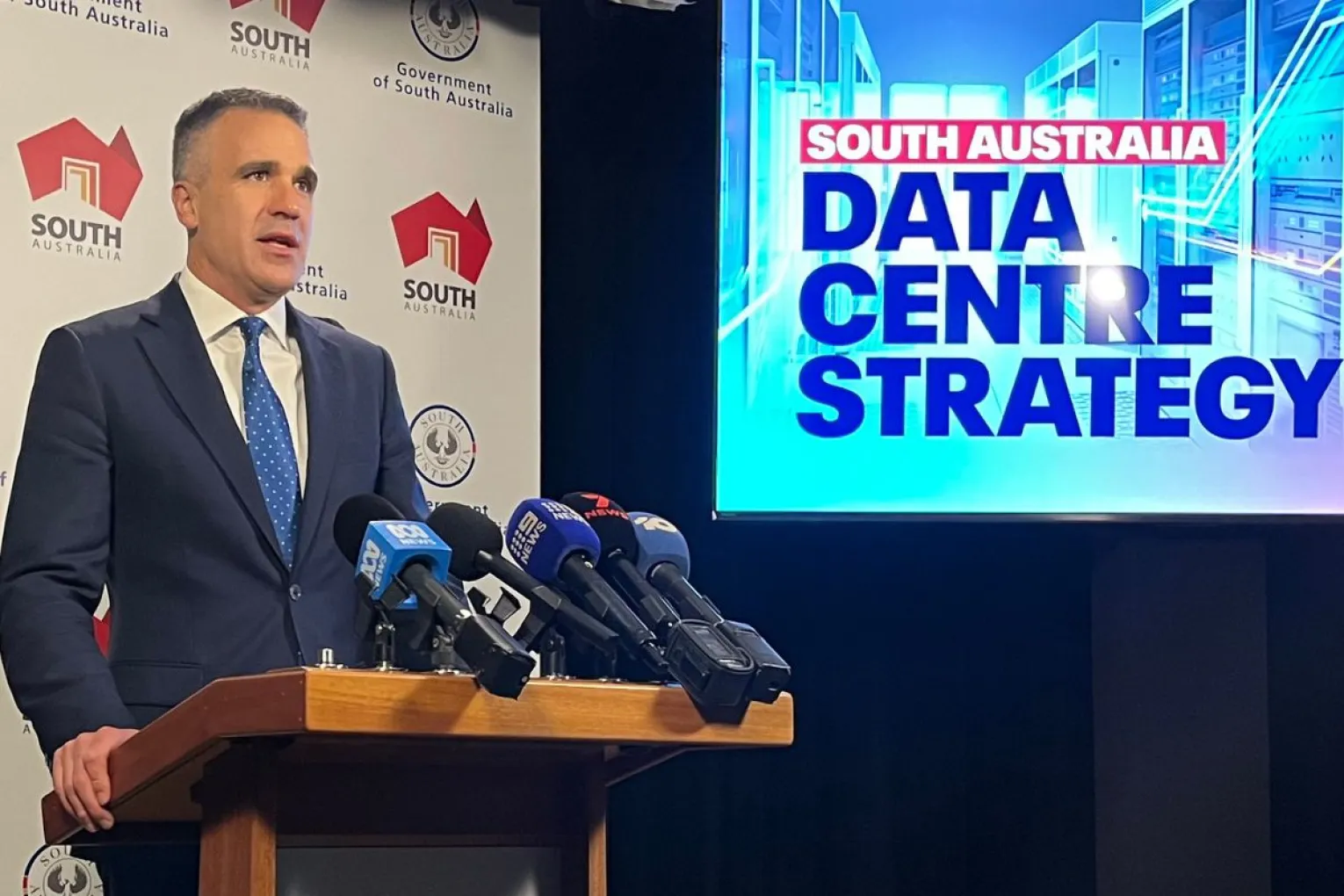
The state government is pushing ahead to reap the “economic benefits” of artificial intelligence with a new strategy, as plans for multiple AI data centres in regional South Australia are announced.
Premier Peter Malinauskas today released plans to lead the nation in AI infrastructure and development through the ‘Data Centre Strategy’, with the government estimating $850 billion would be invested in the sector over the next few years.
“AI represents the single biggest source of growth in the global economy. We are seeing billions and billions of dollars of capital flow into the AI opportunity in any number of different forms,” Malinauskas said.
“We need data centres in Australia. As a state, we’ve got a choice to either embrace it and seek to utilise it where we can or let others have the opportunity and regret it later down the track.
“What we’ve got a responsibility to do as a government is to make sure that opportunity isn’t at the expense of our living standards but rather enhances it.”
The strategy follows recent announcements from IREN Limited, which would build an 800MW AI data centre in the state’s Mid North town of Bundey.
It includes the introduction of a Data Centre and AI Infrastructure Act to streamline data centre development, activating the Coordinator General to take over decision-making functions, deploy renewable energy to power sites, secure industry partnerships and scale AI research and development.
It also outlines a dedicated planning pathway, with data centres designated as essential infrastructure with amendments made to the Planning, Development and Infrastructure Act.
You might like

Applications for data centres must be submitted with advice from SA Water that there is sufficient water supply to meet requirements and a certificate from the Technical Regulator confirming it complies with the requirements of the state’s power system.
Minister for Energy and Mining Tom Koutsantonis said SA’s “$32 billion renewable energy pipeline” would be used to power the data centres.
Federal Grey MP Tom Venning claimed that SA does “not have the reliable base load power that these data centres demand”, and raised concerns about water usage.
“The traditional data centre uses a lot of water, and in the driest state, in the driest continent, we cannot afford to be using our precious resource on data centres,” Venning told InDaily.
“IREN has proposed a closed-loop cooling system in Bundey, and the permit must ensure that they stick to that.”
He was also worried that large-scale AI companies may not have to pay council rates, as many regional councils struggle with funding.
“Multinational companies are making hundreds of millions of dollars from Australian business, from Australian households, but they’re not paying any council rates. That must change,” Venning said.
“We absolutely need to be at the forefront of this technology, but we’ve got to do it right.”
In recent weeks, regional communities have expressed concerns over potential environmental damage and a lack of community consultation from the government over data centre proposals.
Coorong District Council acting mayor Jonathan Pietzsch told InDaily there was “concern and fear from locals developing in a vacuum” about a proposed data centre from Firmus Technologies in Tailem Bend.
Stay informed, daily
But the Premier said there would be “very substantial” consultation with regional communities to quell fears from locals.
“Remember when large-scale renewables started to first get constructed in South Australia? There were concerns and queries coming from the community,” Malinauskas said.
“Remember the very first large wind farms, we had people talking about noise and sound, and those concerns shouldn’t be dismissed lightly.
“There should be thorough community consultation and engagement where science is shared — it’s a process that we are committed to in the same way with data centres.”
Malinauskas also said commentary surrounding water usage for cooling in data centres was “outdated and in some cases exaggerated”.
Data Centres Australia CEO Belinda Dennett said technology had evolved, where new data centres had transitioned away from evaporative water cooling, which used millions of litres of water.
“What we’re now seeing is, because of the new chips that are used in AI, are far more powerful. We’re seeing liquid to chip cooling,” Dennett said.
“You don’t actually use water; you’re using a glycogen or something as a different medium. So, we’re seeing the water use come down.
“A closed loop system uses one set of water that circulates around the building, and it’s not replaced particularly frequently, so much lower water use.”
Greens leader Robert Simms said the government should be “slamming on the brakes” rather than “rolling out the red carpet for AI data centres”.
“Data miners and big tech want to harvest our natural resources in order to make huge profits. We know that these centres have will have a huge impact on water and energy,” Simms said.
“We need to be sure that South Australians aren’t forced to carry the can in terms of increased prices and diminished water supply and quality.
“We will be closely examining the details of any proposed legislation associated with the Government’s strategy to make sure that it’s not imposing these centres on communities against their wishes.”
Want to see more stories from InDaily SA in your Google search results?
- Click here to set InDaily SA as a preferred source.
- Tick the box next to "InDaily SA". That's it.