Sport and politics collide in most polarising World Cup
It is clear that sport and politics are entwined like never before as the World Cup gets underway in the United States, Canada and Mexico.
The biggest, flashiest and most polarising World Cup is finally here.
The action officially gets under way on Thursday (Friday 5am AEST) when co-hosts Mexico play South Africa at the Estadio Azteca.
The following day, Canada host Bosnia and Herzegovina in Toronto while the United States play Paraguay.
There will be a monster 104 matches across 39 days in the new 48-team format, stretching across three countries.
But so far what’s happening off the field is taking centre stage.
If some continue to argue that politics should be kept out of sports, the lead-up to this tournament has underlined how the two are always connected.
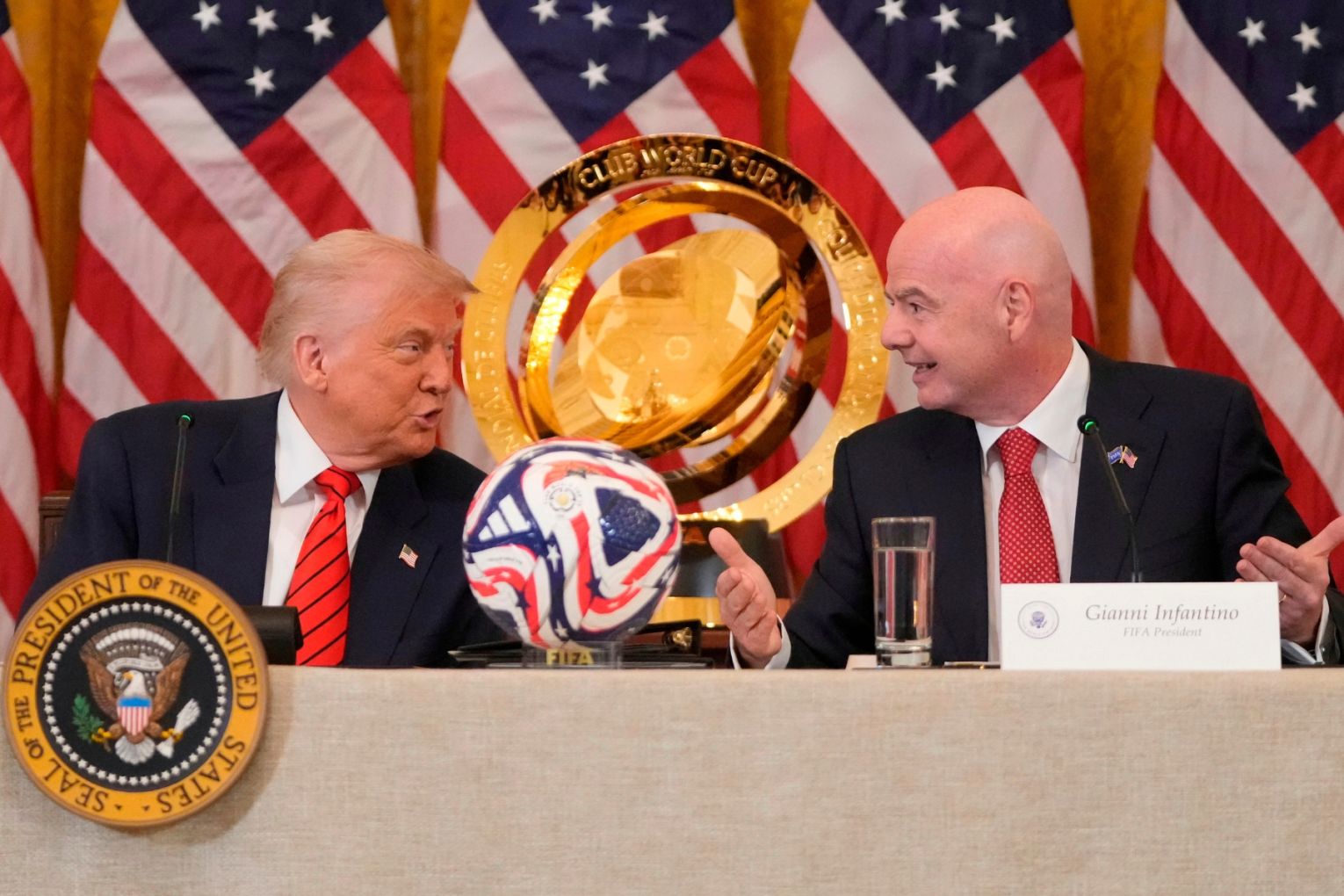
FIFA president Gianni Infantino famously declared this tournament would be “the biggest, the most inclusive, the greatest FIFA World Cup ever”.
But fans, officials and players alike have had their issues entering the United States amid the country’s immigration crackdown under President Donald Trump.
Somali referee Omar Abdulkadir Artan had his World Cup dream ended by border control.
Artan, who was due to become the first Somali referee to officiate at the World Cup finals, was denied entry to the US after arriving at Miami International Airport from Istanbul on Saturday.
An Iraq team photographer was turned back at Chicago’s O’Hare airport while striker Aymen Hussein was held and questioned for nearly seven hours before he was permitted to enter.
Then there’s Iran.
The US, with Israel, launched military attacks on Iran mere months after FIFA awarded Trump their inaugural ‘Peace Prize’.
The Iranian football team’s stresses have included relocating their training base from Arizona to Tijuana, Mexico, members of the delegation being denied visas for the US and concerns over travel for games there.
Fans from multiple countries have been denied visas, while the astronomical cost of some tickets has locked out others.
Because of the size of the tournament, the cost and duress of travel has been a deal breaker for many.
Even with Australia having one of the more straight-forward travel routes – Vancouver, Seattle, then Santa Clara – it’s a lot.
Some players will have family along for the journey.
Others, like Awer Mabil, chose to do it alone, noting how the complications of travel and border crossings compared to the far easier logistics experienced in Qatar.
“This time, it was last-minute to organise a lot of things so it was better for them to stay at home,” Mabil told AAP.
“Also the travelling would be tough for my mum and my little siblings to travel in and out.
“I didn’t want that headache for them. To be honest, also, it’s probably better for me because I can be at peace knowing my family’s OK, they’re watching the game at home.”
You might like
The Socceroos are among those teams hoping to shock the world when the football gets started.
This World Cup includes four debutants: Cape Verde, Curacao, Jordan and Uzbekistan.
In the expanded 48-team format, 32 teams – including eight of the 12 best third-placed outfits – reach the knockouts.
European champions Spain are the favourites, ahead of France, and 2010 champion Juan Mata is feeling optimistic.
“Spain has a good chance – I would say they’re one of the favourites,” Mata told AAP.
“But sometimes in the World Cup, it’s a short competition so not always the best team wins – you need sometimes luck on your side in certain elimination rounds.
“But it things go well, Spain should have a chance of fighting for it.”
Can a 41-year-old Cristiano Ronaldo snare a coveted World Cup trophy with Portugal?
Will Lionel Messi, 38, and Argentina defend their crown?
Is this the year England end 60 years of hurt?
Let the games begin.
– AAP
Want to see more stories from InDaily SA in your Google search results?
- Click here to set InDaily SA as a preferred source.
- Tick the box next to "InDaily SA". That's it.