Lifelong crusade for women abused in war
The passage of time does not diminish the pain of women who have suffered from violence and rape during armed conflicts.
Years after the horrors they endured during the Second World War the remaining ‘comfort women’ continue to speak about the effect their experiences had on their lives.
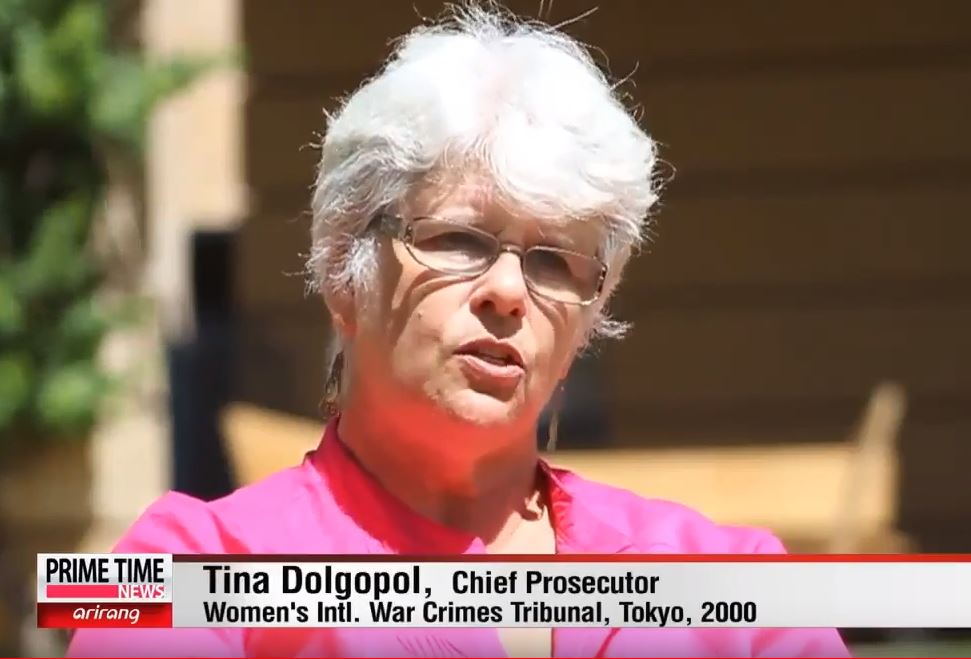
South Australian legal academic Associate Professor Tina Dolgopol’s long campaign for female victims of war has seen her join an elite list men and women honoured at the launch of the Gender Justice Legacy Wall in New York last week.
The Women’s Initiatives for Gender Justice Legacy Wall was launched at the United Nations in New York during the International Criminal Court (ICC) Assembly of States Parties, with the Legacy Wall names to be incorporated next year into the new ICC building in The Hague, The Netherlands in mid-2018.
Associate Professor Dolgopol, who taught at Flinders University for more than 20 years, has been recognised for her work to promote the human rights of women affected by armed conflict including her participation in the negotiations for the Rome Statute which established the International Criminal Court.

“Many of those who are targeted during armed conflict are reluctant to speak about their experience,” says US-born Associate Professor Dolgopol, who has extensively researched and published information about the ‘comfort women’.
“From the Korean peninsula, China and Taiwan, to Malaysia, the Philippines, Indonesia, Timor, PNG and the Pacific, the then military and government of Japan systematically created ‘comfort stations’.
You might like

“They captured women from the countries they occupied, including some women from expatriate communities such as the Dutch living in Indonesia.
“One of the Dutch women who was subjected to the brutality of the ‘comfort stations was Adelaide woman Jan Ruff O’Herne who was brave enough to speak about her experiences nationally and internationally.
“Her testimony helped to publicise the cause of the comfort women.”
Sadly violence against women has not decreased despite the overwhelming condemnation of such acts by the international community.
Two recent widely reported instances are the systematic rape by Myanmar armed forces of Rohingya women escaping to safety and the rape and sexual enslavement of Yazidi women by ISIS.
“Armed conflict breeds acts of inhumanity and women become particular targets for acts deemed to be war crimes or crimes against humanity,” Associate Professor Dolgopol says.
Her inclusion in the inaugural Gender Justice Legacy Wall acknowledges her work at the Tokyo Women’s Tribunal in 2000, which investigated the Japanese Imperial Army’s sexual enslavement of the comfort women during World War II. She was one of the co-chief prosecutors at the Tribunal.
Prior to the commencement of the Tribunal, she worked with the organising committee to develop its terms of reference and create its statute. She then provided a legal brief on issues concerning compensation for international wrongs, interviewed a number of expert witnesses and supplied documents from the Allied war records held by the Australian War Memorial archives.
Stay informed, daily
Many years of work preceded Associate Professor Dolgopol’s role in the tribunal.
In the early 1990s, Associate Professor Dolgopol undertook an investigative mission for the International Commission of Jurists (ICJ).
During the mission, she visited North and South Korea, Japan and the Philippines, and interviewed women who had been forced into the ‘comfort stations’.
The ICJ published a final report that included an extensive legal analysis in 1994. Both the initial and final reports were entitled ‘Comfort Women – an Unfinished Ordeal’.
The final report received widespread publicity and was widely quoted in UN reports on the issue and remains a major source of material for groups working on this issue.
Associate Professor Dolgopol’s work on comfort women, and the publicity that accompanied the ICJ reports, contributed to the growing international pressure on Japan to offer a full and frank apology. “Although several apologies were issued, many feel they were not sufficiently frank,” she adds.
The Legacy Wall honours and celebrates many of those who, over the past 125 years, have contributed to the field of international gender justice as practitioners, advocates, judges, prosecutors, grassroots and other organisations, survivors, witnesses (by number for anonymity), academics, diplomats and others.
The names installed on the Gender Justice Legacy Wall are representative of the disciplines which have helped to shape this work and those selected reflect regional diversity, a variety of contributions to international gender justice, as well as noteworthy and memorable developments.
The Women’s Initiatives for Gender Justice works globally to ensure justice for women and communities affected by armed conflict and an independent and effective International Criminal Court.
Associate Professor Dolgopol continues to publish and to supervise Flinders’ postgraduate students although she retired from undergraduate teaching in 2014.
She is on the management committee of Justice for Refugees, contributes to the work of the Circle of Friends and is a guide and volunteer at the Art Gallery of SA.
Human Rights Day on 10 December marks 69 years since the United Nations General Assembly adopted the Universal Declaration of Human Rights on December 10, 1948. With the 70th anniversary coming up in 2018, the UN has launched Stand Up 4 Human Rights, a year-long campaign to bring the ideals of the declaration closer to reality.
Want to see more stories from InDaily SA in your Google search results?
- Click here to set InDaily SA as a preferred source.
- Tick the box next to "InDaily SA". That's it.