Why not build wind farms at sea?
The Australian Government appears to be intent on scaling back wind farms in Australia.
A Senate inquiry has recommended increasing regulation for wind farms in response to health concerns, and Prime Minister Tony Abbott recently commented to radio host Alan Jones that his government has managed to reduce the number of “these things” [wind turbines], but he personally would have preferred “to have reduced the number a whole lot more”.
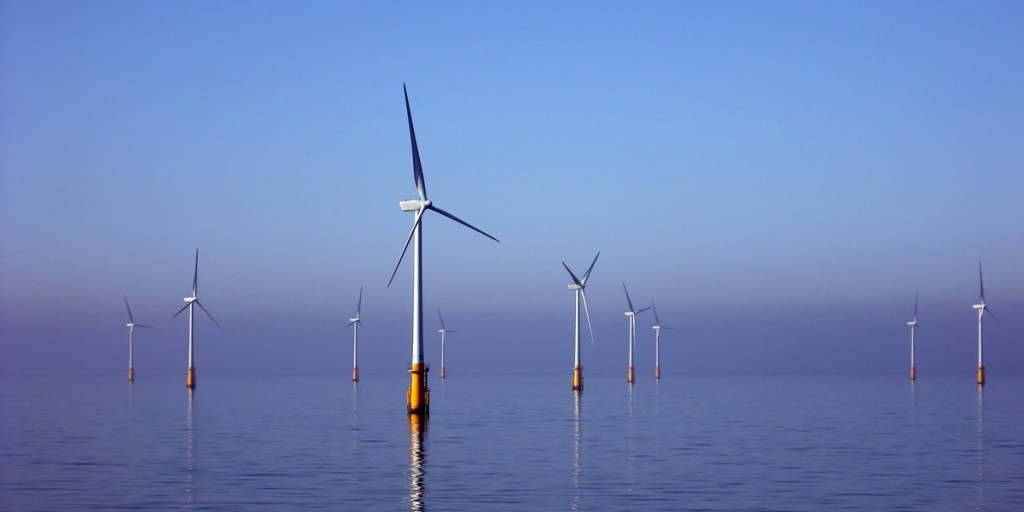
But there’s another solution that would continue to build the capacity of wind energy while removing possible impacts on land-holders: put wind farms out to sea.
The primary drivers for the government’s hostility to wind farms centre around the alleged socio-cultural and health impacts of wind turbines.
In the view of opponents, wind turbines represent an unsightly blight upon the landscape and cause intolerable noise pollution.
Concerns over their potential impacts on human health have also been raised, although here it can be observed that the National Health and Medical Research Council recently stated there is no direct evidence that turbines affect physical or mental health.
The Australian Government’s stance is increasingly out of step with the international community – both economically and morally.
In recent weeks the G7 group of nations announced its commitment to reduce emissions of carbon dioxide to 40-70 per cent below current levels by 2050, and to eliminate the use of fossil fuels altogether by 2100. As a renewable energy source, wind farms can help to displace the use of fossil fuel generation in the electricity network.
You might like


And last week Pope Francis and his 183-page encyclical made a radical call to decarbonise and address climate change as a major existential issue.
The government-led attack on wind farms is therefore at odds with a global shift in the development of renewable energy, with wind a leading technology in the renewable picture.
Stepping offshore
One approach that would serve to sidestep the problems of terrestrial wind farms (real or perceived) is to send the turbines offshore. Marine renewable energy, whether from wind, wave or tidal sources, is set to become a major supplier to global energy needs.
Among the differing technologies, offshore wind is emerging as the most efficient and competitive player, with significant expansion in Europe and Asia.
In Europe, more than 2080 offshore turbines have been installed and connected to the grid in 11 European countries, with a cumulative total of 6562 megawatts (6.562 gigawatts, or GW) in 69 wind farms. Wind energy (both offshore and terrestrial) is a small but growing part of renewables production in the EU, consisting of 10.5 per cent of the EU-28’s renewable energy produced in 2013. The United Kingdom is the leading producer of offshore wind energy, with installed capacity of 4.5 GW, a further 12.6 GW in construction or approval, and 5.2 GW in planning.
Ambitious future forecasts include 40 GW of European offshore wind by 2020, meeting 4 per cent of the EU’s electricity demand, with a further 110GW to be installed between 2020 and 2030 that would meet 14 per cent of EU demand.
In China, 0.67 GW of offshore wind capacity is installed, with more on the way as renewable energy is increasingly recognised as an important and growing element of China’s energy mix. China produced 450 GW of renewable energy in 2014.
Meanwhile, South Korea is forecast to become a major strategic player, with numerous offshore wind farm sites in the planning phase. It is investing $US9 billion into a massive 2.5 GW wind power development led by Korea Electric, one of the world’s leaders in tidal energy production.
Small-scale but growing
Stay informed, daily
In terms of the overall energy picture the amount of installed capacity from marine sources – wind, wave and tidal – is currently small. Of the 369 GW of global wind production, only 8.7 GW (2.3 per cent) is from offshore wind.
Total ocean renewable energy as a proportion of the global renewable capacity (which includes hydropower and onshore wind) is also tiny, currently just 0.5 per cent.
This situation is expected to substantially shift in coming years as terrestrial systems reach capacity in terms of competition for space, social opposition or in limits to generative capacity, and the concept of the blue economy gains momentum in coastal states and regional clusters such as the European Union and the Asia-Pacific Economic Cooperation (APEC) countries.
Opportunities and challenges
Australia has a long coastline and abundant offshore wind, wave and tidal energy resources at its disposal. Pushing wind farms offshore would seem to circumvent the main objections to wind turbines on land while giving the renewable energy sector an opportunity to grow.
Providing such an avenue for the renewable energy sector would grow the innovation and manufacturing base, providing an avenue for a high-skilled and technical workforce and giving Australia a stake in a growing global market.
Emerging technologies such as wave and tidal, while currently small, have been recently supported by coalition ministers, including a recent world-first connection of a wave hub in Western Australia.
Arguably, moving wind turbines offshore merely transfers the burden of their visual impacts to sea. Crucially, though, few people (indeed, vocal voters) live where such turbines might be located.
Offshore wind turbines represent proven technology but are likely to be more expensive both to build and maintain. However, recent estimates highlight that costs are falling, and are potentially cheaper than gas-fired or nuclear options.
It can also be anticipated that existing marine users, such as fishermen, are unlikely to welcome such a “new” and potentially competing offshore activity. That said, there are ways and means to overcome such apparently conflicting uses, for instance through processes of marine spatial planning that are emerging worldwide.
While implementation challenges exist for offshore wind energy developments, this option offers a pathway for Australia to stay in the renewable energy game, reduce our carbon emissions and develop innovative new industries.
Clive Schofield is Professor and Challenge Lead, Sustaining Coastal and Marine Zones, at the University of Wollongong. Tavis Potts is a senior lecturer in Human Geography at the University of Aberdeen. This article was first published on The Conversation.
Want to see more stories from InDaily SA in your Google search results?
- Click here to set InDaily SA as a preferred source.
- Tick the box next to "InDaily SA". That's it.