Socceroos journey into the unknown
Exactly a year ago, I understood how odd it feels to leave a city that you’re certain you’ll never return to.
Cuiabá, in Brazil’s mid-west, isn’t awful but it is remote. A place that can only be reached by two flights from Rio would have to offer a bit more to be added to a future travel itinerary.
As I lined up to board a plane out of Cuiabá, in a giant shed that poses as an international airport, I wondered if I’d made the most of my stay. Perhaps not, but I wasn’t despondent – it was enough just to experience a place I wouldn’t have seen if Australia hadn’t played a World Cup match there.
This is actually one of the best things about following the Socceroos overseas if you’re fortunate enough to have the means to do so. It takes you to cities you might not have thought of visiting.
In 2008, I was planning a trip to Uzbekistan’s capital, Tashkent, for a World Cup qualifier but it would have needed two weeks of leave and that wasn’t possible at the time.
A few months later I travelled to a qualifier in Japan and I met some of the Aussies who’d been to Tashkent. They all said they’d never have gone there were it not for the Socceroos’ match; they were gushing about that trip.
Back then I thought Uzbekistan (who Australia hadn’t played before) was one of our last frontiers. We’d recently made the move from Oceania to Asia and the World Cup qualification system of the time ensured we’d only ever face the region’s better teams. Most of those countries are either in Asia’s east or around the Persian Gulf. Uzbekistan is an exception.
You might like

This time the Asian Football Confederation has given most of the region’s minnows a chance to play the big guns. A consequence is that the group of five Australia has been drawn into includes another three countries we haven’t faced before: Bangladesh, Tajikistan and Kyrgyzstan.
And it’s in Kyrgyzstan, once a part of the Soviet Union, where the Socceroos’ campaign to qualify for Russia 2018 begins tomorrow night.
Kyrgyzstan? There can’t be many nations we know less about.
We have few ties with the landlocked central Asian country, it’s a long way from our main overseas travel destinations and there aren’t many Kyrgyz here (the ABS estimates there are only 460 in Australia).
Yet all this just adds to the fascination. I know of three Aussies who are currently in Bishkek, the capital city. And yes, I’m a bit jealous.
It’s likely that Kyrgyzstan’s national team and its players were also largely unknown to the Socceroos’ backroom staff before Australia was drawn into the same group.
Until its 3-1 win in a qualifier in Bangladesh last week, Kyrgyzstan hadn’t played an international for six months. Most of its matches are against other minor Asian teams and all bar one of its players are either with a local side or a lower-division club in Europe.
Even Kyrgyzstan’s pre-1991 soccer history is unremarkable. None of its clubs ever reached the Soviet Union’s top division.
Stay informed, daily
The reasons? It’s never been one of the bigger nations in the region (the current population is around 6 million) and it’s also one of the poorest. Kyrgyzstan and Tajikistan are by far the worst off ex-Soviet countries.
So we should win, right?
Yes. But it might not be straightforward.
When I looked at the then-upcoming draw to decide the qualification groups in April, I wrote that our away matches “could involve playing in unfamiliar places, perhaps on bumpy pitches, with an opposition using all 11 players to defend desperately in front of its raucous crowd”.
We certainly start in an unfamiliar place and photos of the pitch have appeared on Twitter in recent days showing it’s far from ideal. We’ll see how our opponents set themselves up and whether the crowd is raucous tomorrow night.

The Kyrgyz might also hold an ace in Anton Zemlianukhin, who plays in Serbia’s first division and scored two outstanding goals in the win over Bangladesh.
Failure could be costly. Even though this is the first of eight games the Socceroos will play in the qualification group, they’ll be desperate to begin well. Only the group winner definitely progresses to the next phase. Anything less and our 2018 campaign might be over by March 2016.
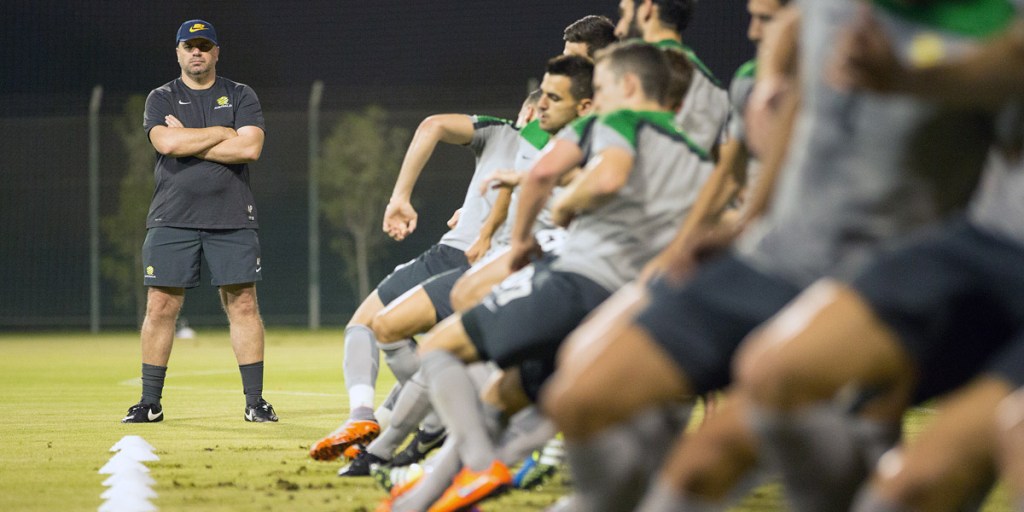
Ange Postecoglou is sticking with the team that won the Asian Cup in January, with most of his squad changes forced by injury. But this assignment will be something new for a lot of those players. It’ll be Australia’s first qualifier for two years and in that time there has been so much turnover that only four Socceroos remain from the team that clinched a ticket to Brazil 2014 with a 1-0 win over Iraq.
It was a little strange seeing a story recently published on Football Federation Australia’s website about how defender Alex Wilkinson hasn’t played in a qualifier despite playing at last year’s World Cup finals and in the Asian Cup. He’s not the only chap in that boat.
Indeed, two months ago I also pointed out that Postecoglou himself has never taken charge of a qualifier (at senior level) even though he coached the team in Brazil last year and in January’s Asian tournament.
So many unknowns, so many firsts and, though it will be mentioned rarely, so much pressure. Win and there’ll be fewer nerves the next time the Socceroos find themselves playing in an unfamiliar country.
Speaking of which, who fancies a trip to Tajikistan in September?
Paul Marcuccitti’s soccer column is published in InDaily on Mondays. He is a co-presenter of 5RTI’s Soccer on 531 program which can be heard from 11am on Saturdays.
Want to see more stories from InDaily SA in your Google search results?
- Click here to set InDaily SA as a preferred source.
- Tick the box next to "InDaily SA". That's it.