Enchanting Venice full of surprises
Venice is a cliché, a travel tale told once too often, the backdrop to too many Bond films and advertisements featuring George Clooney to be taken seriously as a destination.
This was the line of the conversation with my husband as we planned an extended holiday in Italy and the prospect of a visit to the waterlogged city came up.
But something compelled me to put those reservations aside and go anyway – maybe the thought of rising seas and a ticking clock for this ancient wonder. Whatever it was, we booked our train from Torino to Venice in late October, mercifully missing the celebrity wedding of the year by just one week and emerging from Santa Lucia station onto the Grand Canal in brilliant sunshine.
Lugging our cases behind us, we tracked down the ferry to the district of Castello, where our apartment was located, and settled in for a half an hour of postcard-perfect canal views. Eventually our little boat burst free of the confines of the canals into the open water of the Laguna dividing the hospital from the cemetery.
It was school pick-up time and we had taken on a variety of mums and kids along the way, with prams vying for space alongside bulging suitcases. I started eavesdropping on the conversations between the locals (one of the benefits of knowing the language) – play dates for kids, promises to meet for coffee later in the afternoon, the usual stuff of family life.

The ferry pulled up to Celestia, just past the city hospital stop where the water ambulances surge in and out attending to the medical dramas of the local population. We disembarked onto a fairly deserted side street, stopping to consult our map.
You might like


My Italian husband, by now deprived of coffee for at least a couple of hours, commented on the delicious aroma wafting from a window above. Almost immediately, a greying head popped out and asked if we would like a cup. Welcome to Venice! Despite our protests, moments later he reappeared with a steaming espresso and a reassurance that he and his wife always enjoy a pot of coffee at this time of the afternoon and it was no trouble at all.
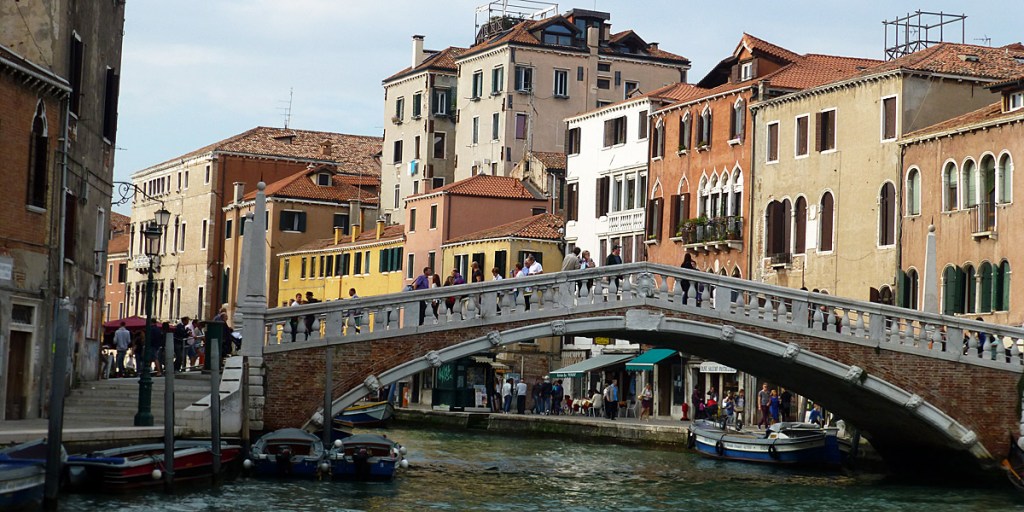
 Warmed by this random act of kindness, we began wending our way through laneways and tiny piazzas to Palazzo Contarini della Porta di Ferro hotel, past the Chiesa di San Francesco della Vigna (Roman Catholic church) and the Biblioteca (library) of the same name, over an arched bridge traversing the Rio de San Giovanni Laterano and into a maze of narrow lanes.
Feeling we may be almost there, we paused again on a corner to check the map. A sartorially dressed local gentleman approached, asking if we needed assistance. When we told him what we were looking for, he beamed and announced we had found it, triumphantly waving us on towards an imposing gate a couple of steps further down the lane as though it was the most exciting thing that had happened to him all day.
So it was that the first two Venetians we met set the tone for four days of genuine hospitality and attitudes that belied the tsunami of tourists that flood this ancient city, day after day, a phenomenon that you might expect would cause a level of pleasantry fatigue among the locals. Instead, we observed a tight-knit group, getting on with their very Italian lifestyle but happy to interact with curious onlookers when the need arose.
The area of Castello in Venezia is, like every part of the city, packed with history. It contains the Arsenale di Venezia, the city arsenal with spectacularly thick brick walls, heavily decorated with statuary, as well as various churches, piazzas and bridges. But tucked in among them are schools, medical clinics, local markets, cafes and trattorias. Every little piazza, no matter how small, comes to life with local activity in the early evening when Italians take their passeggiata or stroll.

From our apartment, a brief and fascinating walk brought us to the famous sites of San Marco, the Bridge of Sighs and the Rialto Bridge and Markets. Our hosts at Porto di Ferro advised us to avoid these zones between the hours of 10am and 2pm, when tourist buses and cruise ships disgorge their human cargoes into Piazza San Marco. Outside of these times, we found places such as the Rialto Bridge almost deserted, making it easy to perpetuate the fantasy that we were the only visitors to the city.
As with all Italian cities, if you wish to eat like the locals, it is best to avoid the restaurants lining the famous piazzas and waterfront. This also means sometimes foregoing the best views, but a good compromise can be found in taking the traditional aperitivo somewhere picturesque but repairing to the back streets for the main event.
Stay informed, daily
In the maze of back lanes, there are countless small establishments, most of them serving cuisine that is fairly typical to the Veneto region.
Obviously, seafood is a good choice when visiting a city that is more seawater than land. Specialties such as baked crab and frittura mista, a golden mountain of lightly floured and fried seafood and vegetables, had us licking our fingers, as did the cigar-shaped shellfish cannolicchi and the scampi-like crustaceans cigale.
If you get up early, a visit to the Rialto Markets will reward with displays of the freshest catches from local waters, most still wriggling, and beautifully presented seasonable fruit and vegetables. We were particularly taken with the pre-prepared artichokes, expertly cleaned and sitting in acidulated water ready to be turned into any number of delicious local dishes. Other treats available in autumn included various funghi, especially the orange-coloured ovali, or egg mushrooms, and various forms of radicchio.

Foodies be warned: unless your accommodation includes a kitchen (ours did), you may find the market tour agonising. Including a coffee stop with all the market workers and a very detailed shopping session, we easily spent half a day at the markets.
Another Venetian cliché is the gondola. I had to work hard to convince my husband that a ride was worth the expense and the time. We waited until our last evening in Venice and I had been observing the ebb and flow of the many gondoliers as we wandered about. Ultimately, we chose a very late afternoon and a departure point away from the usual spots.
Our gondolier had been plying the canals for more than 40 years and had an interesting story for every building we passed. Thankfully, he also allowed much of our trip, which lasted a good half-hour, to pass in silence. As the evening descended, we saw an enchanting side of Venice from the perspective of the dark water, looking into the city through back doors just as the lights inside were coming on. It was a very peaceful end to our stay and well worth the cost.

Venice no doubt shows a different face to every visitor, depending on where you visit, at what time of year and what exactly you are looking for. However, as seasoned travellers, we were both surprised and delighted by what it had to offer and plan to return very soon for another taste.
Getting there: Emirates flies daily to Venice from Adelaide (via Dubai). Boat transfers from the airport to the city offer a spectacular start to your Venetian stay. Trains from most major cities in Italy arrive daily at Santa Lucia station, which opens directly onto the Grand Canal from where boats can be boarded for all parts of Venice. A long-term carpark is located on the city fringe.
Where to stay: Palazzo Contarini della Porta di Ferro. Set on one of the smaller canals in a quiet area of Castello, tucked away from the tourist hubbub, the apartment suites in this ancient palace, dating back to 1300, retain a strong sense of their history. They are elegant and restrained in décor but rich in Venetian splendour such as sparkling chandeliers and tapestries, marble fireplaces and terrazzo floors.
Where to eat: Osteria da Alberto opened in 1924 on the site of an old inn on Calle Giacinto Gallina, in the Cannaregio district. The building is classic Venetian, with a long, skinny dining room that looks like it grew on the banks of the canal, rather than being built there! Cuisine is also traditional Venetian and, judging by the healthy mix of locals along with the tourists, they get it right. There is a strong focus on seafood but also other famous cicchetti, or bar snacks and delicacies such as polpette (meatballs) and nervetti con cipolla (tendons with onions).
Want to see more stories from InDaily SA in your Google search results?
- Click here to set InDaily SA as a preferred source.
- Tick the box next to "InDaily SA". That's it.