China deal a win for services sector
China has seized the opportunity of a free trade deal to get Australia’s help in transforming its economy from an industrial base to a services one, the government says.
Trade Minister Andrew Robb says there will be thousands of opportunities for Australian businesses arising from the new deal.
“They’ve still got 700 million people on farms who are, most of them, below the poverty line, who will be moving into the cities,” he told ABC radio today.
Moving to a service-based economy would provide jobs for all those people, he said.

“That’s our sweet spot, that’s our skill set,” Mr Robb said.
“China realised that Australia offered an enormous opportunity to assist them to move from what is an industrialised economy to a services economy.”
He highlighted areas such as legal services, child care, aged care, private hospitals, health, education, engineering, mining and extraction services, manufacturing, architecture and urban planning.
“If you run an aged-care home in Australia, once this deal is in place … you’ll be able to open up one or 100 (in China) if you like, own 100 per cent of it, make profits out of it,” he said.
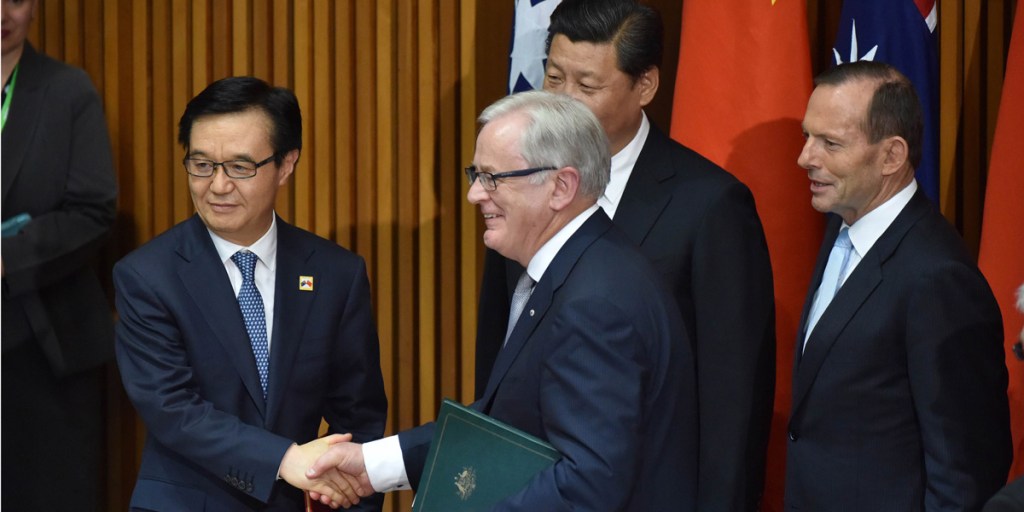
Chinese president Xi Jinping and Prime Minister Tony Abbott inked the deal in Canberra yesterday, but it won’t come into effect for another four or five months.
Stay informed, daily
More than 85 per cent of Australian goods exports will be tariff-free when the agreement starts, rising to 93 per cent in four years.
When it is fully operating 95 per cent of Australian goods exports to China will be tariff-free.
Labor is continuing to call on the government to release the full text of the deal before it comes into effect.
But Opposition trade spokeswoman Penny Wong says Labor generally stands by the principle of trade liberalisation being good for Australian jobs.
Want to see more stories from InDaily SA in your Google search results?
- Click here to set InDaily SA as a preferred source.
- Tick the box next to "InDaily SA". That's it.