Working to get science a fair hearing
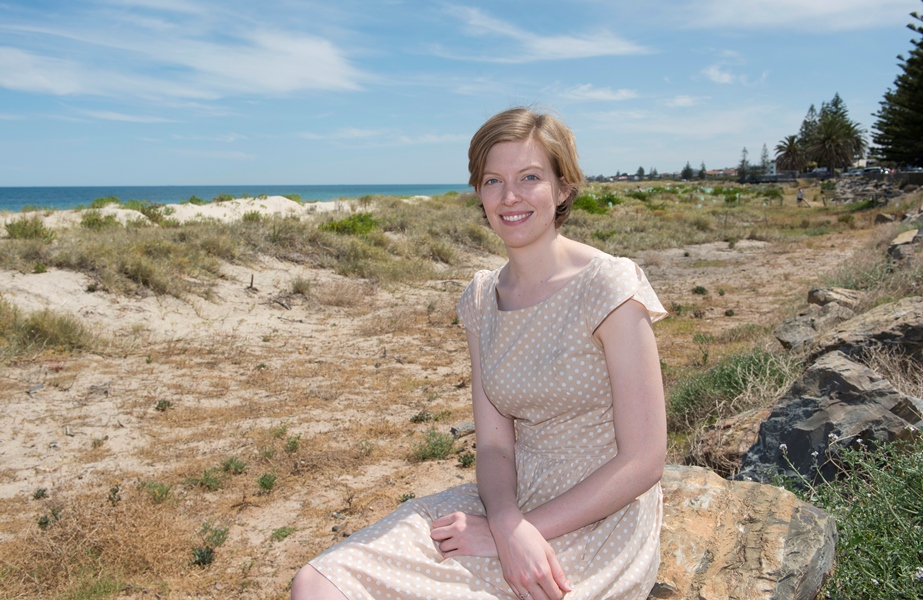
Flinders Law and Environmental Science graduate Carley Bartlett is on a quest for understanding.
She wants to understand, for example, why good science is often not included in important decision-making. She’d also like to understand why public policy occasionally verges on the irrational or outright reckless in the face of irrefutable scientific evidence to the contrary.
This quest has seen her spend the past two years working with the Wentworth Group of Concerned Scientists as a Graduate Researcher, and will soon take her to the Chambers of Chief Judge of the Land and Environment Court of New South Wales, Brian Preston.
Speaking over the phone from Sydney, she quickly identifies one of the challenges currently facing Australia which could benefit from better use of science.
“I’ve worked with all thirteen members of the Wentworth Group to varying degrees, but in particular I’ve work a lot with Professor Bruce Thom, who is one of the foremost coastal experts in Australia,” she said.
“As part of that, I’ve been looking at the role of land use planning in preparing for natural disasters and extreme weather events; which has been really interesting.
“One of the things we’ve discussed and worked on is how as a society we rebuild things which have been destroyed or badly damaged in extreme events.
You might like


“Sometimes readily available science is not incorporated into recovery efforts when it seems so obvious that it could be.
“For surely, in these cases, you need to look at building things better and stronger, or even consider whether you should be rebuilding at all, but often things are rebuilt to the same standard as before. I want to understand why this occurs.
“If you rebuild something in an area of high risk, particularly with a changing climate, it seems obvious that you would reassess if it should be built there at all, but sometimes that doesn’t happen.
“Risk of future disasters is not just important when rebuilding, it is also vital when assessing new developments.
“If we can influence planning reforms so that there is more consideration of these kinds of issues that would be a great thing.”
After two years spent identifying some of the issues with the Wentworth Group, Ms Bartlett is hoping to achieve a greater understanding of how they are dealt with in law when she begins working as ‘Tipstaff’ for Justice Brian Preston.
“A Tipstaff is a court position, which is called a Judge’s Associate position in South Australia,” she said. “It’s a research position, so will build on the responsibilities I’ve had at the Wentworth Group.
“I will sit in court and support the writing of Judgments, and work in Chambers with the Judge assisting with things like drafting speeches and papers.
Stay informed, daily
“That’s going to give me a new perspective on the interactions between science and law – for example, what the role of science is in judicial decision making.”
“Hopefully that will help me get a better understanding of how to stand up for science.”
Given that Flinders Law School has a proud history of the kind of law reform that Ms Bartlett cares so passionately about, it’s perhaps not surprising that she has fond memories of her time there.
“My time at Flinders was very positive,” she said. “I had multiple courses taught by Brendan Grigg, who taught me a lot about Environmental Law.
“I found even the simple practical things, like watching a lot of court proceedings, to be really beneficial as early exposure to how the legal system actually works.”
It was on Flinders University’s website, in fact, that she saw the Wentworth Group position.
“I saw the advertisement and put my application in because I wanted to work with the Group’s members; people of principle with formidable reputations in their fields, who continue to stand up for science despite being knocked back time after time,” she said.
“I thought it was an incredible opportunity and a great way to combine my science and my law background.
“I did a double degree in Law and Environmental Science at Flinders because I loved environmental chemistry in high school and because I also wanted to see how environment fits into the world through law.
“I had heard of the reputation of Flinders Law School and how it was designed to me more practical and prepared people for the real world and work force.
“I found that to be true. It’s given me an invaluable foundation to my career.”
Want to see more stories from InDaily SA in your Google search results?
- Click here to set InDaily SA as a preferred source.
- Tick the box next to "InDaily SA". That's it.