Richardson: All that glitters isn’t gold
At one point on Wednesday night, while the Aussies were flailing through their Twenty 20 innings, some behind-the-scenes boffin thought it a grand idea to blast an old-time fist-pumper through the Adelaide Oval loudspeakers. Their choice, simultaneously uplifting and jarringly awkward, was the one-time stadium standard ‘Rock And Roll, Part 2’ by fallen ‘70s icon Gary Glitter.
I never grew up with the song; the first I was aware of it was on the soundtrack to the ‘90s cult film The Full Monty. I didn’t even know it was by Gary Glitter until a couple of years ago, long after the pop star’s alter ego Paul Francis Gadd was first convicted of persistent child sexual abuse.
But no doubt for many in the Oval crowd, Rock And Roll was a part of their own childhood; it might conjure carefree reminiscences of driving down Rundle Street with the top down and the stereo blaring, or lounging by a Victor Harbor campfire with the ghetto-blaster blasting; it might have heralded a first dance with a future spouse, or that weekend away with best mates that still inspires a pensive smile decades on. But I can’t imagine even those people break into spontaneous fist-pumping these days when it comes on. Surely the appropriate response to it momentarily hijacking the Adelaide Oval PA is an uncomfortable mass recognition: “Oh, this is that song by the convicted paedophile.”
It’s not, though, that the artist’s subsequent arrests and convictions, with his name ensconced for life on the Sex Offenders’ Register, make the song intrinsically any less catchy.
It’s a moral dilemma I wrestled with last year when Ian Watkins, the lead singer of Welsh band Lostprophets, pleaded guilty to attempted rape, sexual assault and child pornography involving children as young as one. The details of the case were appalling. Lostprophets weren’t a particularly good band, but I did have one of their (relatively) old songs floating around in the virtual recesses of my iTunes library, and when it inevitably shuffled its way out of my speakers, it reminded me happily of people and places mostly forgotten. I liked the song. But I deleted it from my iTunes library nonetheless. There is no piece of music good enough to justify putting Ian Watkins’ crimes back into your thoughts.
It’s not that those crimes fundamentally devalue his art (for want of a better word); it’s just that it becomes impossible to separate that work from its creator.
You might like


The evil that men do lives after them, and all that; the good, such as it was, interred with their bones.
This, of course, prompts many a moral debate: should people be judged only on their worst deeds? Or only if their worst deeds are the most despicable of crimes? Even then, does that mean everything of value in their life and work is undone?
Bernie Finnigan was a Labor star slowly but surely (in his understated way) rising through the political ranks at the time of his 2011 arrest on child pornography charges. The specific charges have been varied a few times since, and he is of course presumed innocent, and may yet be proven so; though the Labor Party’s public actions do not greatly respect this presumption. Whatever the outcome of the case, he is unlikely to be welcomed back into the ALP fold and even less likely to be re-elected to parliament. Such is life.
Some of his one-time friends and colleagues will admit privately, though, that he made a significant contribution to the party; he had a rare talent, a “brilliance”, for campaign strategy, to which more than a few Labor MPs in marginal seats probably owe their careers. As a factional powerbroker, he helped build and maintain the Labor “machine” that has proved such a successful apparatus for seizing and, more importantly, retaining power. None of that, however, will be remembered when the story of his contribution comes to be told, regardless of the outcome of his case.
Invariably, when people reflect on others, they are wont to remember the good or to remember the bad. Rarely both. It’s simply too complicated.
So when the bad is so egregious as to be criminal, it’s easy to dismiss their individual contributions; to delete them from our music libraries, or to demand their resignation from parliament even before their case has proceeded to trial.
Stay informed, daily
The uncomfortable truth is that their worst misdeeds don’t undo their successes, merely sit awkwardly alongside them.
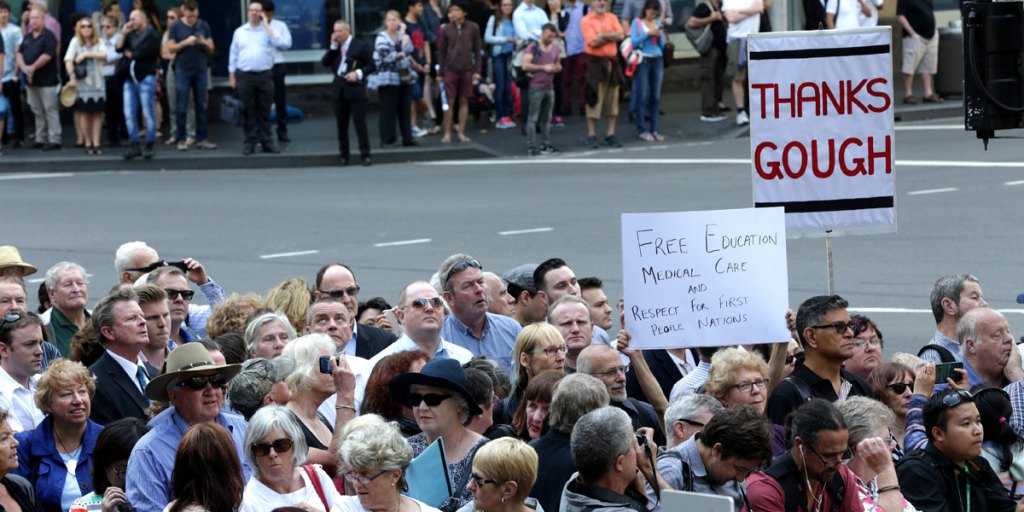
While child sexual predators and alleged viewers of child pornography are an extreme example, we saw a similar phenomenon after the recent death of Gough Whitlam. In life, most reasonable observers would acknowledge he led a bold and well-intentioned Government that tried to undertake a generation of reform in three years of turmoil, exacerbated by economic malaise. In the 1993 documentary Labor In Power, Bob Hawke himself sneered that the Whitlam Government was “economically inept to a degree which is almost beyond description”. It was not an estimation he repeated after Gough’s death, instead eulogising that “no star has shone brighter in the Australian political firmament”.
As Jim Morrison once said: “Death makes angels of us all.”
The hagiographers deifying the man who lost three out of the five elections he contested as Labor leader – two by record margins – at least struck a tasteful chord (apart from those who felt compelled to jeer his Liberal successors at his memorial event). By contrast, some critics simply couldn’t stomach all this talk of the man’s notable achievements, and were thus moved to unnecessarily highlight his shortcomings; as if to prove that the left’s hyperbole was no match for the right’s, Greg Sheridan at The Australian pointedly chose the day of Whitlam’s death to proclaim him the “worst Prime Minister in Australian history”.
(Interestingly, Whitlam’s great political nemesis Malcolm Fraser managed to provide the most genuine of tributes, visibly moved as he declared Whitlam would be “remembered as a giant of an Australian who contributed enormously to Australian life in so many ways”.)
Even in death, Whitlam has divided Australians, as his standard-bearers and his crucifiers jostle for column inches. Australians, it seems, like a larrikin, a trier, a risk-taker. Gough’s “crash-through-or-crash” philosophy resonates with our national identity, even though it tended to result in the latter course during his fleeting, incandescent tenure in Government.
But no doubt a large part of the national outpouring in the weeks since Whitlam’s death is due to the collective wistfulness of a generation that recalled the opportunities of their free education, the passion of their ideology, the anger at their party being denied Government after only three years out of the wilderness. Recalling that era might summon youthful reminiscences of long-forgotten friends and long-suppressed political zeal, of cruising down Rundle St with Gary Glitter’s Rock And Roll, Part 2 blasting from the stereo.
One never likes to have that nostalgic idealism sullied by the realisation that our heroes were less than perfect. We can, though, for the most part, be mature enough as a nation to recognise Whitlam’s notable achievements – equal pay, Aboriginal land rights, free tertiary education (subsequently undone by another Labor Government), abolition of the death penalty, Medibank, abolishing conscription, touring China – while acknowledging the economic and political failures. Ultimately, one can’t have one without the other; which you choose to emphasise probably depends on your political persuasion.
Gough’s successes are significant enough after 40 years to withstand his significant failures. There is a degree of national maturity and benevolence in simultaneously celebrating the former while acknowledging the latter, rather than simply deleting that turbulent era from our collective consciousness.
After 40 years, we are evidently ready to dispassionately assess the Whitlam era – it’s time. Though I’m not sure there’ll ever be a time when it’s appropriate to blare Gary Glitter across Adelaide Oval.
Tom Richardson is InDaily’s political commentator and Channel Nine’s state political reporter.
In great news for InDaily readers, Tom will be joining InDaily full time from January next year.
Want to see more stories from InDaily SA in your Google search results?
- Click here to set InDaily SA as a preferred source.
- Tick the box next to "InDaily SA". That's it.