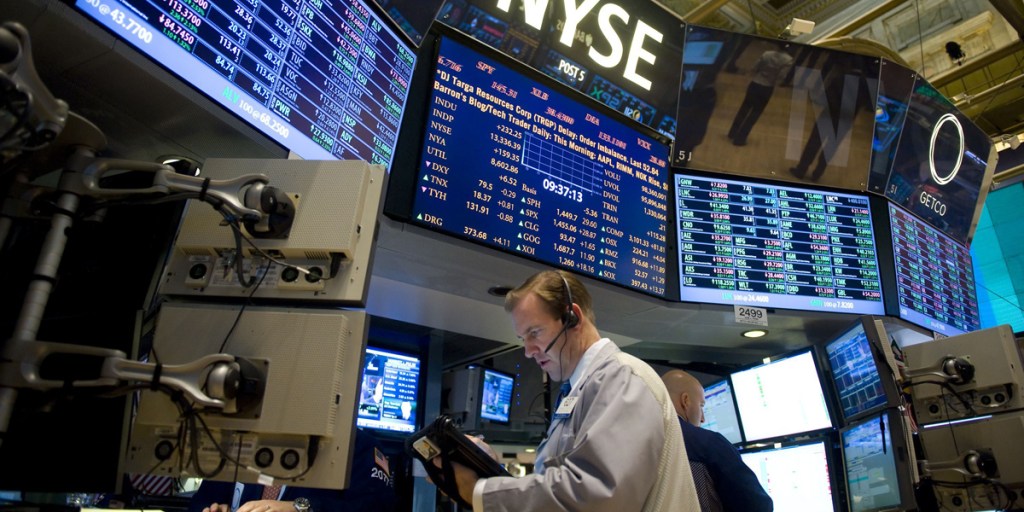
US stocks have finished a turbulent day in the red, rallying somewhat from a huge midday drop spurred by worries over global economic weakness and the Ebola epidemic.
The Dow Jones Industrial Average on Wednesday fell 173.45 points (1.06 per cent) to 16,141.74. The blue-chip index had fallen more than 400 points earlier in the session.
The broad-based S&P 500 dropped 15.21 (0.81 per cent) to 1,862.49, while the Nasdaq Composite Index lost 11.85 (0.28 per cent) at 4,215.32.
The main indices were in negative territory throughout the session, with swings in stocks accompanied by big moves in other markets. Equity markets in Britain, France and Germany closed more than two per cent lower, while yields on US Treasury bonds also sank below key benchmarks before rallying.
“We haven’t seen this level of volatility since 2011,” said Tyson McCabe, senior director of advisory services at Nasdaq.
You might like


“There are so many different data points coming in, being Ebola or some of the weak US data points, that market participants are really struggling with where to get their read from.”
Stocks fell sharply soon after the markets opened following disappointing reports on US retail sales and producer prices.
Equity markets then cut their losses but plunged again midday soon after US health officials warned of more potential Ebola cases after a second healthcare worker in Dallas was diagnosed with the virus.
Stocks began paring their losses again soon after the Federal Reserve’s Beige Book said the US economy continues to grow at about the same modest pace of recent months.
Stay informed, daily
The market’s lurches lifted some investments, such as the Russell 2000, a closely watched small cap index, which rose 1.0 per cent.
But “there is more negative than positive”, McCabe said.
The Australian dollar has bounced back above 88 US cents following the disappointing economic data from the US.
At 0700 AEDT on Thursday, the local currency was trading at 88.12 US cents, up from 87.31 cents on Wednesday.
Westpac senior market strategist in Wellington, Imre Speizer, said risk aversion accelerated overnight.
The US dollar dropped while bond prices surged.
He said the disappointing US data, along with additional reports on the spread of the Ebola virus, had driven the moves, but the Australian dollar had fared well.
“(The Australian dollar was) weighed by global risk aversion but supported by US dollar weakness,” Speizer said.
“We favour a rise towards 88.50 US cents.”
Want to see more stories from InDaily SA in your Google search results?
- Click here to set InDaily SA as a preferred source.
- Tick the box next to "InDaily SA". That's it.