Japanese military warns against subs deal: report
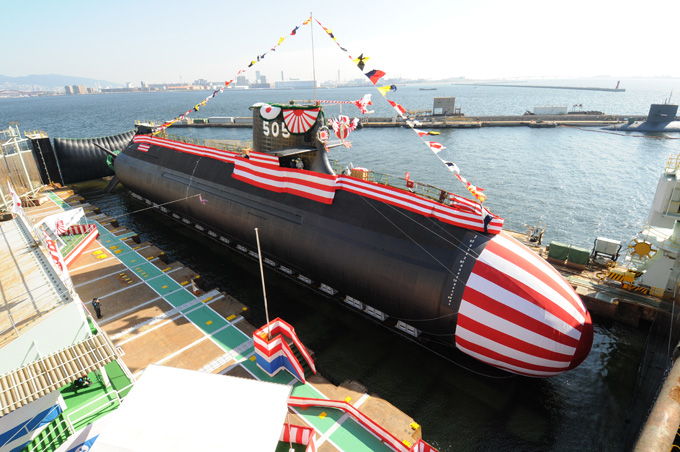
Former senior Japanese defence personnel have warned there is great reluctance within their ranks to share expertise – and caution that Australia could face long-term technical and implementation problems if it decides to buy Japanese submarines.
The report emerged today as the Australian Government continues its assessment of whether it should buy 10 state-of-the-art Soryu class submarines from Japan, at a reported price of more than $20 billion.
The Japanese subs are the only long range non-nuclear design that fits the Australian Navy’s specifications for boats to replace the current Collins Class, raising fears for the future of shipbuilding in Adelaide.
“It’s an issue of hull strength. Japan has secret technology, like special steel and noise reduction. So the issue is how can we share it,” Kazuhisa Ogawa, a former government defence adviser and one of Japan’s top military analysts, told Radio Australia.
He said the success of submarine warfare was decided by how quiet and deep the vessels could go.
You might like

Former Japanese submarine commander Toshihide Yamauchi, who was at sea for nearly 30 years. told the ABC’s North Asia correspondent that it took Japan 60 years to develop and master the Soryu technology, and he believed they would not just give it all away.
“This is not just about building a hull, it’s the most advanced submarine in the world and unless Australia studies it intensely and Japan helps, it will take decades,” he said.
“Australia could have many technical and implementation problems.”
Yamauchi and Ogawa both told the ABC that an Australian budget of $20 billion would mean that all the construction would have to happen in Japan.
Stay informed, daily
And they said any attempts to do any of the work in Adelaide would double the price.
Ogawa said if construction happened in Japan it would be bad for Australian jobs, but good for the Japanese economy.
“If the issue of military secrets can be resolved then Japanese business will be happy it will bring jobs and growth,” he said.
Retired submarine commander Yamauchi said buying the Japanese subs was not in Australia’s best interests, adding that Australia should keep developing its own industry.
“Australia should be clear about what kind of submarine it wants for its naval strategy for the later half of this century.
“Then it needs to ask Japan what part it can help with and get co-operation. Just to ask for the whole Soryu is not a good idea.”
Want to see more stories from InDaily SA in your Google search results?
- Click here to set InDaily SA as a preferred source.
- Tick the box next to "InDaily SA". That's it.