Richardson: When politicians say nothing at all
There was a surprisingly muted reaction to reports this week that the contract for the next generation of Australian defence submarines – long promised by both major parties to ASC in Adelaide – would likely instead be sent to Japan.
When the Olympic Dam expansion – a similarly-priced investment likewise hyped as an economic panacea – was shelved, there was mass hysteria; Jay Weatherill attempted to calm the doomsayers by pointing out that nothing bad had happened; rather, something good that we had expected would no longer happen.It’s an interesting distinction, and one he pointedly ignored recently when promised federal funding increases for health and education were withdrawn.
This time, though, there seems more resignation than outrage. Perhaps in South Australia we have simply become too accustomed (to borrow the Premier’s rationale) not to bad things happening, but to good things not happening.
Nonetheless, suggestions the subs contract was sunk prompted a requisite outcry (as much, I think, over the broken promise as over the policy decision per se) and a small but concerted rearguard action.
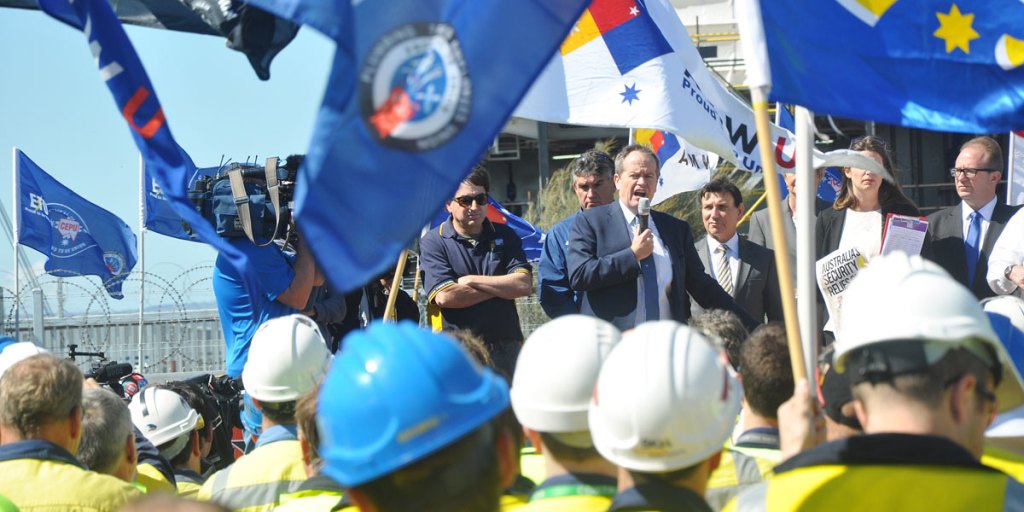
Around 1200 ASC workers rallied during their lunch break, with the assent and (presumably) support of their employer, whipped into an angry fervour by union officials, including Labor leader Bill Shorten.
Shorten hasn’t had a notable association with South Australia. He popped up, only once, in the recent state election campaign, introducing Jay Weatherill at Labor’s first-week campaign launch. His speech didn’t make headlines, had little local focus and didn’t particularly galvanise the gathered faithful.
Shorten’s old mate David Feeney once spent some time here, seconded by head office to co-ordinate Mike Rann’s ridiculously successful 2006 campaign against inept opposition. Feeney, now a Labor spokesman on defence matters, was at Shorten’s side on Tuesday, and the Opposition Leader deferred to him on any questions of genuine substance or fact. These were not Shorten’s stock in trade. His lot was more the platitudes; fire-and-brimstone throwaways, but delivered with neither fire nor brimstone.
He adopted a weird “union-heavy” persona when he stepped onto the makeshift hustings, on the back of a ute.
“Under Labor,” he barked in the manner of someone shooting for Winston Churchill but landing on Ted Whitten, “we will build ships and submarines in Australia … because we love this country!”
The workers applauded. Because they love this country too.
You might like

But like the Labor faithful at Weatherill’s election launch, they didn’t seem enraptured. Shorten’s address, while robust, was strangely lifeless.
He attempted to mount a national security argument for the subs deal, on the grounds that “long-term national security relies on having our own ability to build the equipment for our defence forces, so we can protect the best country in the world”. (That’s Australia, in case you were wondering.)
The rhetoric was empty, silly. It tacitly belittled his audience, the ASC workers, assuming them to be simplistic, xenophobic, jingoistic. He assumed ranting about the unquestionable quality of local manufacture and raving about national pride would win him brownie points. AMWU national secretary Paul Bastian sung from a similar songsheet, literally in fact; he tried to gee the crowd up with some military-style call-and-respond chants, although he quickly lost the rhyme and metre. But his point was succinctly made in the stanza: “They gave our jobs to the Japanese!”
It was never quite clear whether the real outrage was the likely lost contract, or the fact it appeared destined for the Land of the Rising Sun.
“The last time we had a Japanese sub in Australia it was in Sydney Harbour,” cried a voice from the crowd at one point.
Shorten tried to illustrate Australia’s island vulnerability by recalling the merchant ships that were sunk off the coast in the Second World War.
I imagined his Basil Fawlty-esque debrief: “Look, we’re talking about Japan, so don’t mention the War; I mentioned it once, but I think I got away with it!”
Perhaps we’re just lucky no-one pointed out the other frontrunner for our maritime business is Germany.
Shorten had one thing right, when he told the ASC employees: “You are the victims of a lie.” (Even if it is a lie in which Labor has been culpable, by failing in office to safeguard the contract Kevin Rudd pledged five years ago.)
There is no mistaking that the Coalition has walked away from an explicit election commitment. Back in 2010 and as recently as last year, Defence spokesman David Johnston expressly reiterated his commitment to a dozen new submarines being built at ASC in Adelaide. Even without a final decision to the contrary having been taken, the Federal Government is right now unwilling to confirm this commitment still stands. So the promise is already broken; it has abandoned the guarantee. If ASC is to win the contract (and the tea leaves suggest it won’t), a case must be made to convince the Commonwealth it is worthy of winning it.
Needless to say, Shorten did not make that case.

The workers he addressed knew it. There was little confidence to be taken from his “unequivocal” pledge that Labor would build subs in Australia, particularly when he twice refused to explicitly explain whether that included tearing up existing contracts if elected.
The first time he enigmatically explained there was “no way any person of conscience can reward Tony Abbott for lying”, before rambling off on a shallow political tangent that concluded with the pearler: “Torpedo Tony has torpedoed the Australian shipbuilding industry and Labor’s never going to stand for that”.
None the wiser, the reporter asked the same question again, to an even more mysterious response: “If this Government is committing us to 50 years and multiple billions of dollars, I don’t think future Governments automatically have to be bound to every mistake of the current Government.”
Got that straight?
Stay informed, daily
I used to deal with Shorten on occasion when he was national secretary of the AWU (before his 15 minutes of Beaconsfield fame). I found him impressive. There was little impressive on display on his Adelaide visit.
Perhaps the disparity is a symptom of the symbiotic relationship between federal politicians and the media; perhaps we’re both to blame.
You could almost see Shorten smirking to his adviser in the back of his chauffeured car as they drove off: “Did you like that line about Torpedo Tony? It just came to me!”
“That was brilliant, Bill; that’s sure to get a run on TV!”
And maybe it did, somewhere.
"… a canny politician quickly learns to say more or less whatever they like. Or to say, effectively, nothing at all."
A while back, Tony Abbott made headlines by attacking Shorten during a speech to the Tasmanian Liberal state conference, over Labor’s confused position on repealing the carbon tax. So, did Abbott appeal to him to respect his democratic mandate?
No. He called him “Electricity Bill”. Oh, and “Bill Shock” Shorten. Two insulting monikers, enough to justify a national story on a quiet day.
A problem with the media cycle in our national democracy is its devolved nature; political reporters are centred in Canberra while the objects of their reportage are more often far-flung across the country.
It’s a conundrum of which we’re frequently reminded when we watch a dedicated news channel and see a political press conference; the culture is frequently of obeisance rather than inquisition. Usually, before too long, a minder steps in to warn of the impending “last question”. Shorten even called the moment himself, which made me think wistfully of the likes of Kevin Foley, who might bully and snipe but would never think of walking out of a press conference until there was nothing left to ask (which often came after a good hour of questioning). Well, unless he happened to shed a tear, which wasn’t as infrequently as you’d think.
But generally, when you’re asked to hold a microphone in front of your friendly local federal pollie the exchange is fleeting and inconsequential, and the subsequent social media scuttlebutt goes something like this: “LOL Briggs talking crap about the economy again and stupid MSM letting him get away with it FFS!!!!!!!”
It may disappoint the types who post with such gleeful cynicism, but it’s really not all a mainstream media conspiracy. The fact that such media conferences have become stocking fillers for content-deprived 24 hour news channels is fraught; avid political followers want theatre, not grandstanding and passive interrogation.
But most often, the journos being sent off to such jobs are not seasoned political reporters; they’re probably having to fit them in en route to or from the unrelated story they’re actually covering, and on a tight deadline. They may have been given a question or two to ask, or they might have been asked to simply “head over and see what he’s got to say”. They have no vested interest in prolonging the exchange. So a canny politician quickly learns to say more or less whatever they like. Or to say, effectively, nothing at all.
Which is, perhaps, part of the culture that created a scenario wherein the Federal Leader of the Opposition can fly in and out of a state and address more than a thousand workers at length, without really saying anything at all.
He called the Government “clowns”. He professed his love for Australia. But did he make a legitimate case to those tasked with the decision for delivering a submarine contract to ASC?
Did he argue, as Goran Roos has, that higher construction costs might be outweighed by a longer operating life and the incidental benefit of economic activity? Did he warn, as local defence supremo Chris Burns has, of cost overruns from trying to locally adapt off-the-shelf foreign subs rather than building a bespoke model?
No. If anything, he devalued the case for building them in Australia.
If the Coalition has truly abandoned its iron-clad guarantee, ASC’s workers and South Australian manufacturing depend on an argument being made that can convince the Commonwealth to invest $30 billion in local shipbuilding. They need to hope Shorten’s isn’t the best one they’ve got.
Tom Richardson is InDaily’s political commentator and Channel Nine’s state political reporter.
Want to see more stories from InDaily SA in your Google search results?
- Click here to set InDaily SA as a preferred source.
- Tick the box next to "InDaily SA". That's it.