Chilling reality inspires Pulteney students
The ice bucket challenge has raised $100 million and driven a massive increase in awareness for Motor Neurone Disease globally – but a link to one of South Australia’s oldest families has raised the motivation of a group of students at Pulteney Grammar School.
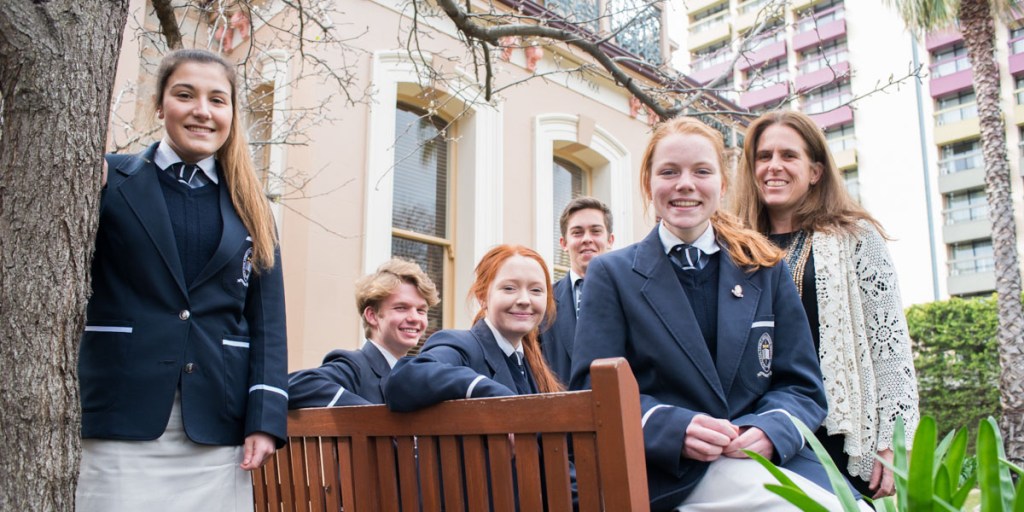
Just over two weeks ago, inspired by SOSE teacher Dr Christina Jarvis’ speech about MND and her family friend Jenny Barr Smith who was diagnosed with the illness in June, a group of more than 70 students decided to join their teacher in taking the challenge.
Before the ice bucket challenge took off, MND was generally unheard of outside family, friends and the community of those suffering from the terrible disease.
“My speech wasn’t a spectacle; it was intended to be educational,” says Jarvis, who afterwards learned that two members of the school community have close family who are affected by MND.
According to the Motor Neurone Disease Association of South Australia, MND is a progressive, terminal neurological disease.
People with MND progressively lose the use of their limbs and ability to speak, swallow and breathe, while their mind and senses usually remain unaffected. There is no known cure and no effective treatment for MND.
Each day in Australia two people are diagnosed with MND and two people die from the disease. An estimated 1900 people have MND in Australia, including approximately 120 South Australians. The average life expectancy after diagnosis is two to three years.

When Jenny’s husband Tom learned of the student’s commitment to the cause, he says it was like a call to action.
You might like


“I offered to sponsor every student in the school $5 for the ice bucket challenge and $10 for every student who was brave enough to do it,” says Tom.
The rules for ice bucket challenge stipulate that participants must fill a bucket or larger container with water and ice, tip it over their head and then challenge three other people to take the challenge within 48 hours. If the nominees choose not to take the challenge within 48 hours they make a donation to an MND charity.
Jenny and Tom Barr Smith’s youngest son, Mark, taking the Ice Bucket Challenge.
“When the principal Anne Dunstan heard about the students’ participation the school then matched me dollar for dollar,” says Tom.
Tom Barr Smith’s Ice Bucket Challenge video nominates Pulteney Grammar School.
Tom and Jenny Barr Smith now live in Victoria, but the family is well known in Adelaide for its pioneering and philanthropic contributions to the state. The Barr Smith name is remembered in the histories of many of South Australia’s important properties and businesses, including The University of Adelaide’s Barr Smith Library which the Pulteney Grammar School students use as a resource.
So far the students at Pulteney have raised $7063 for the Motor Neurone Disease Association of South Australia.
Teachers Dr Christina Jarvis and Richard Drogemuller and a group of more than 70 Pulteney Grammar School students take the Ice Bucket Challenge.
“If you take the money out of the equation, the awareness the ice bucket challenge has raised is enormous,” says Tom. “The stories that have come out of the Pulteney community alone are amazing.
Stay informed, daily
“The students made a card for Jenny, thanking her for inspiring them to make a difference. They said ‘we know we can’t help you, but at least we can try to help other people’.
“I’m told another student – Alice Ascari – who wants to study medicine has since been inspired to specialise in MND.”
There can be a familial pattern in which members of the family through several generations are affected by MND. Genes involved in some cases of familial MND were recently discovered. However, most cases of MND are “sporadic” and do not appear to have a hereditary element.
“Both Jenny’s mother and aunt died from MND,” says Tom. “It’s a terrible thing. It attacks the legs, hands and lungs and they can’t tell you in which order that will happen. It has attacked Jen’s legs, but she still sits and knits for the family.”
“But my hands are getting weaker,” adds Jenny.
“The most confronting thing is that people say ‘you’ll get on top it, you’ll get better, but with MND there are no miracles, every part of your body goes down except for your brain.”
Since being diagnosed the couple have been to a couple of Exit International workshops and Jenny has signed up to Dying with Dignity.
“We watched Jen’s mum die and with MND there isn’t any quality of life,” says Tom. “In the end you’re going to need help to die, otherwise you either starve to death because you can’t swallow or suffocate because of respiratory problems. Neither of those are a reasonable way to die.
“But ultimately we’d like to see a cure for MND. It will be too late for Jenny, but there are other generations and with familial MND the number of people having the disease can only grow.
“It would be lovely to see one of those Pulteney students come up with a cure.”
Gayle Jackson, executive director of the Motor Neurone Disease Association of South Australia, says that Pulteney Grammar School’s contribution is a significant part of the $30,000 plus raised during the ice bucket campaign in this state.
“I’m not aware of any other social media campaign that’s been as successful both financially and in terms of awareness,” says Jackson. “Our Facebook page alone is reaching in excess of 5000 followers compared to a few hundred prior to the campaign.
“People who are living with MND feel supported and are now they are sharing their stories of hope. That was an outcome that wasn’t predicted; it’s beautiful.”
Of the $1.5 million that’s been raised nationally, Jackson says over 50 per cent of the funds are going explicitly to research. “A new research grant to find a cure for MND has already been set up with half of the money. It’s called the Icebucket Research Grant.
“The other 50 per cent will fund care and support of people living with MND. We’re still working out the best way to do that.”
Donations to the Motor Neurone Disease Association of South Australia can be made here.
Want to see more stories from InDaily SA in your Google search results?
- Click here to set InDaily SA as a preferred source.
- Tick the box next to "InDaily SA". That's it.