Iraq crisis: Australia withdraws officials
Australia has begun withdrawing its officials from strife-torn Iraq.
The Department of Foreign Affairs and Trade says a number of embassy staff members have been withdrawn from Baghdad due to the deteriorating security situation.
“The Australian embassy remains open with reduced staffing levels,” DFAT says in its latest travel advice.
“We are unlikely to be able to provide consular assistance in Iraq at the current time.”
Islamic militants, spearheaded by the Islamic State of Iraq and the Levant (ISIL) jihadist group, have taken over a swathe of territory in northern Iraq in an offensive that has brought fighting to within 80km of the capital.
Foreign Minister Julie Bishop says an “essential core” of embassy staff will remain in place but they will be limited in what they can do for the estimated 90-plus Australians in Iraq.
“Due to the very challenging security environment we are unlikely to be able to provide the level of consular assistance that might be expected,” she told ABC radio.
The Iraqi government on Sunday said it had “regained the initiative” against the militants, claiming to have killed 279 “terrorists” in the previous 24 hours.
You might like

Bishop described the situation as very volatile and said it could deteriorate further with little warning.
“But we certainly strongly support the Iraqi government’s ongoing efforts to counter this terrorism that’s taking place within its borders,” she said.
The US embassy in Baghdad is also evacuating personnel and increasing military security after militants captured vast swathes of territory and advanced toward the capital, officials say.
It was unclear how many staff members would be evacuated from the mission. Located within the heavily fortified Green Zone that houses much of the international presence in the city, the US embassy is the largest in the world.
Responding to speculation of military action by the west, the Australian Greens will reintroduce a bill to require parliamentary approval of any troop deployment overseas.
While US President Barack Obama is considering what action to take in Iraq, he has ruled out sending troops into the country to end the violence.
Prime Minister Tony Abbott has said Australia will wait for a US decision before developing a response on Iraq but Bishop has played down the likelihood of sending Australian troops.
Greens deputy leader Adam Bandt said parliament should have a say in any troop deployment.
“This is what many other countries, from Germany to Denmark to Spain do.
“The United States constitution gives its Congress the power to declare war, and it is something that Australia should do as well,” Bandt told reporters in Canberra.
Stay informed, daily
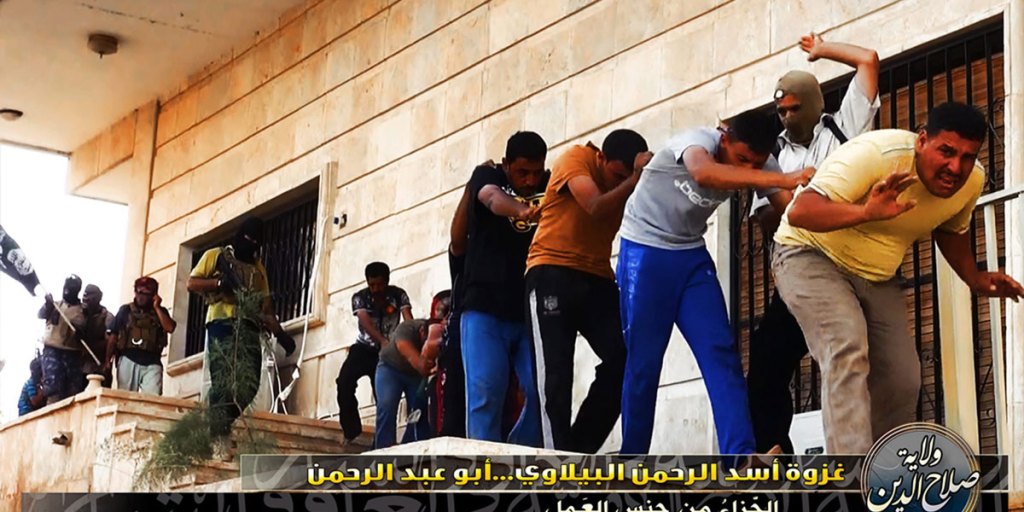
Meanwhile, the United States has condemned a “horrifying” massacre by militants said to have killed hundreds of Iraqi Shia air force recruits in the northern city of Tikrit, urging the country to unite.
Fighters from the Islamic State of Iraq and the Levant (ISIL) have overrun a succession of major towns and cities in the north of Iraq over the last week and are closing on Baghdad.
On Friday, tweets attributed to ISIL claimed the militants had killed 1,700 Shia soldiers as they advanced toward the capital, a figure that has not been independently verified.
“The claim by the Islamic State of Iraq and the Levant that it has massacred 1,700 Iraqi Shia air force recruits in Tikrit is horrifying and a true depiction of the bloodlust that these terrorists represent,” US State Department spokeswoman Jen Psaki said in a statement.
“While we cannot confirm these reports, one of the primary goals of ISIL is to set fear into the hearts of all Iraqis and drive sectarian division among its people.”
She said US officials “condemn these tactics in the strongest possible terms and stand in solidarity with the Iraqi people against these horrendous and senseless acts of violence”.
About 40,000 people have fled Tikrit and Samarra after they came under attack from ISIL militants, according to the International Organisation for Migration.
The latest figure adds to the half a million people the IOM estimates fled Iraq’s second city, Mosul, after it was overrun Tuesday.
“Terrorists who can commit such heinous acts are a shared enemy of the United States, Iraq and the international community,” Psaki said.
“This underscores the need for Iraqi leaders from across the political spectrum to take steps that will unify the country in the face of this threat.”
Secretary of State John Kerry meanwhile made phone calls to his counterparts from Jordan, the United Arab Emirates, Saudi Arabia and Qatar to discuss the ISIL threat in Iraq and neighbouring Syria.
“With each of his counterparts, Secretary Kerry addressed the need to support the Iraqi and Syrian people in confronting terrorists who also pose a threat to nations throughout the region and beyond, including to the United States,” a senior State Department official said.
“They also discussed the need for the Iraqi leaders to put aside differences and implement a co-ordinated and effective approach to forge the national unity necessary to move the country forward.”
– AAP/AFP
Want to see more stories from InDaily SA in your Google search results?
- Click here to set InDaily SA as a preferred source.
- Tick the box next to "InDaily SA". That's it.