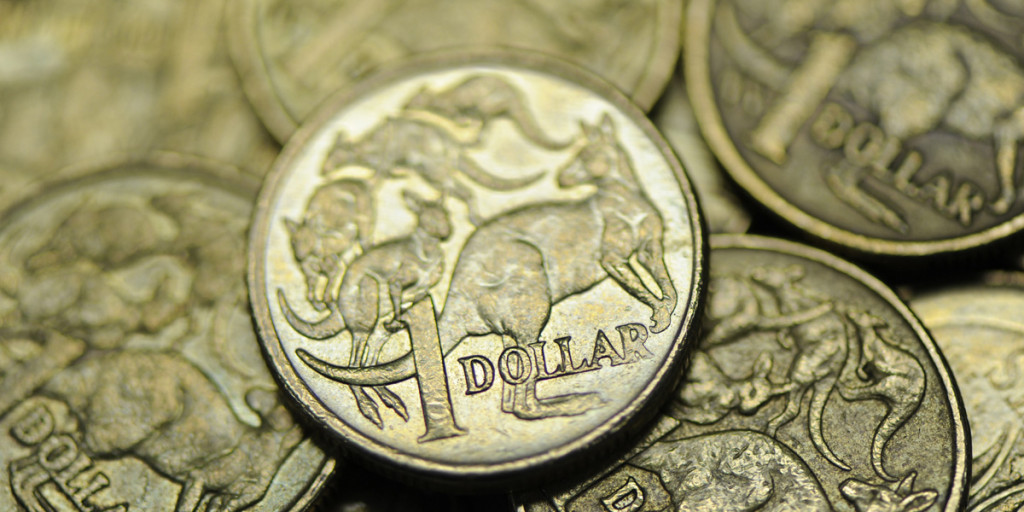
The Australian dollar has jumped after the European Central Bank lowered one of its key interest rates into negative territory for the first time in a bid to stimulate growth and avoid deflation.
At 0700 AEST today, the local currency was trading at 93.41 US cents – the highest level since May 20 – up from 92.82 cents on Thursday.
The ECB move to bolster Eurozone growth also saw the Australian share market open higher, with the big banks and gold miners the main beneficiaries. At 1025 AEST, National Australia Bank had risen 26 cents to $33.49, Westpac was 18 cents higher to $34.38, ANZ had added 22 cents to $33.45, and Commonwealth Bank ascended 66.5 cents to $81.615. Gold miner Newcrest was 23 cents higher at $9.84.
The ECB said it would lower all three of its key interest rates, which have been on hold at record lows all this year, as part of a set of measures to prevent deflation. The deposit rate, the rate at which the central bank pays commercial banks for depositing their unused cash, was reduced from zero per cent to minus 0.10 per cent.
Bank of New Zealand currency strategist Raiko Shareef said the moves caused the US dollar to fall, therefore strengthening the Australian dollar. But the currency would now have a quiet day ahead of the release of US non-farm payrolls on Friday night, he said.
You might like

“It’s going to be very quiet for the Aussie dollar,” he said. “There’s no local data so everyone is waiting for the US data.”
The ECB interest rate move had little immediate effect on Australian bond futures prices.
Australian bond prices should have followed global bonds higher but didn’t, Nomura head of macro products Jon Linton said.
“Our yields are virtually unchanged overnight despite the events in Europe, Australian markets have been surprisingly muted in their reaction,” Mr Linton said.
Stay informed, daily
Bonds should be more attractive after the deposit rate cut, as deposits no longer attract interest, he said.
“What we’re going to see is a grab for yields, people will go and buy assets, they’ll buy bonds,” Mr Linton said. “And yields on Australian products are quite high by global standards, which is potentially why the Aussie dollar has rallied.”
At 0830 AEST today, the June 2014 10-year bond futures contract was trading at 96.215 (implying a yield of 3.785 per cent), down from 96.230 (3.770 per cent) on Thursday. The June 2014 three-year bond futures contract was unchanged at 97.170 (2.830 per cent).
Currency snapshot at 0700 AEST today:
One Australian dollar buys:
* 93.41 US cents, from 92.82 cents on Thursday
* 95.66 Japanese yen, from 95.17 yen
* 68.37 euro cents, from 68.23 euro cents
* 109.91 New Zealand cents, from 109.92 NZ cents
* 55.54 British pence, from 55.43 pence
One euro buys:
* 136.62 US cents, from 136.03 cents
* 139.91 Japanese yen, from 139.48 yen
One US dollar buys:
* 102.42 Japanese yen, from 102.54 yen
(*Closes taken at 1700 AEST previous local session)
Want to see more stories from InDaily SA in your Google search results?
- Click here to set InDaily SA as a preferred source.
- Tick the box next to "InDaily SA". That's it.