‘Australian Aboriginal Art: Come and See’ exhibition
Flinders academic Dr Christine Nicholls has curated an exhibition of Aboriginal art as part of Tea Tree Gully City Council’s Reconciliation Week celebrations.
Australian Aboriginal Art: Come and See is currently on display in Gallery 1855 and Dr Nicholls will give a curator’s talk at 2pm on Saturday, 7 June, to explain the origins and meanings of the paintings.
While extremely supportive of the movement itself, Dr Nicholls believes that the term ‘Reconciliation’ is due for a name change.
“Reconciliation implies a previously harmonious relationship – such as a marriage – that has broken down and is now coming back together, whereas I don’t believe the gap between the colonisers and Aboriginal people has ever been properly bridged,” Dr Nicholls said.
“Perhaps we should be talking about ‘Conciliation’ instead. And I do think that art can contribute to Conciliation.
You might like

“Aboriginal art is really something to celebrate. It’s an area in which Aboriginal people have excelled and for which they are known internationally.
“Elderly Aboriginal people who have held onto their culture and continue to speak their own languages have launched stellar international careers from some of the most unlikely spots in the world.
“Aboriginal art is a repository of cultural knowledge and value, and it puts Aboriginal people in the position of teaching non-Indigenous people about the country itself, its environmental characteristics and its rich narratives, all of which pre-date white colonisation.
“It has the added virtue of providing some economic infrastructure in small communities that otherwise would have none.
Stay informed, daily
“It’s also something the artists love doing and, like language, helps to create a sense of personal well-being, as well as being a means ofearning the respect of members of the dominant culture.”
The exhibition continues until 5 July.
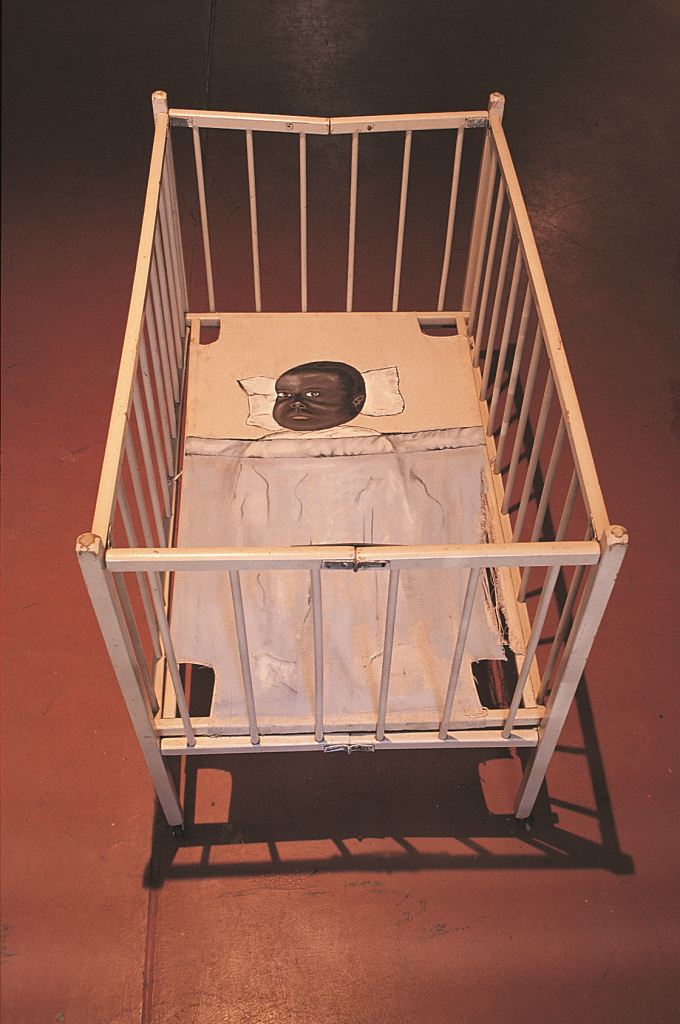
Image 1: John Packham, Ngarrindjeri, River Murray Region, South Australia, My child going away, 1950s baby’s cot (timber) with acrylic on canvas © the artist; courtesy Collection of Tandanya – NACI, Adelaide.
Image 2: Ralph Nganjmirra, Kunwinjku, Western Arnhem Land N.T., Diarrhoea Dreaming, 1994, natural ochres on Arches paper © the artist; licensed by Aboriginal Artists Agency Ltd.
Image 3: Peggy Rockman Napaljarri, Warlpiri, Lajamanu N.T., Warna-jarra Jukurrpa, (‘Two Snakes Dreaming’), 1989, acrylic on Belgian linen © the artist, courtesy Warnayaka Arts, Lajamanu.
Image 4: Louie Pwerle, Eastern Anmatyerr, Utopia N.T., Altyerr, Men’s Dreaming (‘Bush Turkey Dreaming’), 1996, acrylic on Belgian linen © the artist’s estate.
Enquiries about the Gallery 1855 Exhibition, Australian Aboriginal Art Today: Come and See, as well as this Saturday’s Curator’s Talk can be made by email to Niki Vouis [email protected] or by telephone on 8397-7444.
Want to see more stories from InDaily SA in your Google search results?
- Click here to set InDaily SA as a preferred source.
- Tick the box next to "InDaily SA". That's it.