Tom Richardson: Don’t mess with Jay
I’ve always liked Rod Hook. In all my dealings with him – and there have been a few – he’s been straightforward and personable. That’s not an employment reference; just my impression.
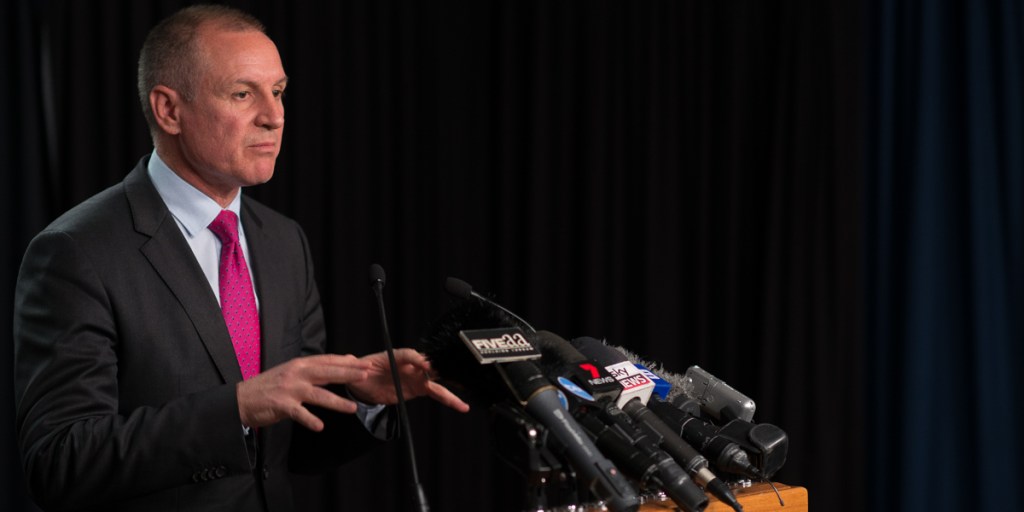
Lots of people, indeed, have a lot of time for Rod “Rooney” Hook. It’s just that Jay Weatherill isn’t one of them.
I understand the Premier has never been a fan of the dour, blokey ousted transport chief.
Fair enough; it’s his prerogative who he hires and fires. But to end the successful career of a successful career public servant with no warning and 24 hours to clear his desk seems unnecessarily harsh, particularly when the central tenet of a recent election campaign that Labor won by the skin of its teeth was to “Keep Building South Australia”. Specifically, to keep building things such as Adelaide Oval, the Southern Expressway, the South Road superway, the Max Fatchen Expressway, the new Royal Adelaide Hospital; all of which tends to lend weight to Hook’s public assertions that Labor wouldn’t have won were it not for the work of his department.
This is probably a reasonable time to mention that former Transport Services Minister Chloe Fox could well have won re-election in her own southern suburbs marginal seat of Bright were it not for the work of Hook’s department as well.
"The past week has been the Festival of Rod, with seemingly every media outlet graced with his indiscreet musings on the injustice of it all. It may not have been your typical farewell from a public service honcho, but it was strangely appropriate."
You might like

The Department of Planning, Transport and Infrastructure has long run its own race, with its own costings, its own deadlines and its own figureheads. Blowouts on costings and deadlines may have hastened the demise of the odd political career, but Rooney Hook has been an omnipresent – and omniscient – standard-bearer. The manner of his passing was cold, more akin to the swift decapitations of John Hill and Hook’s one-time minister and good mate Pat Conlon than a long-serving bureaucrat, particularly one who had been so often sent out as the public face of the Labor Government’s infrastructure agenda.
When Hook’s predecessor as Transport chief, Dr James Horne, was similarly dispatched back in 2006, he was conspicuously inconspicuous. So inconspicuous, in fact, that no-one in the media had so much as a file shot of him to use in news broadcasts announcing his departure. We were all relegated to surfing the department’s website for a well-worn headshot. It’s a far cry from Hook, who had a higher media profile than most Labor ministers.
Horne’s exit was also similarly in keeping with his bureaucratic bent; he refused all reporters’ requests to tell his side of the story (which presumably would have meant unloading on the then-Rann Government). As career public servants are wont – and, indeed, required – to do, he was neither seen nor heard.
It couldn’t have been more different with Rooney.
The past week has been the Festival of Rod, with seemingly every media outlet graced with his indiscreet musings on the injustice of it all. It may not have been your typical farewell from a public service honcho, but it was strangely appropriate.
Unlike other bureaucrats of his ilk, Rooney has spent the past decade as the public face of the Labor Government. When the elected minister has been unable or unwilling to submit to public scrutiny, he has been left to carry the can for various delays or cost over-runs. He has been a de facto minister for Infrastructure, in a government wherein infrastructure was the key portfolio. So while his very public swan-song may fly in the face of public sector protocol (which may, ultimately, cruel his chances of prolonging his lucrative career), I feel he has earned the right to go out as a protagonist, rather than an apparatchik.
Stay informed, daily
The reasons for his departure, though, remain insufficiently explained. Weatherill says, effectively, that he wants a clean slate for the term ahead, even though Labor has pinned its colours yet again to the mast of nation-building infrastructure, and Rooney has distinguished himself as an able oarsman. As some Labor insiders point out, he has been cast aside despite delivering on major projects where other public servants have demonstrably leaked to the Opposition, and still been retained.
And what of the Opposition? Weatherill’s week of the long knives continues apace with but a token resistance from the party that, but for a few misplaced votes in a handful of marginal seats, could have been calling the shots.
Having spent the past month on leave, I have had that rare treat of watching the state’s political life unfold as it is reported, rather than reporting it. That made the phone call from a senior Liberal on the opening day of the new parliament all the more perverse; after a month of contributing literally nothing via print or television, I received a call asking if I was “on today”. So they’re clearly as on the ball as ever.
Weatherill may not have much of an Opposition with which to contend, but he has made it clear, as he did when he shafted former education chief Chris Robinson, and Mike Rann, and Kevin Foley, and Pat Conlon, and John Hill, and Russell Wortley, and Paul Caica, and Lyn Breuer, and Don Farrell, and now Rooney Hook, that he is not to be trifled with.
"As captain, it is Weatherill’s prerogative to choose his soldiers, and he has demonstrated that he won’t baulk at making tough administrative decisions."
The Department of Transport and Infrastructure may have been the archetypal boys’ club, and a law unto itself, but it has overseen the fruits of Labor’s proudest achievements after 10 years in office.
Weatherill, Koutsantonis et al now turn their attention towards constructing a new enemy in Joe Hockey, a Tory Treasurer who has done little more than bring down a Tory budget. It provides a convenient target for an administration looking desperately for fall-guys for a state economy that seems unable to extricate itself from the sludge of persistent unemployment and under-investment.
The case will be hard to make with the Commonwealth committing a billion dollars towards much-needed road infrastructure, but that old chestnut, the GST, will provide an appropriate ideological battleground. It’s familiar ground, of course; when John Howard first sought to introduce a consumption tax, the ALP opposed it vociferously, before successive Labor state governments unashamedly cashed in on its proceeds.
The problem with Australia’s model of governance is that various state administrations, interest groups, unions and lobbies are so quick to proclaim every cut or reform the death knell of civilization as we know it that when there is a genuine assault on our fiscal consensus it’s hard to distinguish the genuine critiques from the partisan hysteria.
Weatherill will do his utmost to paint the Abbott Government as the villain of the piece; but there is no hiding from the fact that this administration is now his alone; he has picked and chosen his ministers and their apparatchiks, and next month’s state budget will be less a statement of what Joe Hockey and his ilk have delivered us in six months than it is a legacy of a decade of Labor governance.
As captain, it is Weatherill’s prerogative to choose his soldiers, and he has demonstrated that he won’t baulk at making tough administrative decisions.
Now he must choose his battles. And he is fast running out of allies.
Tom Richardson is InDaily’s political commentator and Channel Nine’s state political reporter.
Want to see more stories from InDaily SA in your Google search results?
- Click here to set InDaily SA as a preferred source.
- Tick the box next to "InDaily SA". That's it.