Fox v the cartoonist might not end in laughter
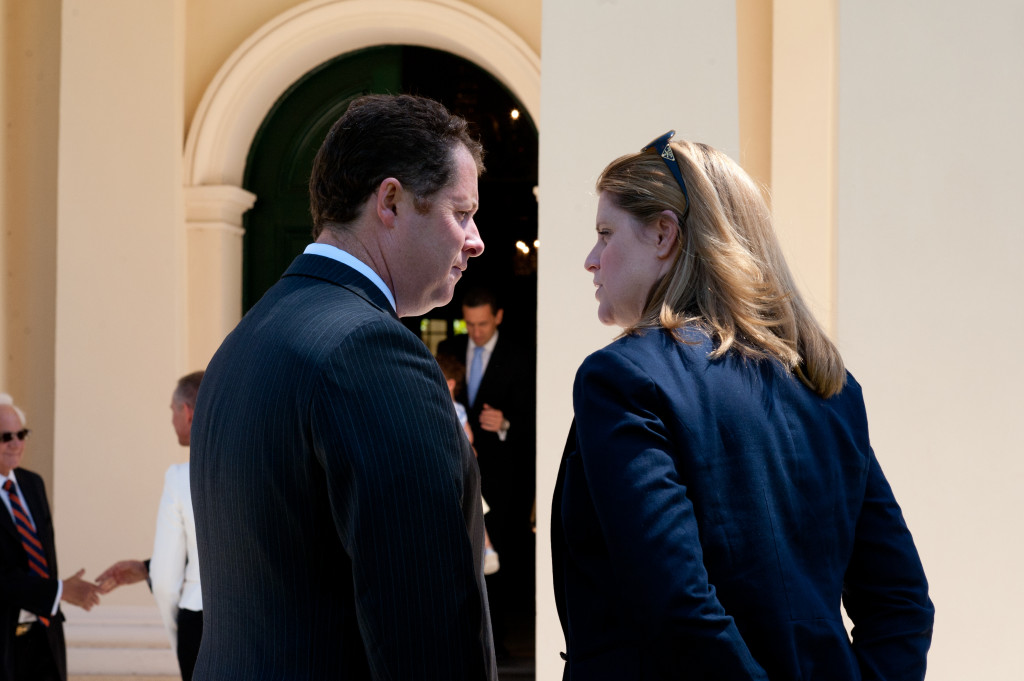
A new front has opened up in the battle between politics and entertainment.
Transport services Minister Chloe Fox has fired a legal letter to The Advertiser, claiming a cartoon it ran on Monday defamed her.
The cartoon was the “visual humour” element to a story the Tiser ran on the number of SA Art Gallery works hanging in Minister’s offices.
Fox’s office has 11 such pieces; the Premier has 47 pieces on loan from the Gallery.
Today, The Advertiser revealed it had received a letter from Fox’s lawyers, Sykes Bidstrup, demanding an “immediate apology and retraction of the article and cartoon”.
The article said Fox, who is Transport Services Minister and Minister assisting the Minister for the Arts, had 11 public artworks from the Art Gallery of SA in her office .
“The letter says the cartoon and use of the word “snaffled” in the story implied she “is a thief, has misappropriated public property, and has engaged in inappropriate conduct as a minister”,” the paper reported.
“The article and the cartoon separately and in conjunction with each other were and remain highly defamatory of our client.
You might like


“Our client is both personally and professionally outraged by the innuendo implicit in the words and the caricature depiction.”
“The innuendo has caused Ms Fox personal distress, stress and damage to her personal reputation.”
A year ago one of Chloe Fox’s staffers, Nicole Cornes, took action against comedian Mick Molloy – and won.
In August 2012 the Supreme Court upheld Cornes’ $93,000 defamation win against Network Ten and Molloy.
Molloy, appearing on sports entertainment show Before the Game, made a comment which Cornes considered was a cheap shot at her sexual morality – a jibe that the Court found “fell flat”.
At the time, Cornes was employed at the Shop Distributive and Allied Employees’ Union after an unsuccessful tilt at Federal politics ion the 2007 election.
Molloy eventually gave an on-air apology, but it was not accepted by Cornes.
“There was no remorse,” Cornes later told The Advertiser.
She said she refused to accept Molloy’s one-liner was just a joke.
Today, Chloe Fox has a similar view of the Valdman cartoon, which depicts her running off with a painting under her arm and a sack over her shoulder.
Stay informed, daily
It also shows a woman staring at a blank wall in the Gallery saying: “She’s taken all the good paintings and put them in her office.”
In terms of political cartoons, it’s hardly up there with the most stinging; but the implication that Fox has nicked good paintings for her own office is inaccurate.
Galleries around Australia have been running artwork loan schemes into government offices for decades.
It’s barely a news story.
Cartoonists have argued in the past they they have a role in encouraging cynicism.
It’s a similar argument used by less-than-funny comedians who find politicians to be easy fodder for a joke.
Flinders University political analyst Dr Haydon Manning examined the role of the cartoonist at an Australasian Political Studies Association Conference some years ago.
In his conclusions, Manning and others noted that the boundaries of public morality are one thing, ideological good taste quite another.
“…in relation to the law of libel, cartoonists are clearly involved in comment rather than reporting, and the comment they make is obviously and recognisably extravagant.
“It is important also, in our opinion, that cartooning not be caught by a definition of fair comment more onerous than the strict legal definition of ‘fair’.
“It is obvious that cartoonists would fail as entertainers if they felt constrained to be cautiously reasonable in their work.
“Cartoonists are licensed skeptics who provide one important medium where the spin that is epidemic in public life can be countered, one forum where the shameless can be shamed and open secrets spoken.
“Their licence is not a simple freedom, but comes from a complicated mix of social, political, historical, and legal factors.”
Bill Leak, cartoonist at The Australian, puts the cartoonists view thus: “I work for a newspaper where I whittle and grind away in the interesting position of being part of the political process but very much on the periphery of it.
“Nevertheless, from the periphery I’m able to throw in little incendiary bombs, stir things up every now and then and, on a good day, kick the bastards really hard. It’s a deeply satisfying way to make a living.”
While Nicole Cornes was found to be the personal subject of a low-rent unfunny slur, the Chloe Fox cartoon is an exaggeration of her personal role in a story that had little to offer.
How far she takes this legal action will be closely watched by the editors; after all, Molloy lost.
Want to see more stories from InDaily SA in your Google search results?
- Click here to set InDaily SA as a preferred source.
- Tick the box next to "InDaily SA". That's it.