US city planner talks the walk
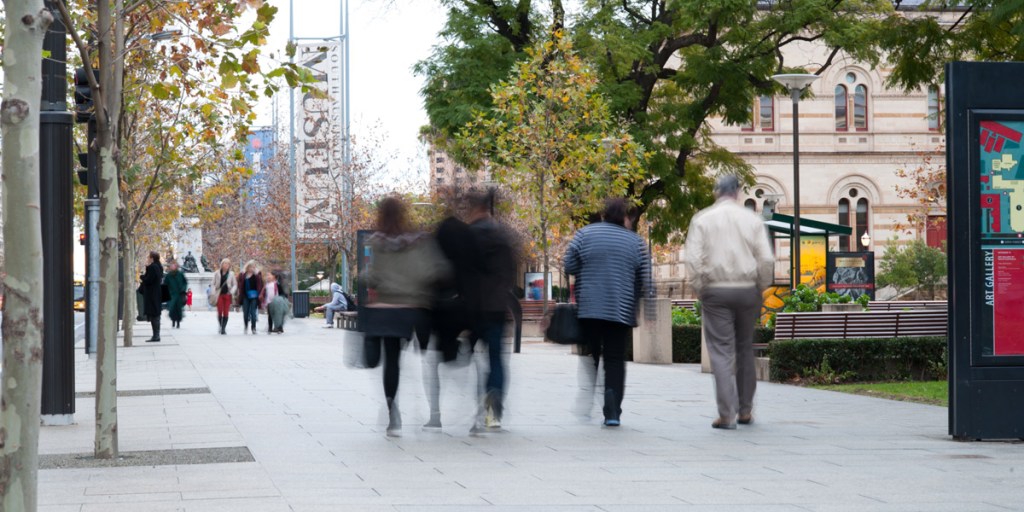
The guru of “walkability” has picked an interesting time to be in Adelaide.
The Adelaide City Council and the State Government are engaged in a public relations battle to convince people to leave their cars at home and take public transport into the city; they’re spurred on by the revolution currently sweeping urban planning, which is for walkable, human-scale cities.
Jeff Speck, author of the recently published Walkable City: How Downtown Can Save America, One Step at a Time, is standing on the forefront of that revolution.
The US city planner and urban designer is here for two events at the Adelaide Festival of Ideas, including a keynote address tomorrow titled The Walkability Imperative.
When InDaily Design spoke to him yesterday, he’d spent only four hours in Adelaide – one of those ensconced inside the Lord Mayor’s electric car.
“I’m still scratching my head as to why I’m in Australia, in a certain sense, because my expertise is so much America,” Speck says.
You might like

Perhaps it’s because he’s a passionate advocate for the case that Adelaide’s civic leaders have been trying to make: cities are healthier when there are fewer cars in them. It’s good for people, and it’s good for business, he says.
“Merchants often fear bike lanes, thinking that bike lanes instead of car lanes will bring down their revenue. The only studies that have been done have shown that the bike lanes have increased revenue.
“It’s much easier to get off a bike and shop. Bikers tend to spend more money locally because they don’t go as far.”
When people catch public transport, the effect is much the same – they’re likely to engage much more strongly with their city.
“Taking the bus out of town gives you the comfort to have a couple of drinks at the bar and then go home.”
"It’s a devil’s bargain – the more room you give a car, the more people change their behaviour"
Stay informed, daily
But none of that is the real game to Speck.
“When you really hit that sweet spot isn’t when more people are coming into town via [mass] transit – which is good – but it’s when more people spend their entire days and nights in one neighbourhood. And that’s a renaissance of your city, if you can pull that off.”
Adelaide’s glut of car parks – we’ve got more than any other capital city, despite our small size – could be exploited as an opportunity for cheap city-centre, high-density housing, Speck says. Building apartments nearby and then linking them to the existing parking would enable the building of cheap homes which would suit residents who need a car, but without adding to Adelaide’s carpark numbers.
On roads, planners can often be split into two broad camps – those who see merit in building roads to ease congestion, and those who see the whole argument as a fallacy. Speck falls into the second camp.
“It’s a devil’s bargain – the more room you give a car, the more people change their behaviour.”
He argues that investment in roads to ease congestion encourages more drivers to use them – therefore doing nothing to ease the problem. The solution: public transport and cycling.
“If you think about the amount of space that a cyclist takes up and the amount of space that a driver takes up, clearly converting a driving lane to a cycle lane is going to make the road carry more people.”
The Adelaide Festival of Ideas runs from October 17-20. Jeff Speck will take part in a panel discussion titled Breathing Life into our City’s Corners at the Freemasons Hall this afternoon, and speak on the Walkability Imperative at a keynote session at Bonython Hall tomorrow afternoon.
Want to see more stories from InDaily SA in your Google search results?
- Click here to set InDaily SA as a preferred source.
- Tick the box next to "InDaily SA". That's it.