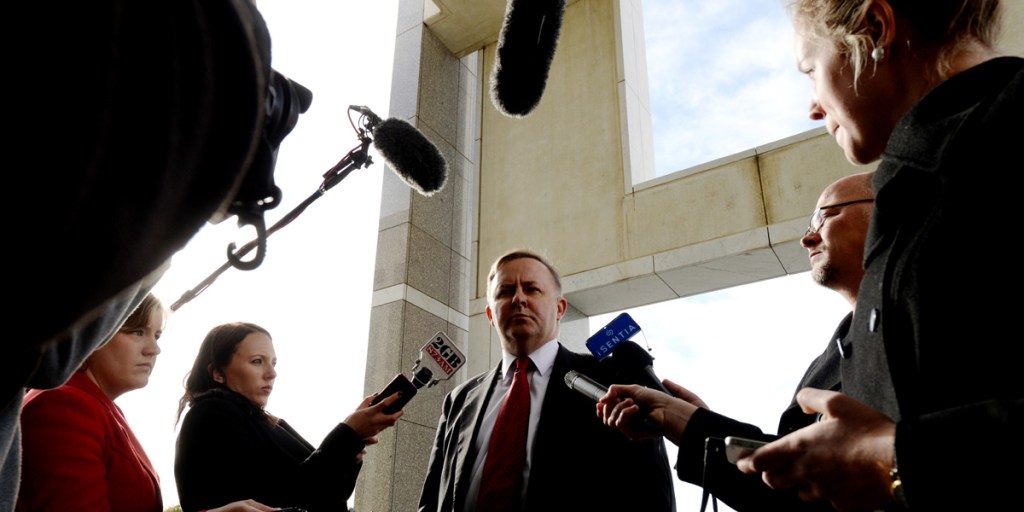
Anthony Albanese has decided to stand for the Labor leadership, meaning rank and file members will help choose the party’s parliamentary leader for the first time.
Chris Bowen will be Labor’s interim leader until the vote is decided.
The contest of two or more candidates triggers a ballot of rank-and-file Labor members, as well as caucus, with both groups having an equal say in the leadership.
Albanese outlined his CV over the past six years of government – deputy prime minister, minister for infrastructure, transport, broadband, communications and the digital economy, and leader of the House of Representatives.
“I think I’m up to a hard job,” he said.
“What you see is what you get.
“I’m someone who puts forward a view strongly and passionately when I believe it.”
You might like

The fourth generation ALP member decided in consultation with his family to run for the leadership.
His rival Bill Shorten was the first other person he told of his decision.
Albanese said Labor needed to change to become better for Australia and for the party.
The party needed to use the period in opposition to come up with new big ideas and visions for the country’s future.
It also had to constructively engage and “not be negative for negative’s sake”.
He believed the ballot process was an important way to empower the party’s membership and ultimately would attract more people to join Labor.
As for his opponent, Albanese said Shorten was a friend.
“He would make a very good leader,” Albanese said.
Stay informed, daily
“He’s someone that I look forward to working with into the future.”
Interim leader Chris Bowen said Labor continue to hold the government to account while the leadership was decided.
“The Labor Party has a choice between two very good candidates. Two very good candidates with a vision for Australia,” Bowen told reporters in Canberra after Labor caucus met for the first time since their election defeat.
“Today the Labor Party begins the process of becoming a bigger, more transparent, more open, more democratic party.”
In the meantime, Bowen said shadow cabinet would consist of those who formed the executive in the outgoing government.
“I’ve asked Richard Marles to be acting shadow minister for defence as well as being shadow minister for trade over the next month.”
The new process of electing their leader brings the party in line with similar movements around the world, he said.
“It means the new Labor leader will have more legitimacy than any other political leader in Australian history,” Bowen said.
“They will have been elected by the whole Labor party, by every eligible rank and file member, as well as by the parliamentary caucus.”
Grassroots members will vote first and then caucus will conduct a ballot without knowing the result of the community poll.
Bowen said former prime minister Kevin Rudd had indicated he would return to the backbench and it was up to him whether he remained in parliament.
Some Labor MPs have called for Rudd to quit parliament to draw a line under the divisive Rudd-Gillard years but Bowen was not doing that.
“He should be given the respect due to to a former leader of the Labor Party and a former prime minister,” Bowen said.
“He is still a relatively young man, with I think things to offer the nation.
“It’s up to him whether he chooses to provide that service through being in parliament, or through other mechanisms.”
Want to see more stories from InDaily SA in your Google search results?
- Click here to set InDaily SA as a preferred source.
- Tick the box next to "InDaily SA". That's it.