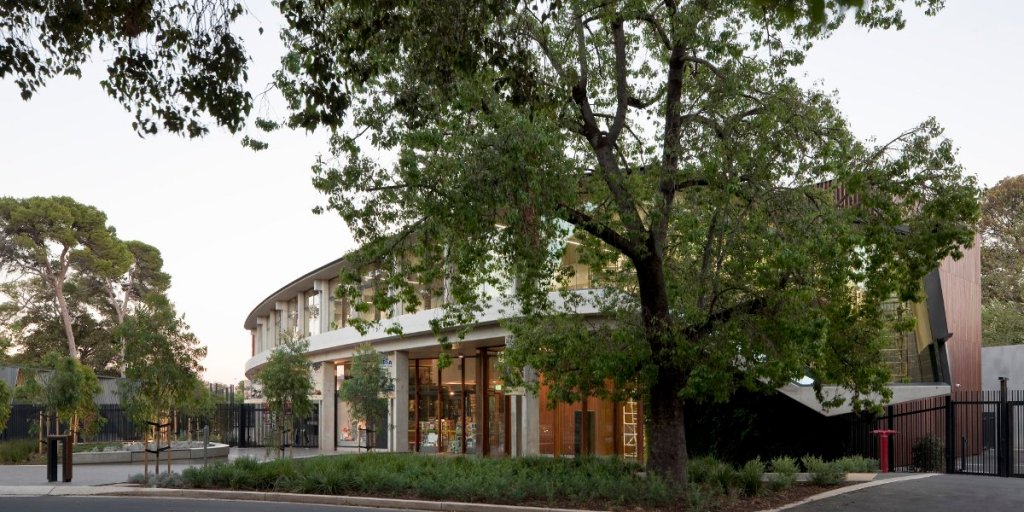
Adelaide Zoo’s panda enclosure, Bank Street and the Tonsley redevelopment are among the projects recognised at Friday’s 2013 South Australian Institute of Landscape Architects Awards.
The awards are judged by a panel of the state’s leading landscape architects. They are open to projects from firms based in South Australia and can be from any year.
Below, InDaily DESIGN features winners in the design, urban design, planning and land management categories, along with images and their submissions to the jury. We’ve also included the judges’ citations for each project, so you can get a sense of what makes a good piece of landscape architecture.
Design in Landscape Architecture

Award of Excellence in Landscape Architecture (Design) – Adelaide Zoo People Project, HASSELL
Client: Royal Zoological Society of SA (Zoos SA)
Project: The People and Pandas Project at the Adelaide Zoo combines the new zoo entrance, the route to the panda exhibit and the exhibit itself – a Giant Panda Forest to accommodate this rare and endangered species. The design employs sustainable landscape systems, lowering life-cycle costs, and increasing amenity and biodiversity for the local environment.
Citation: This exuberant and beautifully executed design creates a high level of anticipation for visitors, celebrating the rare and precious pandas it houses and elevating the experience for all. The complex challenges of accommodating panda habitat and care with visitor experience and education in an established context have been successfully overcome, creating a unique place with clear identity. This project ensures that the landscape experience at Adelaide Zoo is now world-class and a fitting addition to Adelaide’s suite of cultural attractions.

Award – Meningie Lakefront Habitat Restoration Project, Aspect Studios
Client: Department of Environment, Water and Natural Resources
Project: Responding to a relatively open brief that focussed on integration with the recently constructed works and durability, ASPECT Studios design direction took reference from the inherent site qualities – water’s edge, meandering walks and marginal habitat. In keeping with the intent to rehabilitate lakefront plantings along the edge of the reserve, the viewing platforms were kept low and discreet, blending in with the surrounding lake edge. A simplicity of material use including composite timber, steel plate and concrete, met the design brief requirements for durability and working closely with our Engineers FMG, managed to achieve a design life of 100 years for all elements. Interpretive signage plates were designed in-house to compliment the form and character of the interventions, and provide visitors with information on the local flora and fauna that can be found in the areas.
You might like


Citation: With this award, the jury recognises that while quality design should be valued where it occurs across Australia, it is too rarely found beyond urban centres where the thought and skill that informs infrastructure delivery is often perfunctory. This project has recognised the importance and natural qualities of its site and has realised an exquisite outcome through careful siting of well-conceived and crafted interventions. Trails and platforms are carefully inserted in this precious landscape, focusing and elevating its experience and protecting its inherent values.

Award – Port Noarlunga and Witton Centre, Taylor Cullity Lethlean
Client: City of Onkaparinga
Project: With this project, the seaside precinct of Port Noarlunga, including the Witton Centre, the Surf Club, the car-park and pedestrian facilities, have been re-invigorated and re-connected to the town. The project harnesses and represents the much-loved but often lost character of the beach, the river, the port and Kaurna heritage to create a set of spaces and places that have transformed the precinct, using robust materials and sustainability principles throughout.
Citation: This award recognises the transformational impact of landscape architecture on sites that, despite their inherent value, have lost their sense of communal purpose. Skilful reorganisation and furnishing of spaces and facilities within the constraints of a beachfront site has created a unique place that is clearly inviting and useable for all. Client and landscape architects are to be congratulated for their vision and their achievement here. A benchmark for all of Adelaide’s beach-fronts.

Award – M2 and the Plasso, Swanbury Penglase for the University of South Australia
Client: University of South Australia
Project: M2 Plasso is part of the master-planned community of Mawson Lakes and its plaza is integrated with the new Centre for Materials and Mineral Science for the University of Adelaide. The design responds to both the building’s function and the pre-existing dry-creek landscape, expressing the rough-cut rock face and geological stratification in wall and pavement design.
Citation: This award recognises the success of the designer in achieving design quality in substantially scaled development on the urban fringe. This design creates a positive sense of place and seamlessly integrates building and landscape. The works are faultlessly detailed and use quality materials, setting a new standard for landscapes on urban fringe sites.
Urban Design in Landscape Architecture

Award of Excellence in Landscape Architecture (Urban Design) – Kingston Foreshore Master Plan and Kingston Foreshore Bridge, ACT
Client: ACT Land Development Agency
Citation: In this award the jury recognises excellence in the delivery of urban design at all its levels and in all its modes – from an inspirational master-plan and development guide that lays out flexible yet clearly defined performance requirements for all buildings and open spaces through to the design and delivery of a poetic piece of infrastructure such as the bridge, which references not only the history of the site but the rowing skulls that traverse the lake today. The client and the landscape architectural team that led these projects are congratulated for identifying and realising a transformational vision of the national capital. By resisting the protective suburban and pastoral typologies that have all too often been the default position and promoting the industrial heritage of the site, they have created a precinct that celebrates Canberra’s variety and maturity as a city.

Award – Hindley Street Activation, HASSELL
Clients: University of South Australia (UniSA); Adelaide City Council; Department of Planning, Transport and Infrastructure, Government of South Australia; and Federal Government
Project: The Hindley Street Activation Study results from a process initiated when UniSA explored the impact on the city that will result from the opening of its new learning centre in 2014, generating 8000 student crossings per day of a street currently considered unsafe and a barrier. The study process utilised a series of design workshops, a project reference group and rapidly generated 3D scenario modelling and animations to build understanding of issues and possibilities and the way these interact with existing policies.
Stay informed, daily
Citation: This exemplary project uses urban design processes to break new ground, creating a new understanding, shared amongst stakeholders, of the potential of one of Adelaide’s most important, but often most contested places. Building on a concept identified in the UniSA master-plan, the landscape architects choreographed interactions between key parties, demonstrating how they can work together to transform an undistinguished area into a cohesive precinct, in this case an activated and pedestrian-prioritised precinct based on Hindley Street.

Award – Bank Street, Taylor Cullity Lethlean
Client: Department of Planning, Transport and Infrastructure, South Australian Government
Project: Acknowledging the importance of the connections that can better link the CBD north to the riverfront, oval and North Terrace, and the challenges of their establishment in the face of entrenched use patterns, the Bank Street prototype project is a bold test of an alternative approach to decision-making. Prototypes of relocatable modular parklet and pavement treatments have been designed and located to increase space for pedestrians, diners and cyclists. Thus new spatial scenarios can be tested in-situ and can be transplanted to different locations for similar tests across the city once this test is completed.
Citation: The jury commends the landscape architects, Taylor Cullity Lethlean, for facilitating a collaborative dialogue amongst the various authorities and professionals involved, resolving the contradictions inherent in existing policies and standards and reaching this outcome. It also applauds the aspirations of this pioneering project, encouraging those responsible to complete the process, a process which helps solve a problem confronted by all Australian cities – how to build confidence amongst diverse stakeholders about the workability of alternatives before major capital spending on permanent solutions.
Planning in Landscape Architecture

Award of Excellence in Landscape Architecture (Planning) – Tonsley Urban Design Protocol, Oxigen Client: Renewal SA
Project: The Tonsley Urban Design Protocol is the over-arching document that establishes the structure for a series of guideline documents for the public realm, built form across the precinct and, specifically, the refurbishment and adaptive re-use of the Main Assembly Building (previously the car assembly factory). The Protocol synthesises all related work (including the Australian Government’s policy Creating Places for People: An urban design protocol for Australian cities) and presents an easily digestible structure for their application in this location. Each land-use type and land-area on site can be targeted and accessed electronically and discretely and is linked directly to the overall project vision. An emphasis is placed in the document on accessibility and clarity, both of which are manifest in the graphic and written content.
Citation: Embedded in and building on the national, state and local policy context and building on a previous master plan, this protocol establishes a clear way forward for all management and project teams to deliver quality urban outcomes in a governance environment that is still emerging. Targeted, direct and creative in its planning approach, this protocol extends existing practice and provides a promising beginning for the entire development process.

Award – City of Marion Walking and Cycling Strategy, Oxigen
Client: The City of Marion
Project: This strategy provides a comprehensive basis for delivering a cycling and pedestrian network in the suburban context of Adelaide.
Citation: The jury congratulates the City of Marion for this initiative which recognises the potential contribution of pedestrian and bicycle movement to the city’s development. Delivery will make it both liveable and desirable. In an environment where the private vehicle dominates, well-reasoned and clearly presented work such as this can change minds as well as places. Thorough, comprehensive and well-grounded in local issues which are bench-marked against relevant national and international precedents, the strategy builds a convincing evidence-based case for implementation.
Land Management in Landscape Architecture

Award of Excellence in Landscape Architecture (Land Management) – Waterproofing the South, City of Onkaparinga and Outerspace Landscape Architects
Client: City of Onkaparinga
Project: This project consists of six major urban wetlands of multiple hectares in area, two flood retarding basins, a 93 ML/3-ha storage facility, three managed aquifer re-charge schemes, 40km of pipes, the planting of about 250,000 plants and 5km of walking trails.
Citation: The jury commends the City of Onkaparinga for embarking on a remarkable and comprehensive project. The approach is not just multi-disciplinary but trans-disciplinary, delivering water efficiency, conservation benefits and recreational amenity, and shows what can be achieved when experts work with each other and the community. It is of note that the project manager is a landscape architect and that the landscape architectural consultants took a leading role in delivering the community consultation process and the project outcomes. This project has created value at many scales, many levels and in many dimensions for this outer urban locality.
Want to see more stories from InDaily SA in your Google search results?
- Click here to set InDaily SA as a preferred source.
- Tick the box next to "InDaily SA". That's it.