Discover Nobel Laureate Elizabeth Blackburn
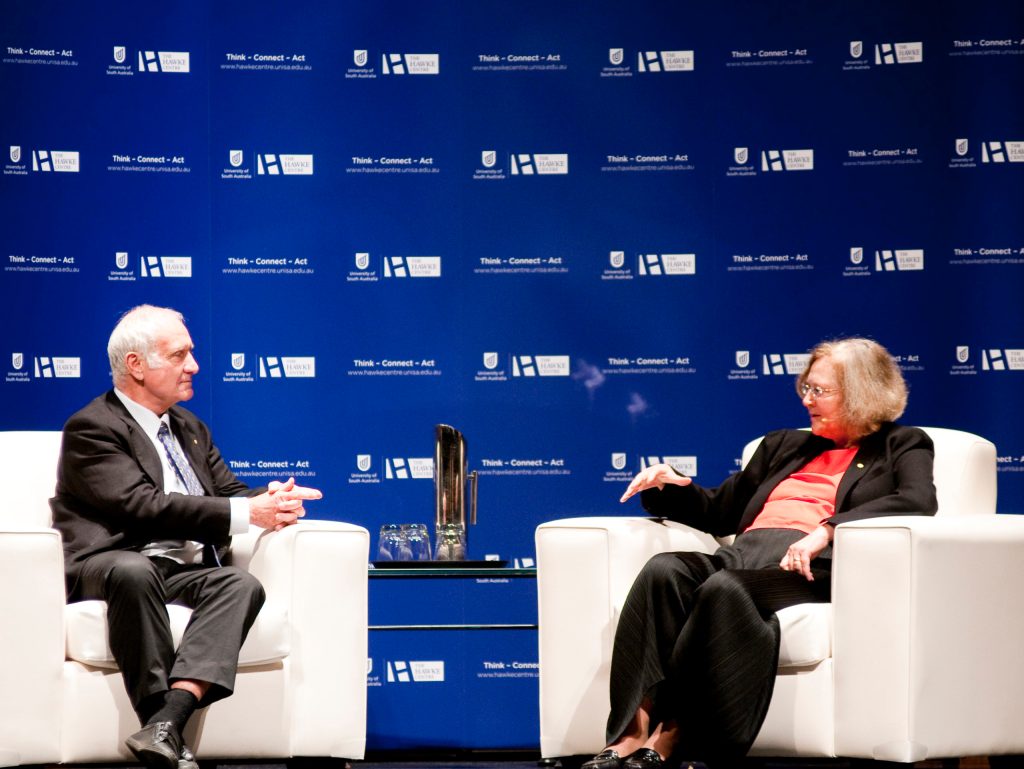
The Hawke Centre was proud to recently present Dr Elizabeth Blackburn – one of Time magazine’s 100 ‘Most Influential People in the World’.
In a compelling conversation with science presenter Robyn Williams, Dr Blackburn shared the passion and insights that have driven her towards her celebrated scientific achievements. She described the journey from her childhood scooping up jellyfish in Tasmania, to her career as an internationally acclaimed microbiologist, and to the moment she was nominated for the Nobel Prize for Physiology or Medicine.
Dr Blackburn reflected on women in science, and on the role of science in policy-making, as well as on her scientific discoveries which are transforming our understanding of human health. She examined the interface between science and society, referring to her dismissal from the President’s Council on Bioethics and the commercialisation of biological data.
Dr Blackburn explored the ‘bio-future’ – pondering on the doors the new findings will open, and explaining how bio-discoveries are challenging our conventional thinking about the ageing process and human mortality. The conversation was presented as the sixteenth Annual Hawke Lecture.
Recognising Dr Blackburn as a committed advocate for women researchers, the University of South Australia was delighted and honoured that she lent her support to the University of South Australia Elizabeth Blackburn Fellowship, formally launched during her visit. This biennial Fellowship will enable early career women scientists working at UniSA in the fields of biomedical, clinical and public health and with an interest in cancer research to gain experience in leading international research environments.
You might like
At the fellowship launch, Dr Blackburn was also conferred an Honorary Bragg Membership by the Governor of South Australia, Rear Admiral Kevin Scarce, on behalf of the Royal Institution of Australia (RiAus).
Appealing to those with a strong interest in the biology field, Dr Elizabeth Blackburn also presented an Occasional Hawke Lecture covering new perspectives on the roles of telomeres and telomerase in human diseases and health.
Watch the YouTube clip to discover Nobel Laureate Dr Elizabeth Blackburn and our bio-future.
Or
 HEAR THE PODCAST
 Want to see more stories from InDaily SA in your Google search results?
- Click here to set InDaily SA as a preferred source.
- Tick the box next to "InDaily SA". That's it.