French doping report names Zabel
Italian Marco Pantani, Germany’s Jan Ullrich and American Bobby Julich, who were the top three during the 1998 Tour de France, were all taking the banned blood booster erythropoetin (EPO), according to reports published by French daily Le Monde today.
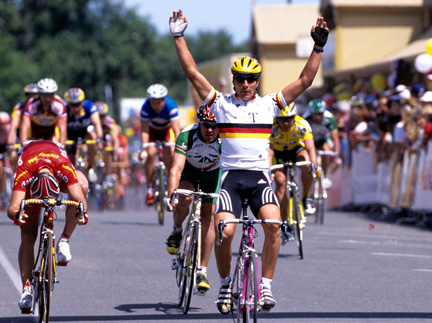
The report also names Tour Down Under 1999 stage winner Erik Zabel; the German star went on to win the green jersey in the Tour de France in 1998.
Zabel has admitted in the past to using EPO; in 2007 Zabel and former Team Telekom team-mate Rolf Aldag admitted using EPO to prepare for the 1996 Tour de France.
At the time, he told a press conference he experimented with it for a week and stopped due to side-effects.
“It doesn’t make any difference whether it happened one time or over two years, the point is that it was forbidden to dope, and I doped. I doped, I lied and I apologise for that,” Zabel said in 2007.
You might like
The latest revelations come just ahead of a French parliamentary commission which is set to release a report on Wednesday night, Australian time.
The commission made waves on May 15 by announcing that senators from the upper chamber of parliament would reveal the identities of those riders using EPO during the race.
Last month, French former rider Laurent Jalabert was alleged to have been one of those implicated through comparison of retrospective testing results from 2004 and a list of anonymous samples from 1998.
Jalabert immediately stepped down as a television and radio pundit for this year’s Tour that was won on Sunday by British rider Chris Froome.
Stay informed, daily
Since then, there has been debate in France about the utility of naming names, with the family of Pantani, who died in 2004, saying they were against identifying riders.
Zabel who won the green jersey that year as points winner is also cited by Le Monde as taking EPO on the way to victory.
The professional cyclists’ union the CPA last Friday said that it, too, was opposed to publication.
“Publication of a list amounts… to an accusation of doping without any means of defence,” the union said, arguing that no counter-analysis was possible as the original samples no longer existed.
Nevertheless, the senators are believed to be likely to publish the riders’ identities and could equally include lists of samples taken on the 1999 Tour, which was won by US rider Lance Armstrong.
Armstrong was stripped of his seven Tour wins and banned from cycling for life last year for doping in a scandal that plunged cycling into crisis about the extent of substance abuse among the peloton.
The commission questioned 84 witnesses under oath, from sportsmen and women to organisers and anti-doping experts, to “lift the lid” on and “break the code of silence” over the subject.
Cycling, with its doping-scarred past, has not been the only focus, however, with attention also paid in particular to rugby.
The French anti-doping agency assessed that the sport was the most affected by doping in relation to its testing, while football and tennis were also examined.
France football coach Didier Deschamps was questioned behind closed doors while tennis came under the scanner for its relative lack of testing at an international level.
The senators are aiming to frame legislation on sport and put it before parliament for debate next year.
Want to see more stories from InDaily SA in your Google search results?
- Click here to set InDaily SA as a preferred source.
- Tick the box next to "InDaily SA". That's it.